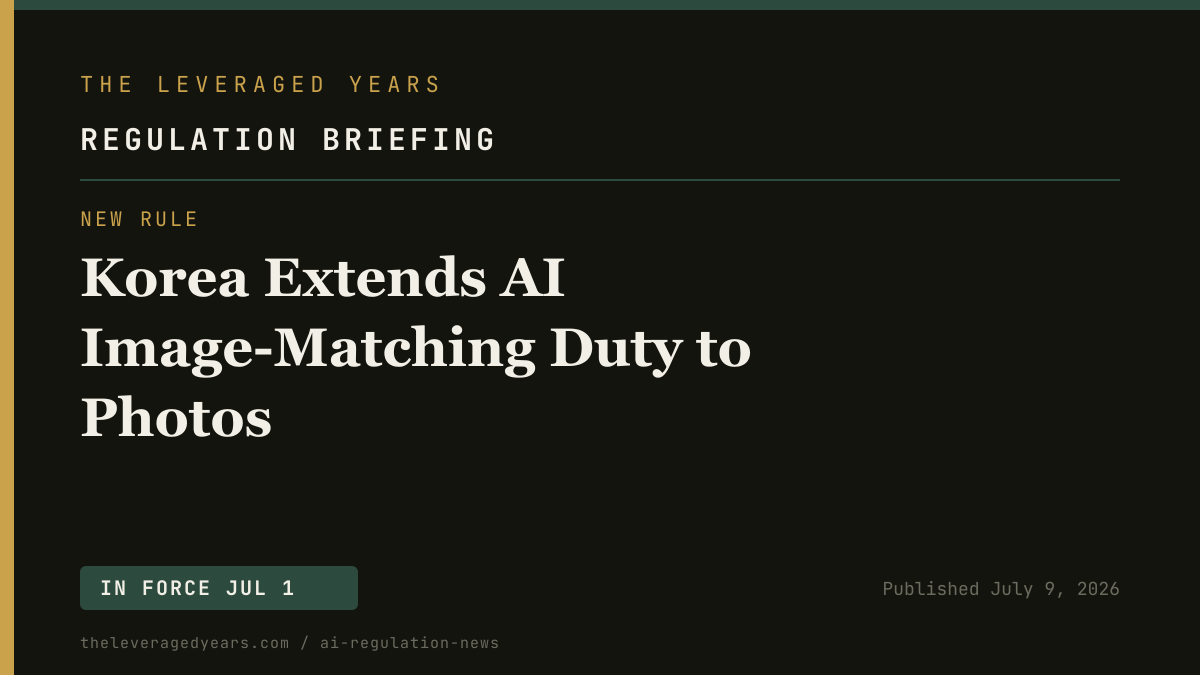
South Korea Extends Its Mandatory AI Image-Matching Duty to Still Photos, Live From July 1
Regulatory summary: From July 1, 2026, South Korea requires around 80 designated platforms to run every uploaded still image through an automated feature-value (DNA) matching system and block anything that matches a government reference database of illegal-filming material. The duty sits in Article 22-5(2) of the Telecommunications Business Act (전기통신사업법) and Article.
South Korea's telecom regulator has expanded the required pre-upload feature-value (DNA) matching system from video to still images, forcing roughly 80 large platforms to auto-scan every uploaded photo against a reference hash database and block matches. The duty is in force from July 1, 2026, with no sanctions until December 31.
By Anthony Guerriero, Founder, The Leveraged Years · Published July 9, 2026 · Last updated July 9, 2026
The Leveraged Years AI Regulation Tracker
Key takeaways
The pre-upload technical measure against illegal-filming material, previously limited to video, now applies to still images as well. Designated platforms must compare each uploaded image against a reference database of feature values (digital DNA) tied to known illegal-filming material and block uploads that match, before the content goes live. The Broadcasting and Media Communications Commission has framed this as an extension of an existing obligation under Article 22-5, not a new duty.
Trust-and-safety, legal, and engineering teams at large platforms with Korean users; content-moderation vendors that supply matching modules; and compliance officers at multinationals that host user-generated images. Smaller services below the designation threshold are not directly bound but should watch the standard.
Status: In force from July 1, 2026.
Confirm whether your upload pipeline already matches still images against the reference database, close any gap while the grace period holds, and document the control so it can withstand a regulator inquiry after January 1, 2027.
Date
Jurisdiction
Rule
Affected professionals
Status or effective date
2026-07-09
South Korea
The pre-upload technical measure against illegal-filming material, previously limited to video, now applies to still images as well. Designated platforms must compare each uploaded image against a reference database of feature values (digital DNA) tied to known illegal-filming material and block uploads that match, before the content goes live. The Broadcasting and Media Communications Commission has framed this as an extension of an existing obligation under Article 22-5, not a new duty.
Trust-and-safety, legal, and engineering teams at large platforms with Korean users; content-moderation vendors that supply matching modules; and compliance officers at multinationals that host user-generated images. Smaller services below the designation threshold are not directly bound but should watch the standard.
In force from July 1, 2026. A six-month guidance period runs to December 31, 2026, during which the regulator will not impose administrative sanctions while operators adopt and reorganize systems.
Frequently Asked Questions
Is the image-matching duty actually in force, or still proposed?
It is in force. The obligation lives in Article 22-5(2) of the Telecommunications Business Act and Article 30-6 of its Enforcement Decree, and the expansion to still images took effect July 1, 2026. Only administrative sanctions are suspended, through December 31, 2026.
What exactly must platforms do to each uploaded image?
Generate a feature value (digital DNA) for the image, compare it against a government reference database of illegal-filming material, and block the upload before publication if it matches.
Does this cover AI-generated deepfakes?
Yes, in effect. The statute targets illegal-filming material generally, and AI-generated or deepfake sexual imagery falls within that category, so the reference database and matching duty capture it.
Which companies are affected?
Roughly 80 designated operators with annual revenue of at least 1 billion won or at least 100,000 daily average users, including Naver, Kakao, Google, Meta, and X.
When can the regulator start imposing penalties?
After the six-month grace period ends. No administrative sanctions apply through December 31, 2026, so enforcement exposure begins January 1, 2027.