AI Regulation Tracker / Draft bill
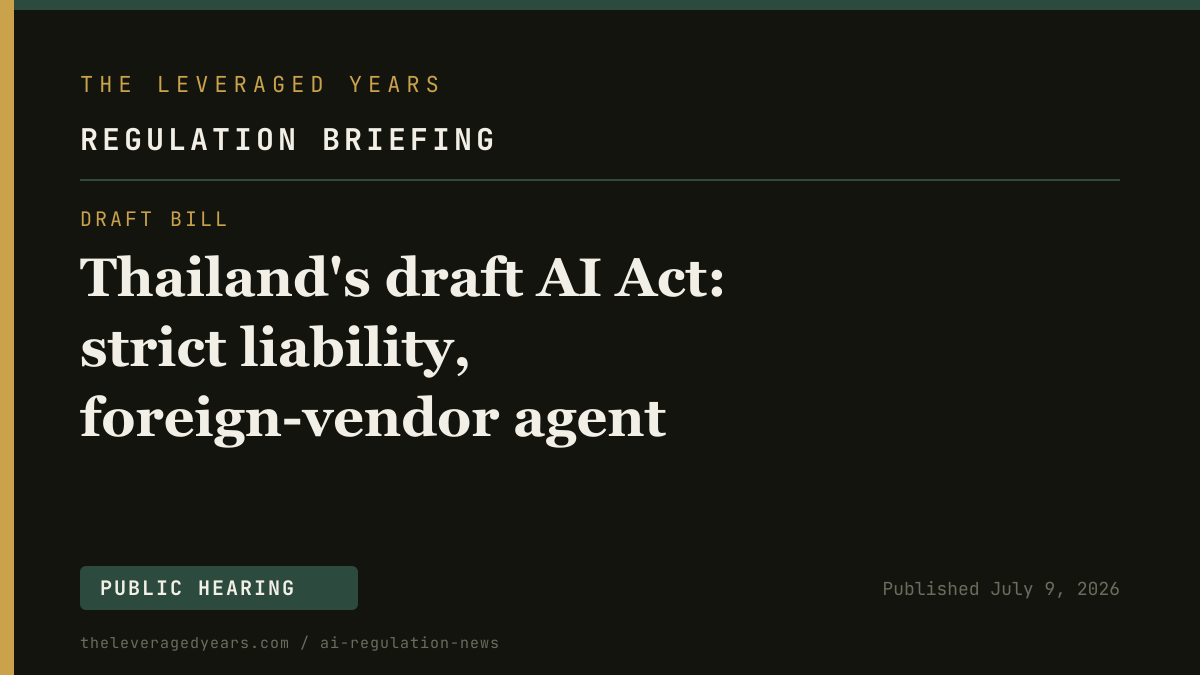
Thailand's Draft AI Act: Strict Liability and a Mandatory Agent for Foreign Vendors
Regulatory summary: Thailand's ETDA, under the Ministry of Digital Economy and Society, released a fuller draft AI Act on July 2, 2026 for a roughly 30-day public hearing. It combines EU-style risk tiers with no-fault (strict) liability, extraterritorial reach, a mandatory local representative for foreign providers, AI-content labeling, and fines of THB.
A single public-hearing draft would rewrite the risk calculus for anyone selling or deploying AI into Thailand, whether or not they have an office there.
Key takeaways
- ETDA replaced its earlier high-level principles with a fuller draft Act that adds strict liability, extraterritorial scope, a foreign-provider agent duty, content labeling, and administrative fines. It moves Thailand from aspirational governance principles toward an enforceable statute.
- General counsel and in-house legal teams, compliance and risk officers, foreign AI vendors and cloud providers serving Thai users, Thai deployers of third-party AI, product and platform executives, and outside counsel advising on cross-border AI
- Status: Draft.
- Submit comments during the hearing window; assess extraterritorial exposure and whether a local representative would be required; inventory AI-content labeling obligations
| Date | Jurisdiction | Rule | Affected professionals | Status or effective date |
|---|---|---|---|---|
| 2026-07-09 | Thailand | ETDA replaced its earlier high-level principles with a fuller draft Act that adds strict liability, extraterritorial scope, a foreign-provider agent duty, content labeling, and administrative fines. It moves Thailand from aspirational governance principles toward an enforceable statute. | General counsel and in-house legal teams, compliance and risk officers, foreign AI vendors and cloud providers serving Thai users, Thai deployers of third-party AI, product and platform executives, and outside counsel advising on cross-border AI | Draft; public hearing opened July 2, 2026 (~30 days) |
Frequently Asked Questions
Is Thailand's AI Act now law?
No. ETDA released a draft for public hearing on July 2, 2026, with a consultation window of roughly 30 days. It is not enacted and not in force, and the text can still change before any Cabinet or Parliament stage.
Does the draft apply to a foreign AI company with no Thai office?
On its face, yes. The draft is written to apply extraterritorially to AI activity affecting people in Thailand even when performed abroad, and foreign providers serving Thai users or deployers would have to appoint a local representative who may carry unlimited liability.
What does no-fault (strict) liability mean for my business?
An injured party may not need to prove your negligence, only harm and a causal link to the AI system. The reported defenses are narrow: force majeure, victim misconduct, or compliance with an official order. It shifts AI harm toward a product-liability posture.
How large are the penalties?
Administrative fines are reported at THB 1 million to THB 5 million. Regulators could also seek court orders for service suspension, product recall, or ISP blocking, which may matter more than the fine because they can cut off Thai market access.
Can I read the official draft myself?
The primary text is on Thailand's central portal, law.go.th, which returns an HTTP 403 error to automated tools. Open it in a browser or ask Thai counsel to confirm the exact survey URL and hearing close date before relying on specific wording.
Internal links
Sponsored Training
Practical AI training for regulated professionals, built around verification, documentation and a defensible process. See the courses.
Browse the full AI Regulation News tracker
Informational analysis for working professionals, not legal advice. Confirm how any rule applies to your situation with qualified counsel.