There is a strange thing happening in offices right now. The person who knows the most AI tricks is rarely the person getting promoted.
You have probably met them. They can rattle off forty prompts from memory. They have a favorite model for every micro-task. And yet, when a real decision lands on the table, nobody asks them what to do. They are treated as a clever utility, not a senior voice.
Meanwhile the partner who quietly used AI to compress a two-week diligence review into three days, and then caught the one number the model got wrong, is having a very different career.
That gap is the whole point of this piece. If you are an experienced professional deciding what AI skills are actually worth your finite time, most of the popular advice is aimed at someone who is not you. It is aimed at a job-seeker building a resume, or a developer building agents. The skills that matter for senior people are a different category. They are not tricks. They are judgment.
Two kinds of AI skill, and only one of them compounds
Type out "ai skills" into a search bar and you will get two flavors of answer.
The first is a newer technical meaning: an AI skill as a packaged file of instructions you hand to an AI agent so it can run a workflow on its own. Useful if you build agents for a living. Mostly irrelevant if you run a practice, a team, or a P&L.
The second is the listicle. "Top 10 AI skills." "6 highly desirable AI skills for 2026." These lists are remarkably consistent and remarkably useless for you. They say: learn Python, learn machine learning, learn prompt engineering, understand neural networks. That is a curriculum for a twenty-six-year-old breaking into a data team. It is not a curriculum for a forty-eight-year-old who already runs the meeting.
So let us split AI skills a cleaner way. There are performative skills and there are leverage skills.
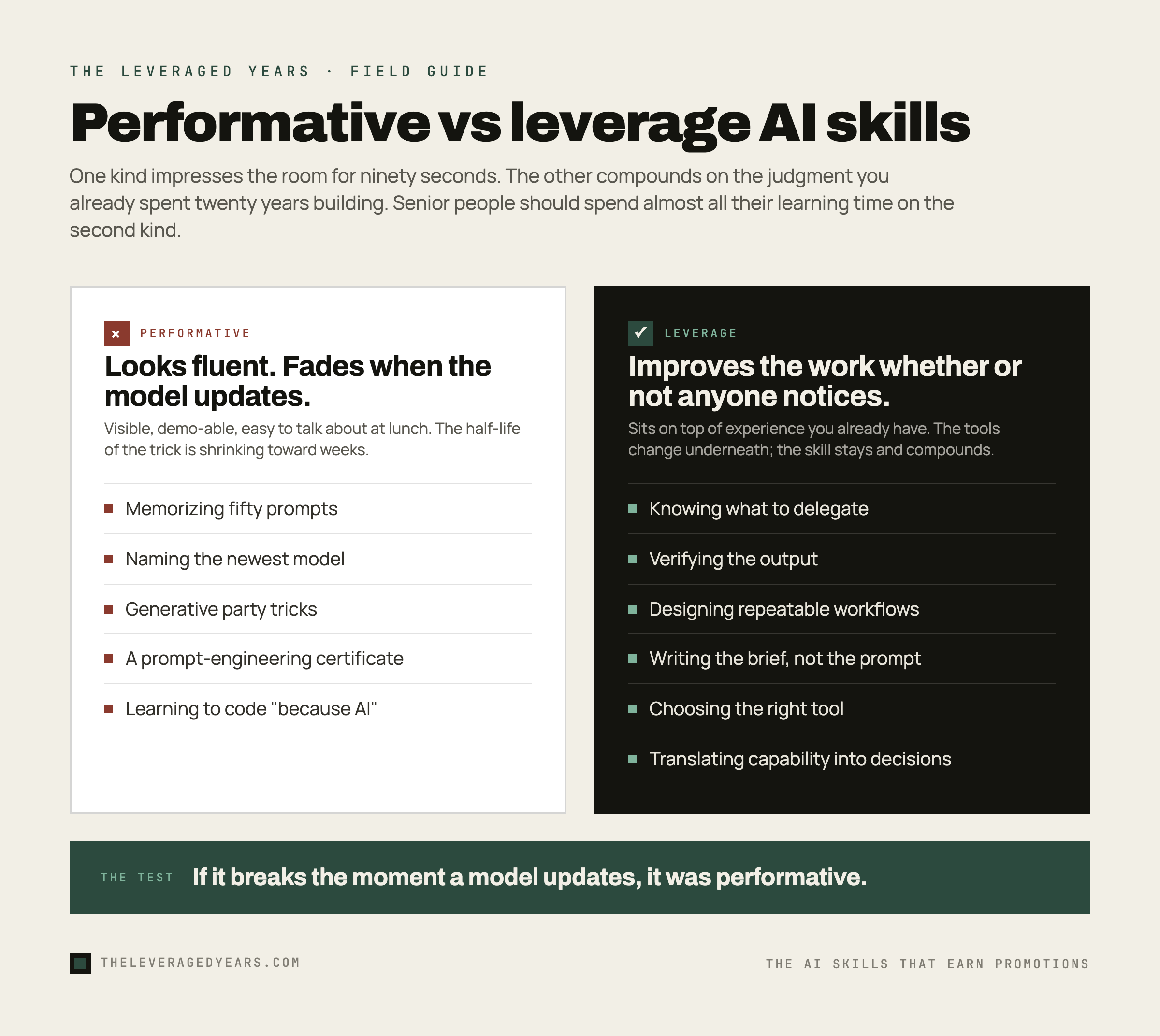
A performative skill makes you look fluent. It is visible, demo-able, and easy to talk about at lunch. Knowing fifty prompts. Naming the newest model. Generating a slick image on demand. These skills impress the room for about ninety seconds and then evaporate, because the tools that make them possible are changing every month. The half-life of a specific prompt trick is shrinking toward weeks, not quarters.
A leverage skill makes your work better whether or not anyone notices. It is about what you decide to hand the machine, how you check what comes back, and how you wire AI into the actual flow of your job so it saves hours every week instead of dazzling people once. Leverage skills compound, because they sit on top of the judgment you already spent twenty years building. The tools change underneath them; the skill stays.
The leverage skills that actually compound
These are the skills worth your time. Notice that none of them require you to write code, and all of them lean on experience you already have.
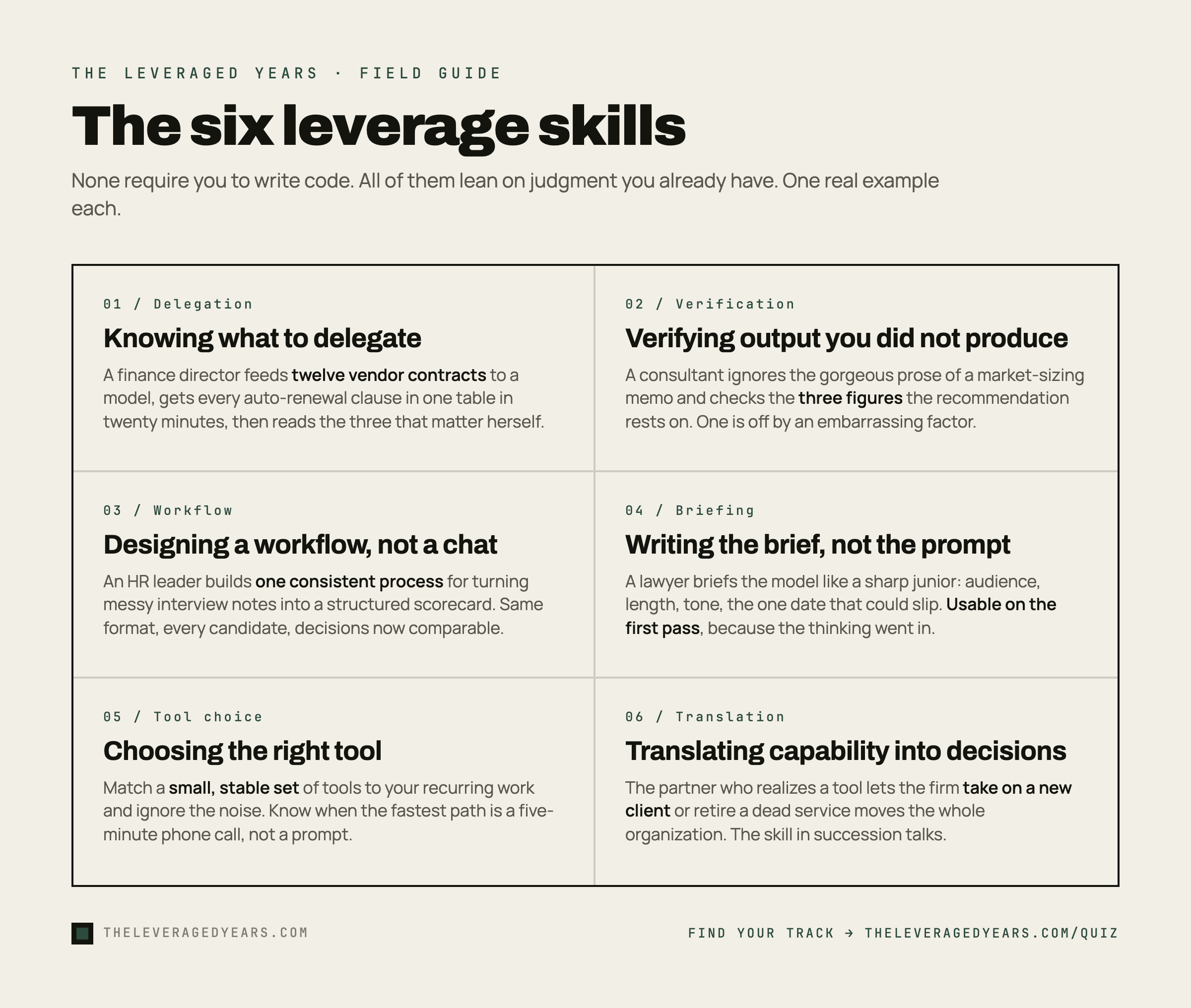
1. Knowing what to delegate (and what to never delegate)
This is the master skill, and it is almost entirely about judgment. AI is excellent at first drafts, summaries, structured extraction, reformatting, and "give me ten options." It is unreliable when asked to recall specific numbers, cite legal precedent from memory, or produce final-version work where being confidently wrong is expensive. The difference is critical: AI is strong at processing what you hand it, like finding the auto-renewal clauses in contracts you upload, and weak when treated as an oracle that knows things on its own.
A junior person delegates randomly, gets burned, then swears off the tool. A senior person delegates deliberately. They know the model can compress a forty-page contract into the five clauses that matter, and they know they personally have to read those five clauses. They use the machine for reach and keep the accountability.
Concrete example: a finance director feeds twelve vendor contracts into a model and asks it to surface every auto-renewal clause and notice deadline into one table. Twenty minutes instead of a day. Then she reads the actual clauses for the three contracts worth real money. The skill was not "using AI." The skill was knowing exactly where her eyes still had to go.
2. Verifying output you did not produce
The single most dangerous habit in professional AI use is trusting fluent text. Models write with total confidence whether they are right or wrong, and senior people are busy, which is a perfect recipe for waving through a plausible error with your name on it.
Verification is a real skill, and it is learnable. It means knowing which claims to spot-check (specific numbers, citations, dates, names, anything load-bearing) and which to let ride (tone, structure, phrasing). It means asking the model to show its reasoning, or running the same question twice to see if the answer is stable. It means having a nose for the kind of mistake this kind of task tends to produce.
Concrete example: a consultant has AI draft a market-sizing memo. The prose is gorgeous. She ignores the prose and goes straight to the three figures the recommendation rests on, traces each to a source, and finds one is off by a factor that would have embarrassed her in front of the client. Five minutes of targeted checking saved the engagement. That instinct, where to look first, is worth more than any prompt library.
3. Designing a workflow, not a one-off chat
Most people use AI like a slot machine. New chat, new question, hope something good falls out. Senior leverage looks different: you design a repeatable process where AI does the same heavy step every time, in the same way, with the same guardrails.
The shift is from "I asked AI a thing" to "I built a small system." That might mean a standing setup where every client intake gets summarized into the same template. It might mean a weekly routine where the model drafts the first version of a report you have to produce anyway. The value is not the cleverness of any single prompt. It is the fact that the workflow runs fifty times a year and reclaims an hour each time.
Concrete example: an HR leader builds one consistent process for turning messy interview notes into a structured candidate scorecard. Same format, same criteria, every candidate. Now hiring decisions are comparable instead of vibes, and she got that for free out of a task she already had to do. That is a workflow, and it is far more durable than any individual trick.
4. Writing the brief, not the prompt
Forget the version of "prompt engineering" that dominates LinkedIn, the cargo-cult of magic words and "act as a world-class expert." The actual skill is something senior people already do with humans: giving a good brief.
When you hand work to a sharp junior, you supply context, constraints, the goal, what good looks like, and what to avoid. When you hand work to a model and supply none of that, you get generic mush and blame the model. The professionals who get extraordinary output are simply the ones who brief the machine as carefully as they would brief a person. We have written more about why this judgment-first framing beats prompt tricks in judgment engineering, not prompt engineering.
Concrete example: instead of "write a client update," a lawyer writes: "Draft a client update on the settlement timeline. Audience is a non-legal CFO. Three paragraphs. Confident but not promissory. Flag the one date that could slip and why." The output is usable on the first pass, because the thinking went into the brief. The skill is identical to good delegation. It always was.
5. Choosing the right tool for the job (and knowing when none is needed)
Tool sprawl is a tax. There are dozens of AI products, each promising to change your life, and chasing all of them is its own kind of procrastination. The leverage skill is the opposite of collecting tools. It is matching a small, stable set of tools to your actual recurring work and ignoring the rest of the noise.
It also includes the maturity to know when AI is the wrong call entirely. Sometimes the fastest path is a five-minute phone call, not a beautifully prompted draft. Senior people do not reach for AI to prove they are modern. They reach for it when it genuinely shortens the distance to done. If you want a calmer way to keep up without drowning in tool-of-the-week content, we covered that in how to learn AI tools efficiently as a busy professional.
6. Translating AI capability into a decision your team can act on
The highest-leverage skill of all is rarely on any list, because it only shows up at the senior level. It is the ability to look at what AI can now do and turn that into a concrete change in how your team works, what you stop doing, what you charge for, where you spend headcount.
This is judgment about the business, applied to a fast-moving capability. The associate who learns a tool helps themselves. The partner who realizes that tool means the firm can take on a new kind of client, or retire a service that no longer makes sense, moves the whole organization. That is the skill that gets discussed in succession conversations.
The skills that are mostly noise
To be useful, a list of what matters has to be honest about what does not. For an experienced professional, the following are oversold.
Memorizing prompts. A library of fifty saved prompts feels like mastery and ages like milk. The underlying judgment, what you are asking for and why, is the part that lasts. The exact wording is disposable.
Chasing the newest model. Knowing which model dropped this week is sport, not skill. The differences at the frontier rarely change what you, a non-engineer, can accomplish. Pick a capable tool, learn it deeply, and let the leaderboard churn without you.
Learning to code "because AI." Unless you were already heading toward engineering, or automations work is a core part of your role, no. The promise of these tools for senior professionals is precisely that you do not need to code to get the value. Spending a year on Python to use a chatbot is a category error.
Prompt-engineering certificates. A certificate in writing instructions to a machine is, for most senior roles, a line on a resume that signals you took the hype literally. The actual capability, briefing well, is demonstrated in your work, not on a badge.
Generative party tricks. Making an image, writing a poem, cloning a voice. Fun. Occasionally useful. They can buy you attention for a moment, but sustained standing at work comes from the work that quietly saves hours or removes risk. If your AI practice lives mostly in the demo, it is performative.
None of these are worthless. They are just not where a senior person's scarce learning time pays off, and the popular lists point you straight at them.
How to build the real skills without a bootcamp
You do not need a course in neural networks, and you certainly do not need to learn to code. Leverage skills are built the way every other professional skill you have was built: on real work, with reflection, in short loops. You can do this alone, but it gets easier when you can see how other senior professionals in your own field are solving the same problems.
Start with one recurring task you already own. Not a toy. Something that eats your week. Run it through AI deliberately for a month, paying attention to where the model helps, where it fails, and where you have to put your eyes. That single loop teaches delegation, verification, and briefing all at once, because you have a real outcome to judge against.
Keep a short running note of what AI got wrong on your kind of work. This becomes your personal verification checklist, more valuable than any generic "AI best practices" article because it is specific to your domain and your risks.
Match the learning to your profession instead of consuming generic advice. What a CPA should delegate is not what a marketer should delegate, and a one-size list serves neither well. The fastest route is to learn AI inside the context of your actual job, which is why the right starting point depends on what you do. Our profession-specific course catalog is built around exactly that idea: same judgment-first method, taught through the real work of your field. If you are not sure where you land, the two-minute skills quiz will point you to the right track.
And if you would rather start with a low-commitment option before committing to a full track, the Leverage Starter gets the core judgment-first method into your hands fast.
The throughline: build skills against real work, keep what compounds, and ignore the leaderboard.