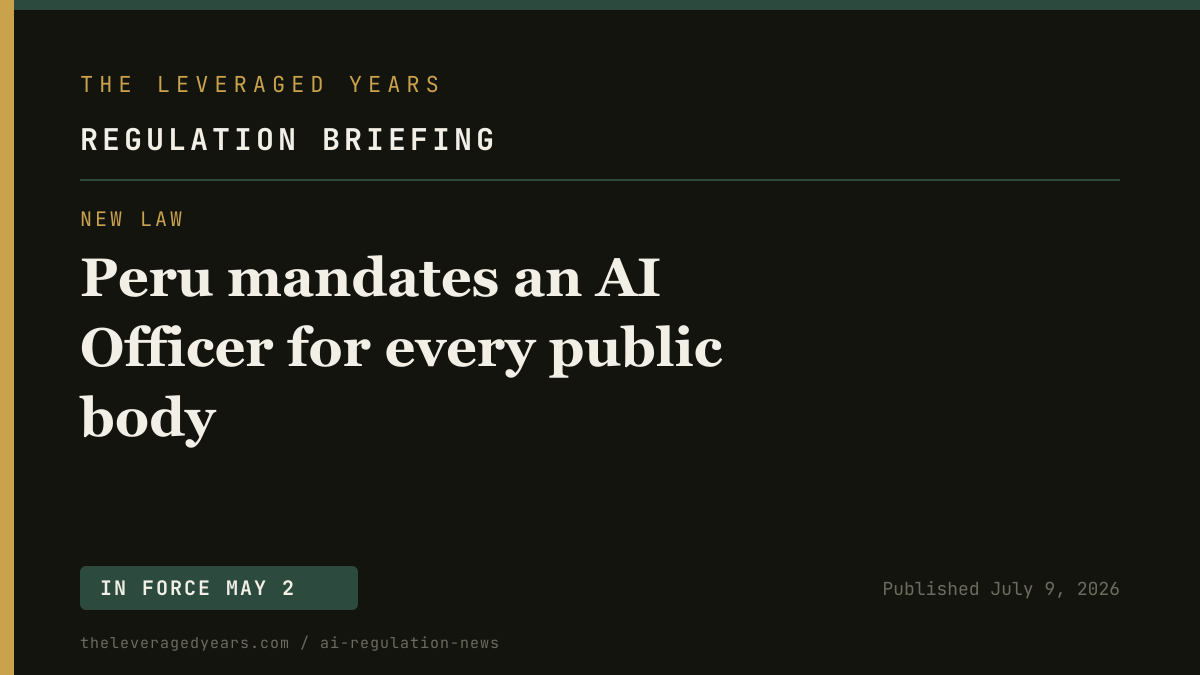
Peru Approves ENIA 2026-2030 and Makes an AI Officer and AI Action Plan Mandatory Across the Public Sector
Regulatory summary: Peru's Council of Ministers approved the National Artificial Intelligence Strategy through Resolucion Ministerial N.o 152-2026-PCM. Every public administration entity, regional and local state enterprise, and FONAFE firm must now run an AI Action Plan and designate an Artificial Intelligence Officer. The rule took effect on May 2, 2026.
By Anthony Guerriero, Founder, The Leveraged Years · Published July 9, 2026 · Last updated July 9, 2026
The Leveraged Years AI Regulation Tracker
Key takeaways
Peru moved from a promotional AI law and scattered digital-government rules to a single national strategy with concrete, enforceable duties for public bodies. Each public entity must now formulate and approve an AI Action Plan with a horizon of not less than three years (Article 5), and each must designate an Artificial Intelligence Officer to coordinate AI governance, formulate the plan, and track its implementation (Article 6). The resolution also creates a national catalogue of datasets and AI models (Catalogo IA Peru) in which public entities publish the AI models and datasets they use.
Public-sector CIOs, digital-transformation committees, and heads of administration in Peruvian federal, regional, and local bodies; managers of regional and local state enterprises and FONAFE firms; govtech and AI vendors selling into the Peruvian public sector; and public-law and data-protection counsel advising on automated decision-making and digital government.
Status: In force.
Decide who will hold the OIA role, inventory every AI or automated system the entity uses, and confirm the entity has an approved Data Governance Action Plan, which Article 5.4 makes a precondition for approving the AI Action Plan. Then wait for the SGTD guidelines before finalizing the OIA appointment mechanics.
Date
Jurisdiction
Rule
Affected professionals
Status or effective date
2026-07-09
Peru
Peru moved from a promotional AI law and scattered digital-government rules to a single national strategy with concrete, enforceable duties for public bodies. Each public entity must now formulate and approve an AI Action Plan with a horizon of not less than three years (Article 5), and each must designate an Artificial Intelligence Officer to coordinate AI governance, formulate the plan, and track its implementation (Article 6). The resolution also creates a national catalogue of datasets and AI models (Catalogo IA Peru) in which public entities publish the AI models and datasets they use.
Public-sector CIOs, digital-transformation committees, and heads of administration in Peruvian federal, regional, and local bodies; managers of regional and local state enterprises and FONAFE firms; govtech and AI vendors selling into the Peruvian public sector; and public-law and data-protection counsel advising on automated decision-making and digital government.
In force. Published in El Peruano on May 1, 2026 and effective May 2, 2026. The SGTD guidelines that define the OIA profile, responsibilities, designation, and coordination are pending and are due within 90 business days of publication under the First Final Complementary Provision.
Frequently Asked Questions
Is Resolucion Ministerial N.o 152-2026-PCM in force?
Yes. It was published in El Peruano on May 1, 2026, and under Article 14 it took effect on May 2, 2026, the day after publication.
Does the private sector have to appoint an AI Officer?
No. Article 2.3 lets private companies, civil society, citizens, and academia use the strategy as a reference where it adds value. The duties to appoint an OIA and approve an AI Action Plan apply only to public entities, regional and local state enterprises, and FONAFE firms.
Who becomes the Artificial Intelligence Officer?
Under Article 6 the OIA role falls to the coordinator of the entity's Digital Government and Transformation Committee, and entities must designate the OIA through a formal document (Article 6.7).
When will the detailed OIA rules be published?
The SGTD has no more than 90 business days from the May 1, 2026 publication to approve guidelines on the OIA profile, responsibilities, designation, and coordination, under the First Final Complementary Provision.
What happens if a public entity does not comply?
Article 8.5 states that failure to comply with the expressly mandatory provisions of the resolution generates responsibility under the applicable disciplinary regime.