Run the passive income product audit for your practice
The Leverage Club includes the prompt and SOP to audit your knowledge assets and map three product options, free with any course, or $49 a month.

Key Takeaways
- Most passive income advice assumes capital is the scarce resource. For professionals billing $300, $1,000 per hour, knowledge is more valuable and more accessible as a starting point.
- The build sequence is: identify highest-value knowledge → productize it into a scalable format → build distribution → add leverage to reduce your active involvement over time.
- Passive income is not passive on day one. Expect six to twelve months of front-loaded work before revenue becomes genuinely hands-off.
- A course or digital product priced at $1,500 needs only 100 buyers per year to generate $150,000 in revenue, achievable with a modest, precise audience and a single strong distribution channel.
- The professionals who fail at this choose the wrong format first. Start with the simplest product that holds your knowledge and proves demand before building anything complex.
You've spent fifteen or twenty years accumulating knowledge that other people genuinely cannot find anywhere else. You know how to structure a cross-border transaction to minimize withholding exposure. You know how to negotiate vendor contracts that most executives sign without reading. You know which operational decisions kill growth companies in years three through five. People pay you serious money for access to that knowledge, by the hour, by the project, or by retainer.
Now you want to know how to generate passive income from it.
Here's what most of the advice you'll find online gets wrong: it assumes you're starting from capital. Index funds, rental properties, REITs, all fine, all real. But they assume you have $500,000 or $1,000,000 sitting idle and waiting to be deployed. Most professionals who are still building their practices don't have that. What they do have is knowledge that, if packaged correctly, can generate income at scale without their direct involvement.
That's the arbitrage. And it's more accessible than most people realize.
Step One: Identify Your Highest-Value Knowledge
Not all knowledge is equal. The test is simple: what do people pay you the most for, or struggle most to find anywhere else? That's where you start.
Think about the last twelve months of client work. Where did you earn the highest effective hourly rate? Where did clients tell you they'd been trying to solve a problem for years before finding you? What questions do you answer on every single engagement, regardless of the client? Those repeating patterns are your signal.
The knowledge worth productizing sits at the intersection of three things: it is complex enough that most people can't figure it out alone, the cost of getting it wrong is meaningful (financial, legal, operational), and you can teach it without personally being in the room. Tax planning frameworks meet all three criteria. So does employment law compliance. So does financial modeling for closely held businesses. So does scaling operations past the 50-person inflection point.
Generic business advice does not. "Mindset for success" does not. Not because those things are worthless, but because the market is saturated, prices have collapsed, and you cannot charge a premium for knowledge that a thousand people are already giving away for free. Your advantage is specificity and credibility, not inspiration.
Write down the three to five knowledge areas where you can credibly claim to be in the top five percent of practitioners. That's your shortlist. Pick one and move.
Step Two: Productize It, Choose the Format That Holds the Value
The format question trips up more professionals than any other step. They spend six months building a 40-module video course when what their buyer actually needed was a $97 template and a 20-page guide. Wrong format, wrong price point, wrong audience. Start over.
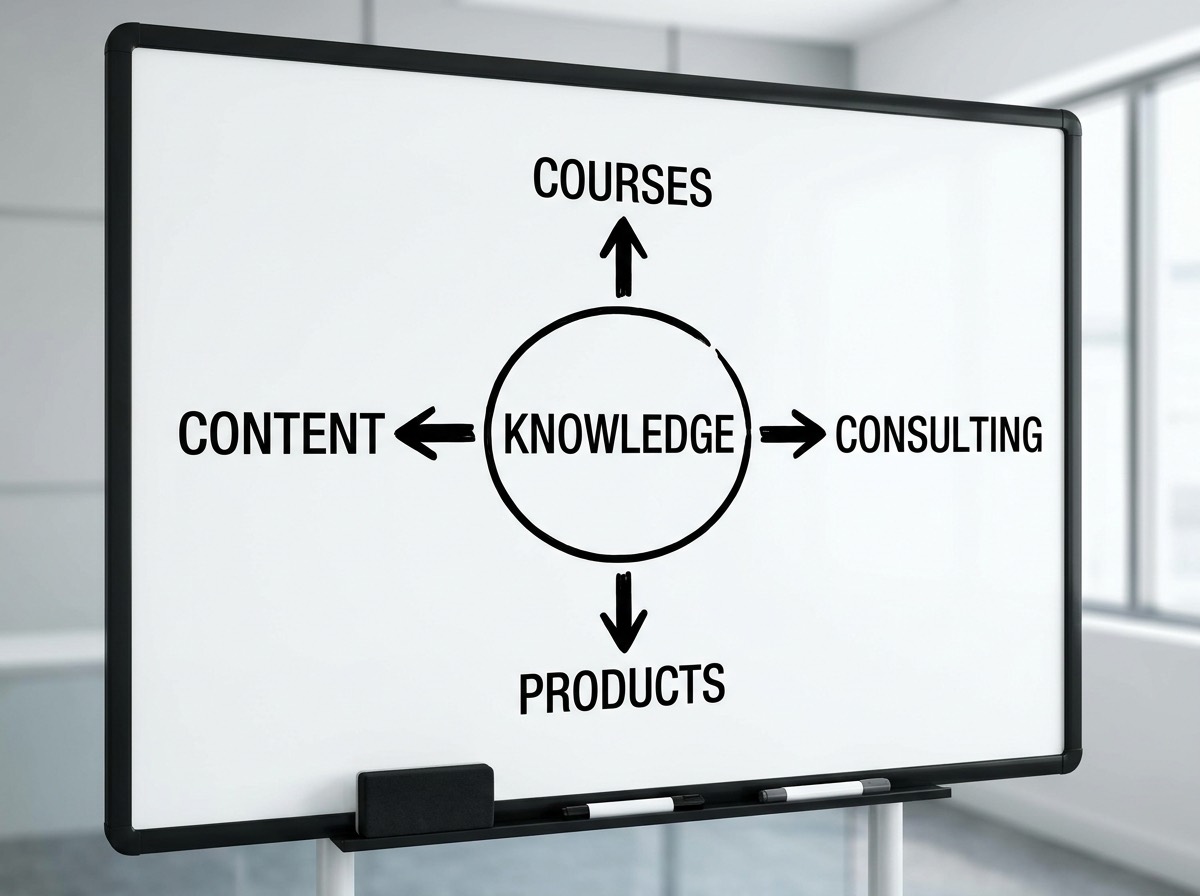
Here are the formats that work for high-knowledge professionals, in order of build complexity:
Templated Tools and Document Packages ($47, $497)
These are contracts, checklists, spreadsheet models, standard operating procedures, due diligence frameworks, or compliance workbooks. Low build time. High perceived value to practitioners who want to skip the learning and go straight to doing. An M&A due diligence checklist built by a former Deloitte manager sells itself to junior associates who need a starting point. A lease abstraction template built by a real estate attorney saves their buyer four billable hours on every deal.
Test your knowledge at this level first. Build the tool in a weekend. Sell it to five people you know for $97. If they use it and come back, you have proof of concept.
Online Courses ($497, $3,500)
Courses work when the knowledge is procedural, it has a logical sequence, there are decisions the learner must make, and the outcome is measurable. "How to structure an S-corp for a medical practice" is procedural. "How to think about leadership" is not.
A well-built professional course is not a recording of a presentation. It is a designed learning experience with specific outcomes, exercises, and implementation steps. Build time is typically 80-200 hours depending on scope. At $1,500 per buyer, you need 100 buyers to generate $150,000 annually. That is not an aggressive number for a professional with twenty years of domain authority.
The courses that fail charge $97 and compete on price. The courses that succeed charge $997, $3,500 and compete on outcome. Price your course at the level where the buyer can justify the investment in one or two applications of the knowledge.
Licensing and White-Label Programs ($5,000, $50,000+)
If you have a proprietary methodology, a repeatable system you've developed and refined across dozens of clients, other firms will pay to license it. An accounting firm licenses your tax planning framework to deploy with their client base. A law firm licenses your compliance training to onboard new associates. A consulting firm licenses your operational framework to avoid building from scratch.
Licensing deals are less passive initially because they require negotiation and onboarding. Once structured, they generate recurring revenue with minimal ongoing involvement. A single licensing agreement at $10,000 per year across eight firms generates $80,000 annually. The build investment is your time to document the methodology thoroughly enough that someone else can execute it without you.
Advisory Retainers With Leverage ($2,000, $10,000 per month)
This is not purely passive, but it becomes passive when you build the right leverage into it. A fractional advisory engagement where you provide strategic guidance and your team or AI tools do the execution is not the same as one-to-one consulting. The model works when you can deliver the outcome with two to four hours of your time per month instead of twenty. That requires systematizing your process, building junior capacity, and documenting decision trees that don't require you to be in the room for every decision.
Step Three: Build the Distribution System
A great product with no distribution earns nothing. Most professionals underinvest here because they assume their reputation will carry the load. It won't, not at scale, not without a system.
The three distribution channels that compound over time are SEO, email, and referral partnerships. You don't need all three on day one. Pick one and go deep before adding the next.
SEO-Driven Content
Search engine optimization is slow, but the economics are exceptional. A single blog post ranking on page one for a high-intent search term can generate 200-2,000 visitors per month indefinitely, with zero ongoing cost. At a 1-3% conversion rate to a lead magnet, and a 10-20% conversion rate from lead to buyer, a page ranking for a term like "S-corp tax strategy for medical practices" can generate six to twelve qualified leads per month on autopilot.
The professionals who succeed at SEO write about exactly what their buyers search for, not what they find interesting. That means understanding how professionals can build passive income streams through search-visible content that earns traffic before it earns revenue. Find the search terms your buyers use when they're trying to solve a problem you solve. Write the most useful thing that exists on that topic. Publish consistently. The compound effect takes twelve to eighteen months to become significant, but it never stops working.
Email List Building
An email list is the only distribution channel you fully own. A 2,000-person list of senior professionals who have opted in to receive your content is worth more than a 50,000-person Instagram following. These are buyers who have given you permission, and who can be reached directly at any time without paying for access.
Build the list with a lead magnet that solves a real, specific problem, not a generic e-book. A five-page guide on avoiding the three most common mistakes in a particular transaction type. A decision-tree flowchart for a process your buyers navigate repeatedly. A checklist that saves a practitioner two hours per engagement. The lead magnet should be good enough that you could charge for it. Give it away to earn the relationship.
Referral Partnerships
If your product solves a problem for the clients of another professional, that professional is a distribution partner. A course on operational scaling for medical practices is relevant to the clients of every healthcare-focused CPA firm in the country. A compliance training program is relevant to every law firm that advises mid-market companies in a specific industry.
Approach referral partnerships as a revenue-share arrangement or a co-branded offering. The referring partner adds value to their existing client relationships; you get distribution without building an audience from scratch. A single referral relationship with a 50-attorney firm can generate 20-50 buyers per year for a course priced at $1,500. That's $30,000, $75,000 in annual revenue from one relationship, with no advertising spend.
Step Four: Add Leverage to Reduce Active Involvement
Here is the part most people skip. They build a product, they build distribution, and they assume the income is now passive. It isn't, not yet. The income is recurring, but if you're still personally answering every support email, moderating every community thread, and showing up for every live session, you have not built passive income. You have built a different kind of job.
Leverage is what converts recurring income into genuinely passive income. It comes in three forms.
The first is process documentation. Every task you currently do personally in your product or distribution system should be written down as a procedure. Once documented, it can be delegated, automated, or removed entirely.
The second is junior capacity. A virtual assistant or junior contractor can handle customer support, scheduling, social publishing, and basic content production for $15, $45 per hour. At a product generating $10,000 per month in revenue, investing $1,500, $2,500 per month in execution support is a reasonable trade. Your time becomes strategic, product development, relationship building, high-judgment decisions, not operational.
The third is AI and automation. AI tools for senior professionals have reached a point where significant portions of content creation, email sequences, customer onboarding, and community management can be automated or AI-assisted without degrading quality. The professionals who are building the most scalable knowledge businesses right now are integrating AI at every layer of the stack, not because they're tech enthusiasts, but because it removes the time-cost of execution that keeps the income from becoming passive.
What to Realistically Expect: Timeline and Income Ranges
Be honest about the build phase. Passive income is not passive on day one. The front-loaded work is real and it takes longer than most people expect. Here is what an honest timeline looks like for a professional starting from zero.
Months 1-3: Research and Production. Validate demand through conversations with ten to fifteen potential buyers. Build your first product. Set up a basic website and email capture. Budget: 60-100 hours of your time, $500, $2,000 in tools and production.
Months 4-6: Early Distribution. Publish ten to fifteen pieces of SEO-targeted content. Activate your first referral relationship. Launch to your existing network. Expected revenue: $0, $5,000. This is the hardest phase, most people quit here because the return feels disproportionate to the effort. It is. The investment is not in today's revenue; it is in the compounding that starts at month twelve.
Months 7-12: Iteration. Refine pricing, messaging, and product based on early buyer feedback. Add a second distribution channel. Begin systematizing delivery. Expected revenue: $2,000, $8,000 per month, depending on price point and distribution progress.
Year 2 and Beyond. A well-built knowledge product with functioning SEO, an email list of 1,500-3,000 qualified subscribers, and one or two active referral partnerships should generate $5,000, $20,000 per month in revenue with two to eight hours of weekly active involvement. At that level, with a part-time contractor handling execution, the model is genuinely passive for most working definitions of the word.
The range is wide because it depends on price point, niche specificity, and consistency of execution. A $500 course in a crowded market generates different results than a $2,500 course in a niche with forty thousand practitioners who have no other resource. Price to the outcome, not to your comfort level.
The Common Failure Mode
The most common failure is choosing the wrong first product. Specifically: choosing the product that feels easiest to build rather than the product that addresses the problem your buyer is actively searching for a solution to. These are rarely the same thing.
An attorney builds a $2,000 contract template bundle covering areas she knows cold. But her buyers don't wake up searching for "contract templates." They wake up searching for "how to avoid getting sued in a software licensing deal." The knowledge is the same. The packaging and entry point are different. One sells; one doesn't.
The fix is to start with the buyer's problem, not your expertise. Map what your target buyer is searching for, what they're asking in industry forums, what they're paying consultants to solve. Then build the product that solves that, and position your expertise as the credential that makes the solution credible.
Understanding which type of product fits your specific knowledge and situation is the fastest way to avoid wasting six months building the wrong thing. The quiz at the link takes four minutes and gives you a specific starting point based on your professional background and goals.
The professionals who generate meaningful passive income from their knowledge share one trait: they shipped something specific, to someone specific, at a price that justified the outcome. They didn't wait for perfect. They built a version one, sold it, learned, and improved. The income became passive not because the product was flawless, but because the distribution system kept bringing buyers in while they were doing something else.
Your knowledge is already valuable. The question is whether it stays locked in hourly engagements or whether it starts working while you sleep.
Frequently Asked Questions
How long does it take to generate passive income from professional knowledge?
Expect a six- to twelve-month build phase before meaningful revenue begins. The first ninety days are research and production. Months four through six focus on distribution and early sales. Months seven through twelve involve iteration. By month twelve, a well-executed knowledge product generating $3,000, $10,000 per month in passive income is a realistic target for an experienced professional with an existing network or audience.
What types of professional knowledge generate the most passive income?
High-value knowledge tends to sit at the intersection of complexity and consequence, tax strategy, legal compliance, clinical protocols, financial modeling, operational scaling, and deal structuring. If people currently pay $300, $1,000 per hour for your time because the cost of getting it wrong is high, that knowledge is ready to productize. Generic business advice and motivational content are oversupplied and generate poor returns.
Do I need a large audience to generate passive income from a course or digital product?
No. A small, precise audience consistently outperforms a large, diffuse one. A course priced at $1,500 needs only 100 buyers per year to generate $150,000 in revenue. Those 100 buyers can come from a 2,000-person email list with a 5% conversion rate, a referral partnership with one accounting firm, or a single high-ranking blog post. Audience size matters far less than audience specificity and product-market fit.
What is the best format for generating passive income from professional expertise?
The format depends on the complexity of the knowledge and the buyer's learning preference. Online courses work well for procedural, step-by-step frameworks that require implementation. Templated tools and document packages work for execution-focused buyers who want to skip the learning and go straight to doing. Licensing models work when you have proprietary methodology other firms want to deploy. Most professionals should start with one format and expand only after proving demand.
How do I build distribution for a knowledge product without paid advertising?
The three most reliable no-ad distribution channels for professionals are SEO-driven content targeting search terms your buyers use, referral partnerships with adjacent service providers who already have the relationship, and email list building anchored to a free lead magnet. Each channel compounds over time. Paid advertising can accelerate early traction but should not be the foundation, it stops the moment you stop paying.
Can I generate passive income as a CPA, attorney, or consultant without violating professional rules?
Yes. Educational content, courses, templates, and frameworks are not the same as professional advice. A course teaching tax planning concepts is educational; preparing a client's return is professional services. The distinction matters and should be stated clearly in your product terms. Most state bars and CPA licensing boards draw the line at specific client advice, not general education. Review your jurisdiction's guidance before launching, but the business model is broadly viable for licensed professionals.
Ready to turn your knowledge into income?
Two courses designed for senior professionals who are done trading time for money. Or take the quiz to find out which path fits your situation best.