Home  /  AI Case Studies  /  How Manufacturers Run on AI
Operations

How Manufacturers Run on AI

On the plant floor, in the supply chain, and over decades of unstructured data, AI has become an operating layer. A sourced look at how industrial leaders use it, where the judgment must stay human, and what a mid-sized manufacturer should do first.

A clean modern factory floor at shift change, a supervisor reviewing a tablet beside production equipment, calm industrial light
The factory of 2026 still runs on machines and people. What changed is the layer of intelligence sitting on top of both.

At BMW, an engineer on the line can now ask a question in plain language and get an answer drawn from decades of maintenance manuals, fault reports, and shift logs. The system, which the company calls Factory Genius, turns the unstructured knowledge that once lived in binders and senior technicians’ heads into something any worker can query mid-task. Paired with simulation work BMW does with Siemens and NVIDIA, the same broad approach has produced transient aerodynamic simulations reported as thirty times faster than the prior method.

This is the quieter, more consequential face of AI in manufacturing. The popular imagination fixes on humanoid robots and lights-out factories. The real change is an intelligence layer settling over the existing operation, making the machines, the data, and the people that already run a plant work better.

The short version: Manufacturers now use AI across five operational areas: production knowledge and troubleshooting, predictive maintenance, quality inspection, supply-chain planning, and engineering and design. The leaders, including BMW and Siemens, treat it as an operating layer over existing assets rather than a replacement for them, and they keep a qualified human in control of anything that affects safety or output. This briefing covers each area with real examples, names the cautions specific to a production environment, and lays out where a mid-sized manufacturer should begin.

How big is AI's impact on manufacturing?

Manufacturing sits among the largest opportunities for AI value of any sector, because the industry runs on exactly the things AI is good at: vast volumes of sensor and process data, mountains of unstructured technical documentation, and repetitive analytical work that consumes skilled time. McKinsey’s analysis of generative AI’s economic potential places manufacturing and the broader industrial sector among the heaviest beneficiaries, on top of the older, well-established gains from predictive and machine-vision AI already deployed across plants worldwide.

The adoption is uneven, which is the strategic point. Industrial leaders such as Siemens are building AI directly into production systems, while a long tail of mid-sized manufacturers has barely begun. That gap is where competitive sorting will happen over the next several years, and it favors the operators who start deliberately rather than wait for a finished, off-the-shelf answer that is not coming.

The five areas where AI now runs in a plant

A manufacturing operation, stripped to essentials, runs five kinds of work that AI now touches. Each has real deployments, and each has a clear line where human control must stay.

1. Production knowledge and troubleshooting

The most immediately useful application is turning a plant’s accumulated knowledge into something a worker can query. BMW’s Factory Genius is the clearest example: a generative system trained on internal manuals, fault reports, and shift logs that answers maintenance and process questions in natural language. The value is twofold. It compresses the time a technician spends hunting through documentation, and it captures the institutional knowledge that usually walks out the door when a veteran retires. For a workforce facing widespread retirements of its most experienced people, that second benefit may matter more than the first.

Where the human stays in control: the system surfaces and suggests, but a qualified technician decides and acts. A confident wrong answer about a torque spec or a lockout procedure is a safety event, not a typo, which is why the responsible deployments treat the AI as a fast reference a trained person verifies.

2. Predictive maintenance

Predictive maintenance is the most mature industrial AI application, predating the generative wave by years. Machine-learning models read vibration, temperature, and performance data to flag a failing component before it fails, converting unplanned downtime into scheduled service. The economics are compelling in any capital-intensive plant, where an hour of unplanned line stoppage can cost more than the entire analytics program. The generative layer now sits on top of this, letting a maintenance lead ask why a machine is flagged and what to check first, rather than reading a dashboard.

Where the human stays in control: the model predicts; the maintenance plan, the parts order, and the decision to pull a machine from service remain human calls, informed by the prediction and by judgment the model does not have.

3. Quality inspection

Computer vision has become standard for quality control on high-volume lines, catching defects faster and more consistently than manual inspection and documenting them automatically. The newer generative layer helps here too, turning inspection data into the quality documentation and root-cause summaries that regulated manufacturers spend enormous time producing. The result is fewer defects reaching the customer and far less skilled time spent writing up what the cameras already saw.

Where the human stays in control: a vision system tuned too tight rejects good product and too loose passes bad product, and the threshold is a judgment about cost, risk, and customer tolerance that an engineer owns.

4. Supply-chain planning

Supply chain is where AI’s analytical strength meets manufacturing’s hardest planning problems: demand forecasting, inventory optimization, supplier risk, and logistics. The volatility of recent years made the case unavoidable, and AI-driven planning that can ingest more signals and run more scenarios than any human team has become a real advantage in matching production to demand without drowning in working capital. The generative layer adds a plain-language interface, letting a planner ask what happens to the schedule if a supplier slips two weeks, and get a usable answer in minutes.

Where the human stays in control: the model proposes an allocation or a forecast; the commitment of capital and the relationships with suppliers stay with planners who understand the context the data omits.

5. Engineering and generative design

At the design end, generative tools now propose component geometries optimized for weight, strength, and manufacturability that a human engineer would not have reached by hand, and simulation work that once took days runs in a fraction of the time. BMW’s simulation collaboration with Siemens and NVIDIA reported transient aerodynamic simulations roughly thirty times faster, with substantial productivity gains in the surrounding workflow. The engineer’s role shifts from generating candidate designs to defining the constraints and judging the output.

Where the human stays in control: a generatively designed part still has to be validated, certified, and owned by a responsible engineer. The model widens the search; it does not sign off.

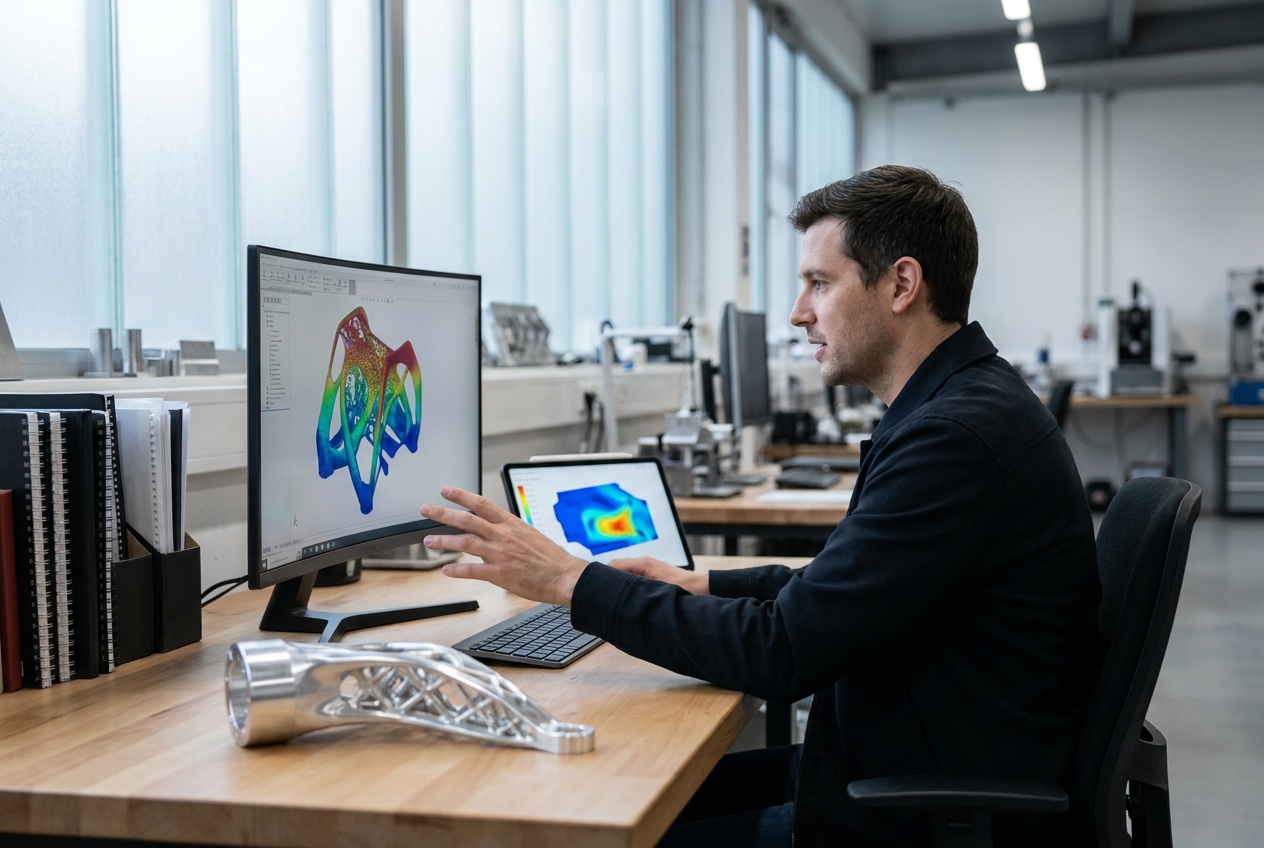
An engineer at a workstation reviewing a generative design and a simulation on screen, with a physical prototype component on the desk
The engineer’s job moves from generating candidates to defining constraints and judging output.

The agentic turn: Siemens and the autonomous plant

The frontier is moving from AI that informs to AI that acts. Siemens has introduced industrial AI agents aimed at autonomous production optimization and predictive maintenance, with the company describing productivity targets as high as 50% and case figures citing throughput gains, reductions in unplanned failures, and quality improvements. These are vendor-stated and should be read as direction rather than audited universal results, but the trajectory is clear: the intelligence layer is beginning to close the loop and adjust the process, not just report on it.

This is also where the discipline matters most. An agent empowered to change a production parameter is operating in a physical environment where errors have physical consequences. The responsible deployments wrap autonomy in tight constraints, clear boundaries, and human oversight on anything that touches safety or significant output. The same principle that governs AI in a law firm or a marketing team governs it on a factory floor, only with higher stakes: the machine proposes and executes within limits, and a qualified human owns the boundary.

The cautions specific to a production environment

Manufacturing carries risks that a purely digital business does not, and a responsible program names them up front.

Safety is the first. Any AI output that bears on machine operation, worker safety, or product integrity must pass through a qualified human, because the failure mode is not an awkward sentence but an injury or a recall. Data quality is the second: industrial AI is only as good as the sensor and process data it learns from, and a plant with poor data discipline will get confident, wrong answers. The third is over-automation: closing the loop too aggressively, before the system has earned trust, trades a known manual process for an opaque automated one whose failures are harder to catch. And the fourth is the workforce question, which manufacturing feels acutely: AI that captures a veteran’s knowledge is valuable, but the plant still has to develop the next generation of judgment, not just digitize the last one.

None of these is a reason to wait. Each is a reason to adopt deliberately, with the human firmly in the loop, which is the through-line of every responsible AI program regardless of industry.

Where a mid-sized manufacturer should start

The industrial giants have research budgets a mid-sized manufacturer does not. The good news is that the highest-value first step requires none of that.

  1. Start with the knowledge layer. Make your decades of manuals, fault reports, SOPs, and shift logs searchable in plain language. This is low-risk, high-value, and it captures the institutional knowledge you are at risk of losing to retirement. It is the BMW Factory Genius idea at any scale.
  2. Pick one high-friction workflow. Choose a single repetitive, costly workflow, often maintenance troubleshooting or quality documentation, and run it on AI with a human reviewing every output.
  3. Keep the human in the loop on the floor. Use AI to draft, diagnose, and surface. Keep a qualified person approving anything that affects safety or output. This is the rule that lets you move fast without taking on physical risk.
  4. Document and expand. Write the workflow into a standard your team can run, then extend it to the next area once it works reliably. A plant with its AI operating system written down has built an asset, not a dependency on one engineer.

The pattern is the same one the largest manufacturers follow, scaled down: an intelligence layer over the existing operation, a human owning every consequential decision, and a written standard that turns experiments into how the plant works.

What a mid-sized plant should copy from the giants

BMW and Siemens have resources a regional manufacturer cannot match, but the principles behind their programs translate down to any plant, and they are worth extracting plainly.

Copy the knowledge-layer idea, not the budget. BMW’s most transferable move was not its simulation supercomputing; it was deciding that the plant’s accumulated knowledge should be queryable in plain language. Any manufacturer can do a version of that with existing documents, and the payoff in time saved and knowledge retained is immediate.

Copy the governance, not just the technology. Siemens wraps its agentic systems in tight constraints and human oversight because it is operating in a physical environment. A smaller plant should adopt the same posture from day one: clear boundaries on what AI may decide, and a qualified human owning anything that touches safety or output. The discipline is free, and it is what makes speed safe.

Leave the moonshots. What a mid-sized manufacturer should not copy is the bleeding-edge autonomy and custom model development that only make sense at enormous scale. The leverage for most plants is in the unglamorous middle: searchable knowledge, predictive maintenance on the most critical assets, automated quality documentation, and better planning. These are proven, affordable, and available now.

The honest framing is that most of the documented industrial AI results, including the strongest Siemens figures, are vendor-stated and reflect favorable deployments rather than guaranteed outcomes. That is a reason to measure your own results against your own baseline, not a reason to sit out. The capability is real; the value accrues to operators who adopt it with discipline and verify it against their own numbers.

Frequently asked questions

How is AI used in manufacturing?

Across five areas: production knowledge and troubleshooting (BMW's Factory Genius answers plant questions from decades of manuals and logs); predictive maintenance (flagging failures before they happen); quality inspection (computer vision plus automated documentation); supply-chain planning (forecasting, inventory, and supplier-risk scenarios); and engineering and generative design (BMW reported simulations roughly 30 times faster with Siemens and NVIDIA). The leaders treat AI as an operating layer over existing assets while keeping a qualified human in control of any safety- or output-critical decision.

What is the best first AI project for a manufacturer?

The knowledge layer. Making decades of manuals, fault reports, SOPs, and shift logs searchable in plain language is low-risk, high-value, and captures institutional knowledge at risk of retiring out the door. It requires no changes to the production line and delivers value immediately, which makes it the safest place to learn the operating discipline before automating anything physical.

Is AI safe to use on the factory floor?

It is safe when a qualified human controls anything that affects machine operation, worker safety, or product integrity. The failure mode in manufacturing is physical, not cosmetic, so responsible programs use AI to diagnose, draft, and surface information while a trained person approves every consequential action. Over-automating before a system has earned trust is the main risk, and it is avoided by keeping tight constraints and human oversight on the loop.

Will AI replace manufacturing workers?

The current pattern is augmentation more than replacement: AI captures and surfaces knowledge, predicts failures, and handles documentation, freeing skilled workers for higher-judgment work. The real workforce challenge is developing the next generation of expertise rather than only digitizing the last one. Manufacturers that use AI to train people on judgment, not just to automate tasks, are positioned best.

How does AI help with supply chain in manufacturing?

AI improves demand forecasting, inventory optimization, supplier-risk monitoring, and logistics by ingesting more signals and running more scenarios than a human team can. A generative layer lets a planner ask, in plain language, how a supplier delay affects the schedule and get a usable answer quickly. The commitment of capital and supplier relationships stay with human planners who understand the context the data omits.

Anthony Guerriero is the founder of The Leverage Years and a CPA and former Deloitte Senior Manager. He built and scaled a medical logistics company from 6 to 1,800 employees and has advised UHNW clients on cross-border real estate transactions across more than 40 countries. The Leverage Years teaches senior professionals and operators how to use Claude, made by Anthropic, to do their best work faster without compromising their judgment or professional standards.

Take it further

Get the workflow + SOP.

The full briefing prompt and the matching SOP page from the binder are inside the Club. Free with any course, or $49/month direct.

Open the Club โ†’
If this matches your work

Find the right course.

Six diagnostic questions, one course recommendation. We will point you at the program out of twenty that maps to the work in this briefing, then send your workflow assessment.

Take the selector โ†’