You are not late. You are under-leveraged
The panic that you missed the AI wave is the wrong diagnosis. You are not behind on the technology. You are sitting on judgment you have never amplified.
Key Takeaways
- The core idea: Your decades of judgment are the scarce asset AI amplifies, not a disadvantage to overcome. The technology itself requires minimal learning time.
- Why it matters: Most experienced professionals confuse being busy with being leveraged. True leverage means designing systems where you adjudicate the critical 10 percent, not execute every task.
- How it works: Clients pay for your conclusions and pattern recognition, not your hours. Separating careful judgment from mechanical execution unlocks compounding returns without hiring teams.
- What to do: The 70/20/10 rule identifies what to delegate: hand mechanical work to AI, direct the shaping in dialogue, and reserve your attention for irreducible judgment calls.
Source: The Leveraged Years Briefing. Permalink
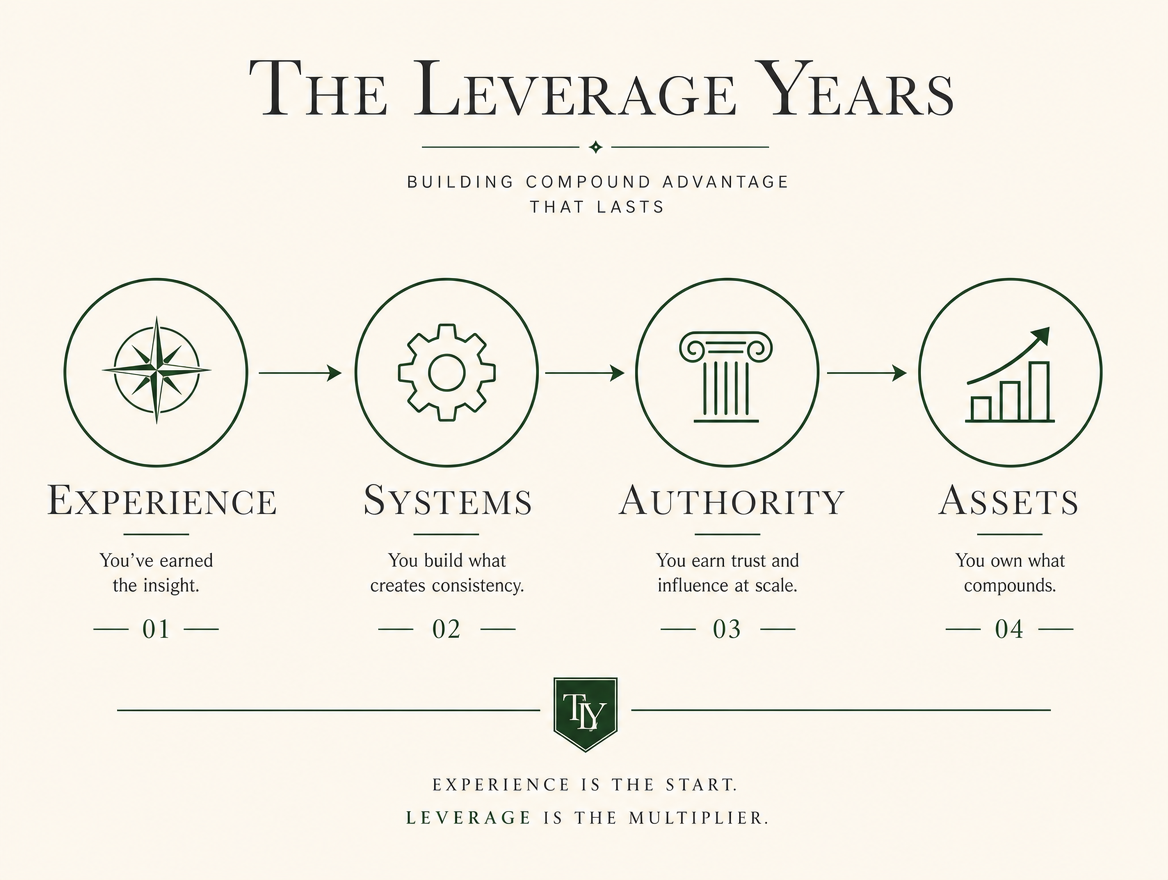
If you are 52 and convinced you missed the AI wave, you have misread your own position. Being late would mean someone with two years more practice has built a lead you cannot close. That is not what is happening. The people posting prompt screenshots have a tool you can learn in a weekend. What they do not have is the twenty-five years of judgment that makes the tool worth using. You are not late. You are under-leveraged, which is a fixable problem.
I say this as someone who ignored Claude for most of a year because I assumed it was for people who could not write their own emails. I was wrong in a specific, instructive way. The tool was never the point. The point was that I had spent a career producing one careful document at a time, by hand, and had never once asked whether the careful part and the by-hand part could be separated. They can. The judgment is yours. The typing does not have to be.
Is it too late to learn AI in your fifties?
No, and the framing is backwards. The hard part of using AI well is not learning the interface. It is knowing what good output looks like, what a lazy argument smells like, and where a confident answer is quietly, expensively wrong. Those are not skills you pick up from a tutorial. They are the residue of decades of doing the work and cleaning up the mess when it went sideways. A 28-year-old can generate a market analysis in four minutes. Whether they can tell it is subtly wrong is another matter. You can. That discrimination is the scarce asset, and you already paid for it.
So the learning curve you are dreading is shorter than you think. You are not starting at zero. You are starting at "expert who has not yet picked up a power tool." The tool takes an afternoon. The expertise took thirty years. Guess which one the market pays for.
What does "under-leveraged" actually mean?
Leverage is output per unit of you. A surgeon who trains ten surgeons has more leverage than one who operates faster. A consultant whose method lives only in their own head has none, because nothing happens unless they personally show up. Most accomplished professionals are badly under-leveraged: rare judgment locked inside a delivery model that needs their hands on every task. AI is the first tool that lets one expert apply that judgment to ten times the volume without hiring a team or dropping the standard.
Here is the distinction I wish someone had drawn for me earlier. There is a difference between being busy and being leveraged. Busy is doing the work faster. Leveraged is designing a system so the work mostly does itself and you adjudicate the hard 10 percent. The first feels productive and changes nothing. The second feels uncomfortable, because it asks you to stop being the person who does everything, and it is the only thing that compounds.
I resisted this for an embarrassing reason: doing every task myself was how I knew I had earned my fee. If I just reviewed and signed off, was I really working? That instinct served me well for twenty years and then quietly became the ceiling. The clients never wanted my hours. They wanted my conclusion, delivered well, on time. Once I accepted that, handing the mechanical 70 percent to a tool stopped feeling like cheating and started feeling like the job.
| "I'm late" (the wrong story) | "I'm under-leveraged" (the real one) | |
|---|---|---|
| The problem | I missed the technology | My judgment isn't multiplied |
| The fix | Frantic catch-up, courses, FOMO | One system applied to real work |
| Your edge | Doesn't exist; you're behind | 25 years of pattern recognition |
| Time to act | Already gone | A weekend to start, weeks to compound |
| Who wins | The 28-year-old with more reps | The expert who finally scales |
How do you decide what to hand off first?
Use the 70/20/10 Delegation Rule. Look at any recurring task and split it. Roughly 70 percent is mechanical: the first draft, the formatting, the research gather, the boilerplate. Hand that to Claude. About 20 percent is shaping: the structure, the argument, the judgment calls. You direct that, in dialogue with the tool. The last 10 percent is irreducibly you: the final read, the relationship, the call that carries your name and reputation. That 10 percent is what clients pay for, and it is the only part you should still be doing by hand.
The mistake I see most often is people defending the 70 percent because it feels like "real work," and rushing the 10 percent because they ran out of time. Reverse it. Give away the part a tool does well so you can spend your scarce attention on the part only you can do.
The 10-Hour Leverage Test
Try this before you buy a single course. Pick the ten hours of last week you would most like to never repeat: the proposal you rewrote four times, the research memo, the email you drafted and redrafted, the meeting that should have been a one-page summary. Those hours are your leverage backlog. Each one is a place where your judgment was required for maybe 20 percent of the task and your time was consumed by the other 80.
Now take the single worst offender into Claude. Give it a real example of your best work as a model, the context, and the raw material, and ask it for a first draft you can react to. You are not asking it to be you. You are asking it to hand you a flawed 70 percent so your expertise goes straight to the part that matters. The first time you watch a two-hour task collapse into twenty minutes of editing, the word "late" stops making sense.
A real before-and-after
A composite from people I have coached, accurate to the pattern: a 56-year-old former operations VP, freshly independent, spending roughly eight hours a week on proposals and follow-ups and convinced she was "too analog" for AI. She was not behind on technology. She was doing eight hours of work her judgment only needed to touch for ninety minutes. We built one Claude Project loaded with her three best past proposals as the standard. Within a month, proposal time dropped from eight hours to about two, and the win rate held, because the judgment, the thing clients were actually paying for, was unchanged. She did not catch up to anyone. She stopped leaving leverage on the table.
What to do this week
Stop measuring yourself against people who have more reps with a tool and less of everything that makes the tool useful. Run the 10-Hour Leverage Test. Apply the 70/20/10 split to your worst recurring task, and take it into Claude with a sample of your best work attached. Edit the draft instead of writing one. Then do it again next week with the next task. Leverage compounds quietly; you will not notice the day it turns, only that six weeks in you have an extra afternoon and the same standard.
You were never behind. You were carrying capability you never put to work. Put it to work.
Frequently Asked Questions
How do I know if I'm actually under-leveraged or just making excuses for poor productivity?
Run the 10-Hour Leverage Test: identify last week's most repetitive tasks where your judgment touched only 20 percent but consumed 80 percent of your time. If collapsing one of those tasks from two hours to twenty minutes of editing would materially change your capacity, you're under-leveraged.
Won't clients feel cheated if I'm not personally doing all the work they're paying for?
Clients pay for your conclusion delivered well and on time, not your hours. If handing off mechanical work lets you spend more attention on the irreducible 10 percent that carries your name and reputation, you're delivering more value, not less.
What if I invest time learning this and the technology changes completely in six months?
The tool interface takes an afternoon to learn. The durable skill is knowing what good output looks like and where confident answers are quietly wrong, which you already possess. Technology shifts won't erase that judgment advantage.
One clear briefing a week on the AI moves that affect your work
Plain English, written for working professionals. Each issue gives you what changed, why it matters for your field, and one ten minute win you can use the same day. No noise, no hype.
Want the full playbook behind these briefings? The Leverage Club is a working library of briefings, prompts, and quick wins with a member feed. Forty nine dollars a month, or free while you are enrolled in any course.