Train your team to use AI within the rules you set
The Leveraged Attorney gives attorneys a structured process for designing and delivering firm-wide AI governance training.
A junior associate pastes a confidential settlement memo into a free chatbot to "tidy up the language." A finance analyst uploads a client's bank statements to summarize them faster. A clinic administrator drafts a patient appeal letter with a tool nobody vetted. None of these people are reckless. They are busy, and the tool was right there, and it worked. That is exactly the problem.
If you run or help run a small or mid sized professional firm, your people are already using AI. The only open question is whether they are doing it inside a set of rules you wrote, or inside a vacuum you will get to explain later to a regulator, a client, or a malpractice carrier. AI governance training is how you close that gap before it becomes a story. This briefing is a practical walkthrough of what governance actually means for a firm your size, why ad hoc use is a real liability rather than a theoretical one, and how to train a team properly without writing a six figure check to a consultancy.
What "AI Governance" Actually Means at Firm Scale
The phrase sounds like something that belongs in a Fortune 100 risk committee. Strip away the jargon and it is much simpler: AI governance is the set of decisions you make once, write down, and enforce, so that every person in the firm uses these tools the same safe way. It is the difference between a policy and a vibe.
National frameworks describe this in formal terms, and it is worth knowing they exist so you can point to them. The US National Institute of Standards and Technology publishes an AI Risk Management Framework that describes characteristics of trustworthy AI across qualities like validity, security, accountability, transparency, privacy, and fairness. ISO/IEC 42001 is an international standard for an auditable AI management system. In the European Union, the AI Act phases in obligations over 2025 and 2026, and notably it introduces an AI literacy expectation for organizations that deploy these systems, signaling a broader trend in which regulators expect staff to have a baseline understanding of the tools they use. You do not need to memorize any of these. You need to understand the through line. Regulators and standards bodies increasingly expect that an organization can show documented, deliberate control over how AI is used. "We trust our people" is not a control.
For a firm of ten or two hundred, governance comes down to roughly six moving parts. None of them require a data science team.
1. An Acceptable Use Policy People Will Actually Read
This is the foundation, and most firms either skip it or produce a twelve page document nobody opens twice. A good acceptable use policy is short, specific, and answers the questions people actually have. Which tools are approved. What you may put into them and what you may never put into them. When a human has to check the output before it leaves the building. What to do when you are not sure.
The single most useful thing the policy does is draw a bright line around confidential and regulated data. For a law firm that means client confidences and privileged material. For an accounting or finance practice it means client financials, tax data, and anything personally identifiable. For healthcare administration it means protected health information. The rule that keeps you out of trouble is plain: regulated or privileged data does not go into a tool unless that specific tool has been vetted and approved for it, in writing, with the right contract behind it. Everything else is a footnote.
2. Data Handling That Matches Your Duties
Not all AI tools are built the same way, and the difference matters enormously for a firm that holds other people's secrets. A free consumer chatbot may retain your inputs and use them to train future models. A paid business tier of the same product often contractually agrees not to. Some vendors offer a zero retention mode. Your job is to know which bucket each approved tool falls into and to route sensitive work only to the tools that contractually protect it.
This is also where the duty of confidentiality stops being abstract. The American Bar Association addressed this directly in Formal Opinion 512, issued in 2024, which emphasized that a lawyer's existing ethical duties around competence, confidentiality, client communication, and supervision continue to apply when work passes through a generative AI tool. The duty travels with the data. A similar principle holds for other regulated professionals: obligations of confidentiality and privacy generally attach to the underlying information, not to the specific tool used to handle it. The tool is not a loophole.
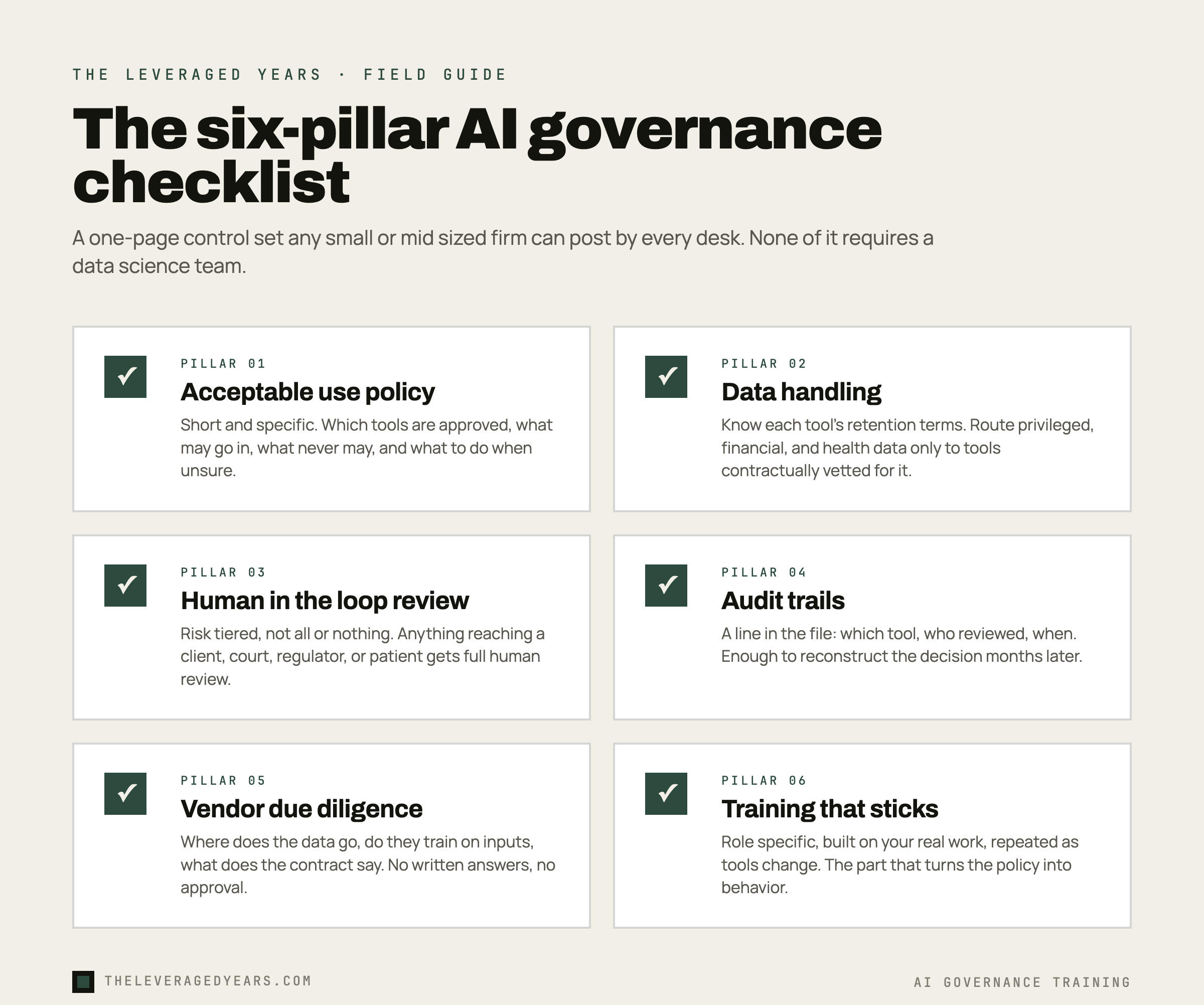
3. Human in the Loop Review
AI tools produce confident, fluent, wrong answers. In a low stakes context that is annoying. In a legal brief it is sanctions. There is now a steady drumbeat of cases where lawyers filed documents citing cases that the AI simply invented, and judges have not found it charming. Governance means deciding, in advance, which categories of work require a qualified human to verify every factual and legal claim before anything goes out the door, and which low risk tasks can move faster.
The framing that works is risk tiered, not all or nothing. Drafting an internal meeting summary needs a glance. Anything that reaches a client, a court, a regulator, a counterparty, or a patient gets full human review by someone competent to catch the errors. A simple test for where the line falls: if you would be uncomfortable explaining to a judge or a client that you did not personally verify a given output, it requires full human review. Write that distinction down. It is the line your insurer will want to see.
4. Audit Trails
If something goes wrong, the first question anyone asks is "what happened, and who did what." A firm that cannot answer is in a far worse position than one that can. You do not need enterprise logging software to start. You need a habit: which tools were approved and when, who has access, and for high stakes work, a note in the file that AI was used and that a named person reviewed it. A single line in the matter file does most of the work, something like "Draft demand letter generated with the approved tool, reviewed for all factual and legal claims by the supervising partner on this date." The goal is to be able to reconstruct a decision months later. Regulators increasingly expect organizations to be able to show documented controls, and a paper trail is what "documented" means in practice.
5. Vendor Due Diligence
Every AI tool you bring in is a third party you are trusting with your work and possibly your clients' data. Before a tool gets approved, somebody should be able to answer a handful of questions. Where does the data go and who can see it. Does the vendor train on your inputs. What are the security commitments. What does the contract actually say about confidentiality and data deletion. Is there a business associate agreement or equivalent where one is legally required. The decision rule is simple: if a vendor cannot answer these in writing, or if their terms say they train on your inputs with no contractual opt out, that tool is not approved for sensitive work. The discipline is in the decision, not just in asking the questions. This is the same standard you already apply to any other outside service that touches client information. AI does not get a pass because it is new.
6. Training That Sticks
A policy nobody understands is a policy nobody follows. Training is the part that turns the document into behavior, and it is the part firms most often treat as a one time email. We will come back to how to do this well, because it is the whole point.
Why Ad Hoc AI Use Is a Real Liability, Not a Hypothetical One
It is tempting to file all of this under "someday." Resist that. The exposure from ungoverned AI use is concrete and it compounds quietly.
The first risk is confidentiality breach. The moment privileged or regulated data goes into a tool that retains it, you may have a disclosure problem that no after the fact policy can undo. For a lawyer that implicates the duty of confidentiality. For a finance professional it can mean a contractual or regulatory breach. For anyone holding health data it can mean a reportable privacy incident. The data does not come back.
The second risk is bad work product delivered with a straight face. AI hallucinations are not rare edge cases; they are a known property of the technology. A fabricated citation, an invented figure, a misread clause, any of these can reach a client or a court if no one is required to check. The professional, not the tool, owns the result. For the wider pattern behind these failures, see the real problems with AI to design around.
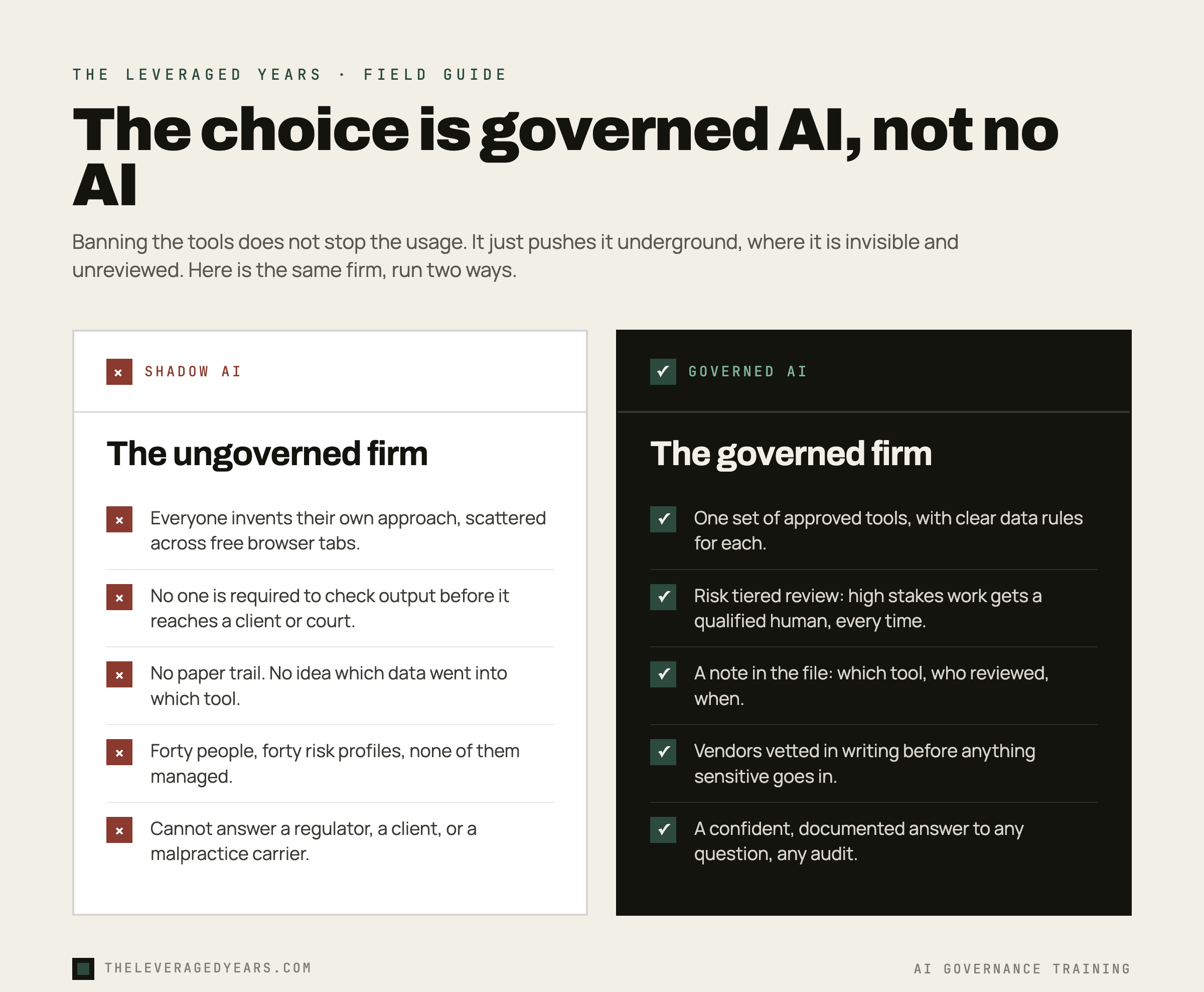
The third risk is the one people underestimate: inconsistency. When forty people each invent their own approach, you have forty different risk profiles and no way to manage any of them. One person uses a vetted tool carefully. Another pastes everything into whatever is free and open in a browser tab. You cannot defend a practice you cannot describe. Governance is what lets you say, truthfully, "here is how our firm uses these tools, and here is how we know."
That is the practical case for training, and it is also why the professionals who get ahead of this end up more capable, not more constrained. Our case studies of how real firms run on AI show the same pattern across very different industries: the firms that win treat governance as the thing that lets them move faster, safely, rather than the thing that slows them down.
How to Train a Team Without a Six Figure Consultant
Here is the part the certification industry would rather you not notice. You do not need an expensive consultant or an alphabet soup credential to govern AI well in a firm your size. Credentials like the IAPP's AI governance professional designation are real and have their place, mostly for people whose full time job is compliance at a large enterprise. For a working professional firm, the certificate on the wall is not what protects you. The behavior of your team is. So spend your effort there.
A practical training program for a small or mid firm has a few characteristics.
It is role specific. A paralegal, a partner, and an office administrator do not face the same risks, so do not give them the same generic deck. Show each group the three or four situations they will actually encounter and exactly what to do. Concrete beats comprehensive.
It teaches the bright lines first. Before anyone learns a single clever prompt, they should be able to recite what must never go into an unapproved tool and which tools are approved for what. If your training accomplishes only this, it has already removed most of your downside.
It uses your real work. Generic AI ethics modules bore people and do not transfer. Run the session on the kinds of documents and decisions your firm handles every day. A finance team should practice on the messy reality of client financials and the rule that those stay out of unvetted tools. A legal team should drill the citation verification habit on a real brief. This is why The Leveraged Attorney is built around real legal workflows, teaching lawyers to use AI on actual client documents while meeting their specific duties of competence, confidentiality, and supervision, rather than on generic AI principles. For accounting and finance practices, The Leveraged CPA and Finance program does the same with the data handling and confidentiality concerns that actually apply to that work.
It is repeated, not one and done. The tools change monthly. A single onboarding email ages out in a quarter. Build a short, recurring touchpoint, even fifteen minutes when something material changes, and you will keep the policy alive far better than any binder.
It makes it safe to ask. The worst outcome is a person who is unsure, too embarrassed to ask, and quietly guesses wrong. Name a go to person for AI questions. Make "I'm not sure, let me check" the celebrated answer rather than the awkward one. Culture does more for governance than any document.
You can stand up the core of this in a few weeks with people you already have. Write the policy. Identify your approved tools and the data rules for each. Run a role specific session with your own documents. Set a recurring check in. Put the one page checklist where people can see it. That is a real governance program, and it costs a fraction of what the consulting market would quote you. If you want a structured starting point matched to your profession, our full course catalog is organized exactly this way, by the work you actually do.
Not sure which gaps your firm has first? Our two minute AI readiness quiz points you to the right starting place based on how your team is using these tools today.