Turn prompt theory into repeatable workflows you control
The Leverage Starter gives experienced professionals new to AI a structured process for building prompt systems that solve real work problems.
Type "prompt engineering certification" into Google and the page that comes back is mostly people who want to sell you one. Course platforms, credential councils, training sites charging a few hundred dollars, a YouTube video promising the whole thing in ten minutes. Even some search overviews, after listing the providers, add that opinions are mixed on whether any of it actually helps you land a job.
That hesitation is the honest part. So let us start there and answer the question most of those pages dodge: should a working professional pay for one of these?
The short version: a standalone prompt engineering certification is a weak signal on its own. It proves you sat through a curriculum, not that you can produce a result. For most senior professionals, the money and hours are better spent building applied, domain-specific proof. But "weak signal" is not "worthless," and there are a few cases where a cert earns its keep. We will name them.
What these certifications actually are
Strip away the marketing and a prompt engineering certification is a short course plus an assessment. You learn a vocabulary (zero-shot, few-shot, chain-of-thought, system prompts), you practice writing instructions for a model, and you pass a quiz or submit a small project. Then you get a PDF and a badge for your LinkedIn profile.
The teaching is usually fine. The patterns are real and useful: giving the model a role, showing it examples, asking it to reason step by step, iterating instead of accepting the first answer. If you have never thought deliberately about how you talk to an AI tool, a structured run through these ideas will make you noticeably better in an afternoon.
The issue is not the content. It is the credential. A certificate's value comes from who issues it and what they verified. A short AI course from a well-known university on a platform like Coursera, or official training from a large tech vendor such as IBM, carries some name recognition. A "professional certification" from a council you have never heard of carries almost none, and hiring managers know the difference. Several of the bodies issuing these credentials exist primarily to issue credentials. That is a thin foundation to put your money on.
When a cert helps, and when it is resume-bait
A prompt engineering cert genuinely helps in a few situations. If you want the skill without the badge, a focused prompt engineering course covers the same mechanics in an afternoon.
If you are early in your career or switching fields, a recognizable certificate gives you something concrete to point to before you have real work to show. It signals initiative and gets you past a keyword filter. If your employer is paying and the badge maps to an internal expectation (your company standardized on Microsoft Copilot and wants staff trained or certified on it), take it. The cost-benefit math is somebody else's problem and the cert is tied to a tool you actually use. And if you genuinely do not know the fundamentals, the structure is worth a modest fee even if you never show anyone the badge.
Now the resume-bait case. If you are a mid-career or senior professional, a generic prompt engineering certificate adds very little. Almost nobody hiring a senior marketer, lawyer, or operations lead is impressed that you can write a chain-of-thought prompt. They assume you can already use the tools, or that you will learn in a week, because you will. Worse, leading with a prompt engineering badge on a senior resume can read as slightly junior, the same way listing "proficient in Microsoft Word" does. It signals you think a commodity skill is a differentiator.
There is a market signal worth noticing here. If you look at tools like Google Trends or recent job postings, interest in standalone "prompt engineer" roles and related certifications appears to have cooled compared with the peak-hype period. The hype cycle that produced six-figure "prompt engineer" job headlines has faded, and the standalone prompt engineer role has largely folded back into normal jobs. Companies rarely hire people whose only skill is talking to a chatbot. That tells you something about where to put your effort.
What employers actually value instead
Ask what a hiring manager or a client is really buying, and it is never "can write prompts." It is "can produce the outcome I need, faster and better, using these tools, in my world."
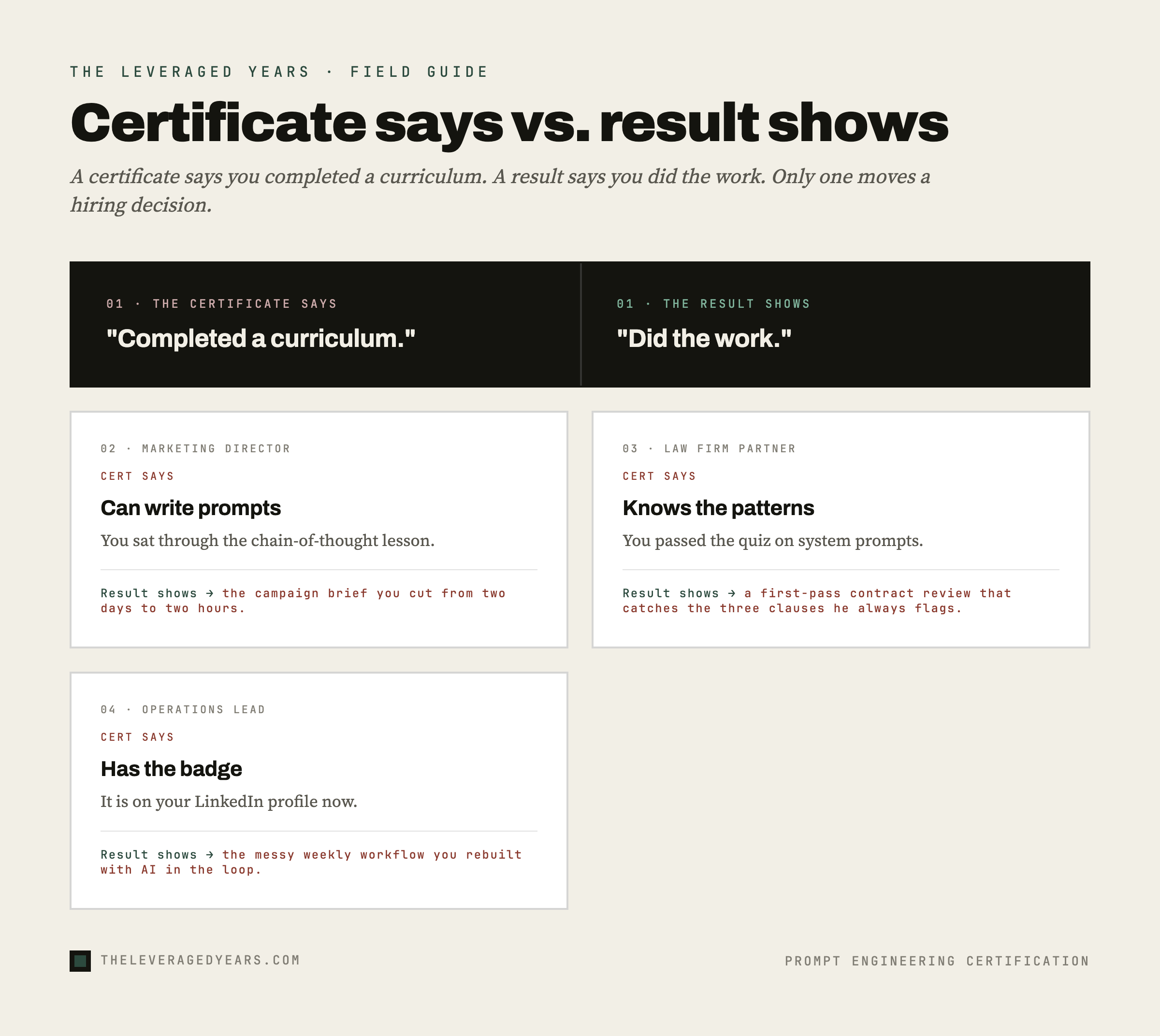
A certificate says you completed a curriculum. A result says you did the work. The marketing director does not want to know you can prompt; she wants to see the campaign brief you cut from two days to two hours. The partner at the firm does not care about your badge; he cares that you built a first-pass contract review that catches the three clauses he always flags. That is the proof that moves hiring decisions and wins clients, and no general cert can manufacture it for you.
This is why applied, domain-specific work beats a generic credential every time. The skill that compounds is not "prompting in the abstract." It is "getting real outcomes in your profession with AI in the loop." That is portfolio-shaped, not certificate-shaped, and it is the thing our profession-specific AI courses are built to produce: you leave with work you can show, not a badge you have to explain. If you are weighing where to spend a learning budget, the test is simple: pick the course that ends in usable work, not the one that ends in another PDF.
The judgment problem nobody certifies
Here is the deeper reason a prompt cert underwhelms. The hard part of working with AI was never the prompt.
Anyone can get a model to produce a confident, polished answer. The model will happily generate a financial projection, a legal summary, a hiring recommendation, all fluent, all plausible. The skill that actually matters is knowing which of those outputs to trust, which to throw away, and which would have quietly cost you a client or a lawsuit if you had shipped it. That is judgment, and it is the one thing a fill-in-the-blank prompt course cannot teach, because it lives entirely inside your domain expertise.
We call this judgment engineering, and we think it is the real skill of the AI era. The full argument is here: judgment engineering, not prompt engineering. The summary is that prompting is the easy, commoditized layer that every model is rapidly absorbing into itself; newer tools need less and less hand-holding to produce good first drafts. What does not commoditize is the seasoned professional who can look at a fluent answer and know, fast, whether it is right. A cert that drills prompt syntax is optimizing the part that is disappearing while ignoring the part that is becoming more valuable.
If you want a feel for the difference in practice, our guide to Claude prompts for business templates shows the prompting layer done well, and also shows how quickly the interesting question shifts from "what do I type" to "is this output any good, and how would I know."
A decision checklist
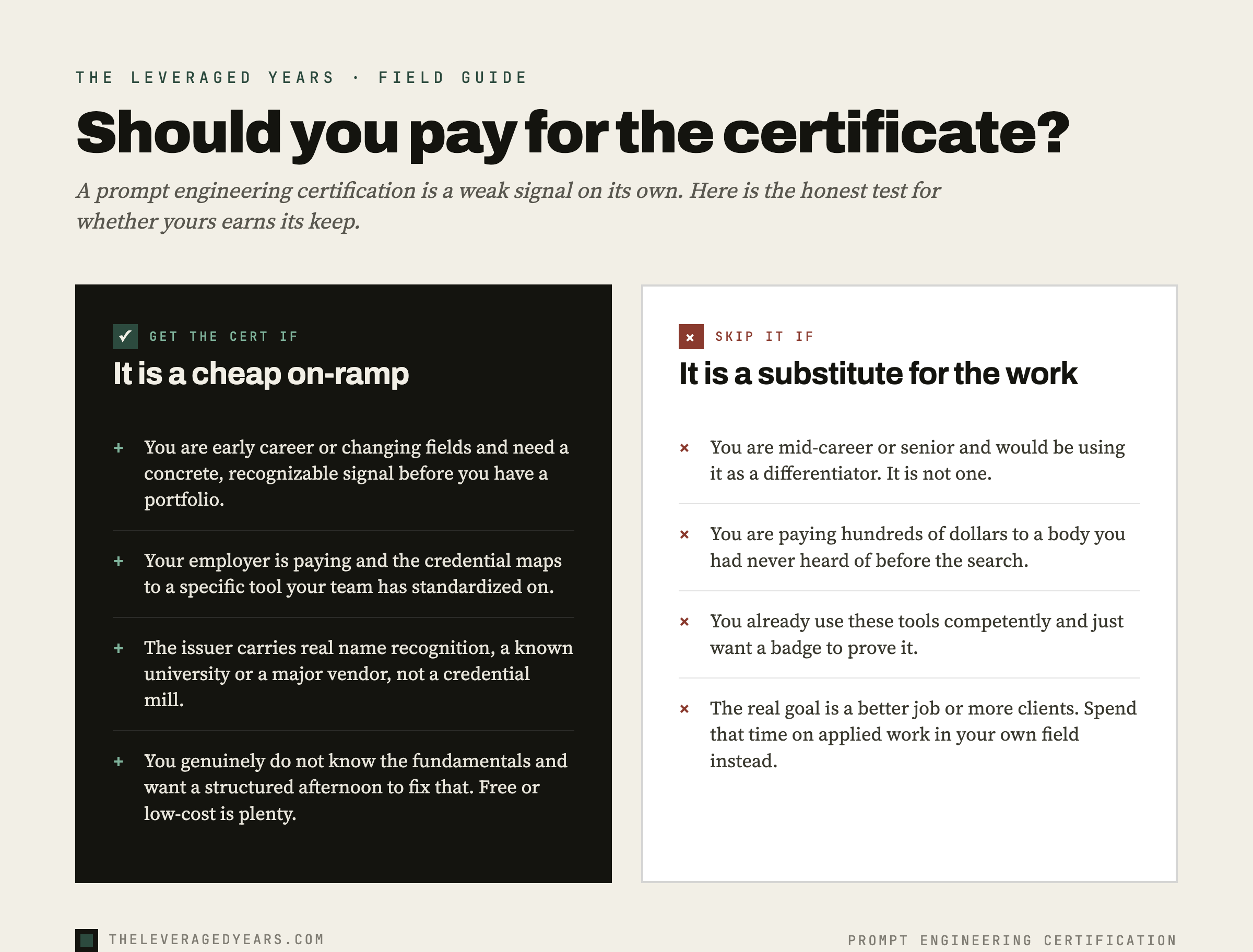
Get the cert if:
- You are early career or changing fields and need a concrete, recognizable signal before you have a portfolio.
- Your employer is paying and the credential maps to a specific tool your team has standardized on.
- The issuer carries real name recognition (a known university or a major vendor whose tool you use), not a credential mill.
- You genuinely do not know the fundamentals and want a structured afternoon to fix that. A free or low-cost option is plenty.
Skip it if:
- You are mid-career or senior and would be using it as a differentiator. It is not one.
- You are paying hundreds of dollars to a body you had never heard of before the search.
- You already use these tools competently and just want a badge to prove it.
- The real goal is a better job or more clients. Spend that time and money on applied work in your own field instead.
The test is simple. If the credential is a stepping stone to building real, domain-specific results, fine, treat it as a cheap on-ramp and move on quickly. If it is a substitute for that work, you are buying the wrong thing. If you are genuinely unsure which bucket you fall into, our two-minute assessment will give you an honest read before you spend a dollar.