Move from syntax tricks to a judgment-based AI practice
Claude Cowork gives professionals building a daily AI workflow a structured process for developing durable prompting judgment.
You searched for a prompt engineering course because you want to get more out of AI at work, and that instinct is right. The problem is what most of these courses sell once you click in. You get a tour of prompt syntax: role-play openers, the magic words, the formatting tricks, the "act as a senior X" templates, a list of phrases that supposedly make the model behave. You memorize the recipes, you pass the quiz, and you walk out fluent in a skill with a short shelf life.
Here is the uncomfortable part. The syntax tricks are the least durable thing you can learn about AI. They degrade quietly as the model underneath you updates. A phrasing that squeezed a better answer out of one version stops mattering on the next, because the new model already does that work for you. You are studying for a test the model keeps rewriting.
The skill that does not expire is judgment: knowing what to ask, what to keep, what to throw away, what to verify before you trust it, and how to put AI inside a real workflow without creating a mess you have to clean up later. That skill compounds. It gets more valuable as the models get better, not less. This piece makes the case for learning that instead, and it is honest about where prompt basics genuinely help so you can spend your time on the part that lasts.
What these courses actually teach
Strip the marketing off a typical prompt engineering course and you find a vocabulary lesson plus a pattern drill. You learn the terms (zero-shot, few-shot, chain-of-thought, system prompts), you practice writing instructions, and you collect a stack of templates you can paste in. Most of the well-known ones, from large vendors and universities, teach this competently. The patterns are real.
The trouble is the emphasis. A lot of the curriculum treats the phrasing as the hard part, as if there is a secret combination of words that opens up the model and your job is to find it. That framing made more sense in the early days, when models were clumsy and needed careful handling to produce anything usable. It made much less sense each year after, as the tools got better at understanding plain, ordinary requests.
You can see this in the market itself. Search interest in prompt engineering courses, and in the "prompt engineer" job title that drove the hype, peaked back in 2023 and has declined steadily since, not risen. The hype cycle moved faster than the course catalogs. The standalone "prompt engineer" role that made six-figure headlines is now the exception, not the norm; in most teams those skills have folded into regular product, engineering, and analyst roles. That is not a coincidence or a temporary dip. It is what happens when a skill gets absorbed into the tools and stops being scarce. A course built around that skill is teaching toward the part of the curve that is flattening.
Why syntax tricks expire and judgment does not
Think about what actually changes when a model updates.
The phrasing tricks lose their edge. The whole point of a clever prompt was to compensate for a model that did not quite get what you meant. As the model gets better at meaning, the compensation stops being necessary. "Take a deep breath and work through this step by step" was a real trick on older models. On current ones it is a marginal tweak, not a magic key, because the model already tends to reason through hard problems when the task is stated clearly. Every model release quietly retires a batch of yesterday's prompt hacks. If your skill is the hacks, your skill depreciates on someone else's release schedule.
Now think about what does not change. The model still produces confident, fluent, plausible output whether or not it is correct. It will write you a financial projection, a contract summary, a hiring recommendation, a market read, all polished, some of them quietly wrong in ways that would cost you. Deciding which is which is judgment, and no model update makes that job go away. If anything, better models make it harder, because the wrong answers get more convincing. The more fluent the output, the more your own judgment is the only thing standing between a good decision and an expensive one.
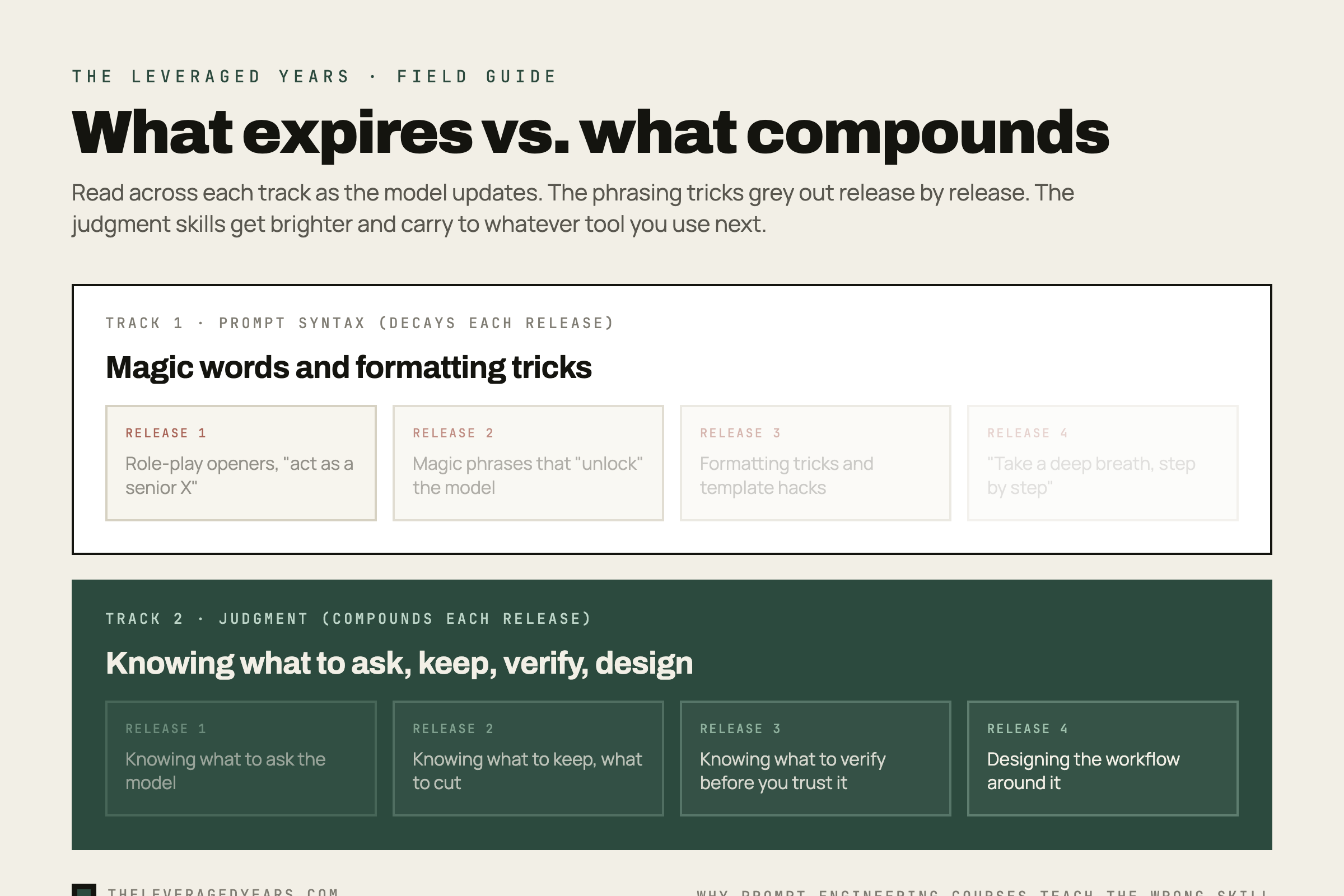
So the question is not whether prompt phrasing helps. It helps a little, and it helps less every year. The question is what you would still know if the model changed under you tomorrow. The phrasing would be gone. The judgment would still be there, and it would carry to whatever tool you use next.
Where prompt basics genuinely help
It would be dishonest to tell you prompting does not matter at all. It does, in a narrow and real way, and a good course can deliver that part in an afternoon.
A handful of fundamentals make almost everyone better immediately. Giving the model the actual context instead of a vague request. Showing it an example of what good looks like rather than describing it. Telling it the shape you want the output in. Asking it to reason before it answers on a genuinely hard problem. Above all, feeding it your real material instead of making it guess. These are not tricks. They are the difference between a generic answer and a usable one, and if you have never thought deliberately about how you talk to a model, learning them is worth a small amount of time.
But notice what these fundamentals actually are. None of them is a secret phrase. Every one is a small act of judgment: deciding what context matters, deciding what good looks like, deciding what you want out. The useful core of prompting is just judgment applied to the input. The part that expires is the costume around it, the role-play openers and the magic words. Learn the core in an afternoon, skip the costume, and put the rest of your time somewhere that pays off longer. If you want the practical version of that core, our walkthrough of ChatGPT prompts that actually get used at work shows the small set of patterns worth keeping and skips the library of five hundred you will never open.
The skill worth building instead
If prompting is the easy, commoditizing layer, what is the durable layer underneath it?
We call it judgment engineering, and we think it is the real skill of the AI era. The short version is this: anyone can get a model to produce a confident answer; the rare and valuable skill is knowing, fast, whether that answer is any good, where it is likely wrong, and what to do about it. That skill lives inside your professional expertise, not inside a prompt template, which is exactly why a fill-in-the-blank course cannot hand it to you. The full case for why this is the central skill of the AI-native professional, what it looks like in practice and how to build it, is laid out in our companion piece, judgment engineering, not prompt engineering. Read this one for why the courses aim wrong; read that for the positive case in full.
Judgment engineering is a set of habits, not phrases. Knowing what to ask means understanding the problem well enough to give the model the right job in the first place. Knowing what to keep means reading an output critically instead of accepting the first fluent draft. Knowing what to verify means having a sense of where this kind of model tends to be wrong, the made-up citation, the plausible-but-off number, the confident summary that drops the one clause that mattered, and checking those spots before you ship. Knowing how to design a workflow means putting AI in the loop where it adds speed without putting it in charge of the decision where it would cost you.
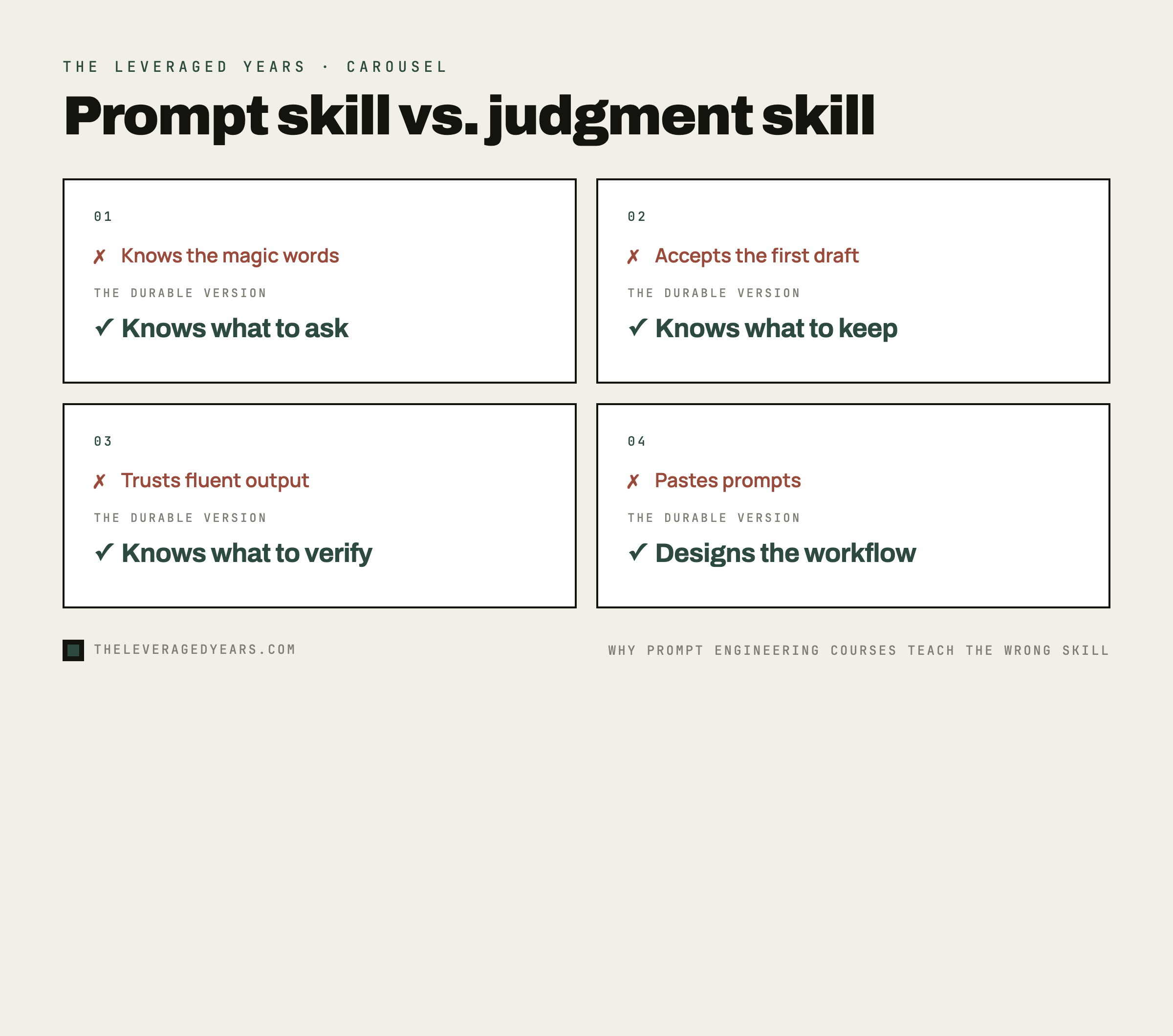
This is the difference between a course that ends in a stack of templates and one that ends in a working professional who is genuinely better at the job. It is the whole design idea behind Claude Cowork, which trains the durable skills of direction, verification, and refinement: working with AI as a capable collaborator you direct and check, rather than a vending machine you feed the right coins. You practice giving it real work, reading what comes back with a critical eye, catching where it went wrong, and building a workflow you would actually trust on a Tuesday. You leave with judgment you can use on any model, this year's and next year's, not a phrasebook for one version that is already on its way out. If you are not sure which of our profession-specific courses fits where you are, the two-minute course finder will point you at the right one before you spend anything.
How to evaluate a course before you pay
You do not have to take our word for any of this. You can size up any AI course in about a minute with three questions.
First, what do you walk out with? If the answer is a certificate and a folder of templates, that is the expiring layer. If the answer is real work in your own field that you can show someone, that is the durable layer. Portfolio beats phrasebook. If a credential is your specific concern, our companion piece on whether prompt engineering certification is worth it covers that question directly, and reaches the same place from a different door.
Second, does the course assume the model is dumb or smart? A course that is mostly about coaxing and tricking the model is built for an older generation of tools and is aging out as you read this. A course that assumes the model is already capable and spends its time on what you do with that capability, when to trust it, how to check it, where to deploy it, is built for the tools you actually have.
Third, would the skill survive a model update? Ask it plainly. If everything you learned is phrasing for one model, a single release can erase most of it. If what you learned is how to think about AI work in your domain, the next model just makes you faster.
Run those three questions on the course you were about to buy. If it fails them, you now know what to look for instead. For the record, we built Claude Cowork to pass all three: you leave with real work in your own field, the method assumes the model is already capable and trains you to direct and check it, and the judgment you build survives every model update.
The bottom line: stop hunting for the magic words and start building the judgment that no model update can take away. Learn the prompt basics in an afternoon, skip the costume around them, and put your real time into knowing what to ask, what to keep, and what to verify. When you are ready to build that on your own work, the two-minute course finder points you at the right track, or you can browse our courses and grade each one against the three questions above.