Build a working AI practice in your actual work
The Leverage Starter gives experienced professionals a structured method for testing AI tools against real tasks in your domain.
Most "AI course for beginners" results were not written for you. They were written for a twenty-two-year-old trying to break into tech, or a career-changer hoping a certificate will open a door. You are neither. You already have a career, a title, a long stretch of hard-won judgment, and a calendar that does not have room for a forty-hour curriculum on neural network history.
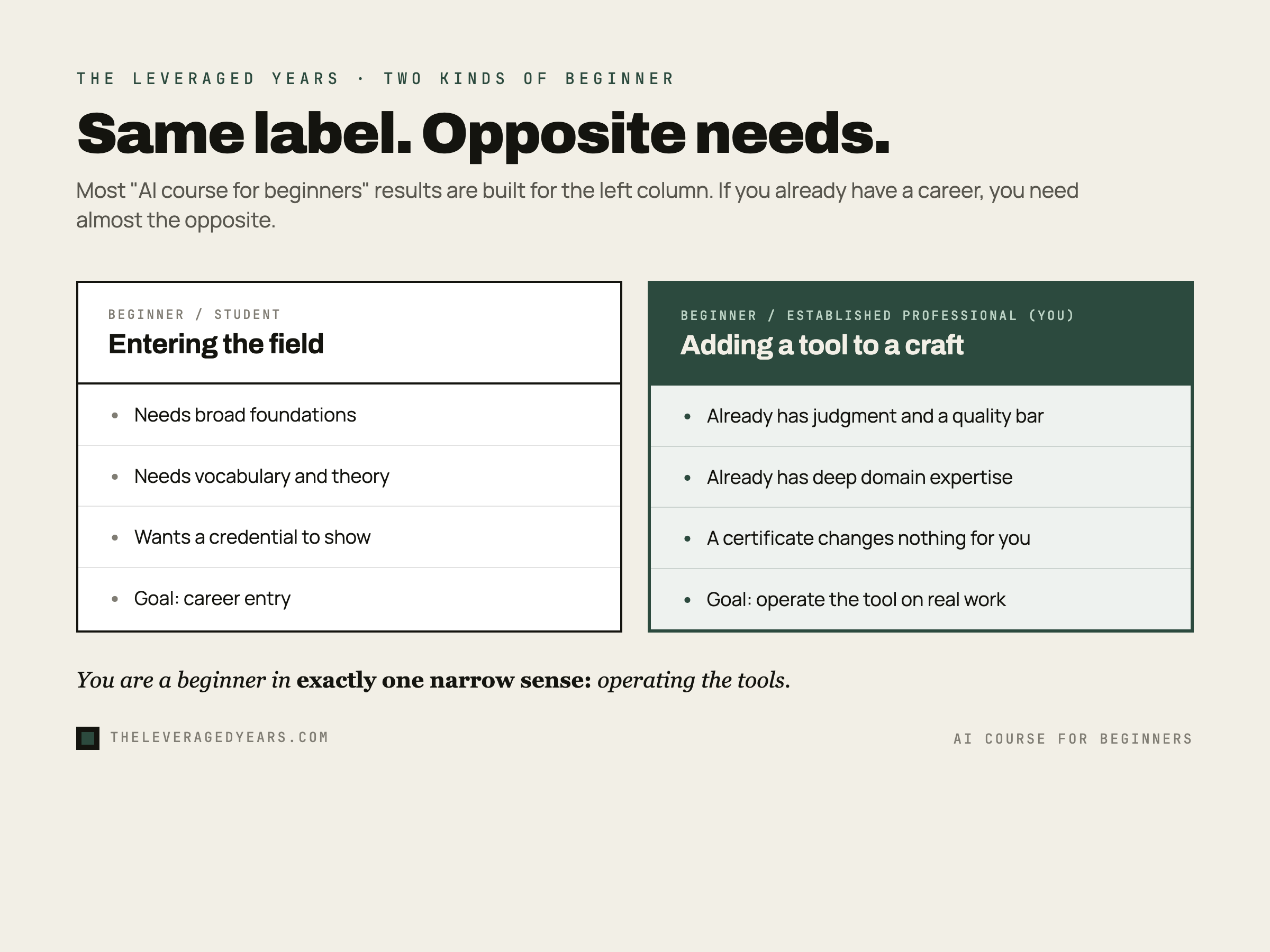
That difference matters more than the course catalogs admit. A beginner who is also an established professional needs almost the opposite of what a beginner who is a student needs. The student needs broad foundations and a credential to show. You need to get one real piece of your actual work done faster and better than you could last week, and you need it without sitting through six modules on how a transformer works under the hood. You are not trying to enter a field. You are trying to add a tool to a craft you already practice well.
So this is a buyer's guide written for that specific person: the skeptical beginner who is excellent at their job and has watched the AI hype cycle with a raised eyebrow. We are going to be blunt about what a beginner AI course should and should not promise, the red flags that should make you close the tab, the one thing that actually matters, and where a course like ours honestly fits. We sell a beginner course, so read all of this with that in mind. We would rather you buy the right thing, ours or anyone's, than waste a weekend on the wrong one.
You are a "beginner" in exactly one narrow sense
Let us name the confusion first, because it sells a lot of bad courses.
You are a beginner at operating these tools. You are not a beginner at thinking, at your domain, at knowing what good work looks like, at managing risk, or at telling a polished output from a hollow one. That is a rare and valuable combination, and almost no beginner course is built for it. Most assume that if you do not know the tools, you must not know anything, so they start from zero on everything: what AI is, a tour of the history, a parade of tools, a glossary.
For a true novice, that scaffolding makes sense. For you, most of it is padding. You do not need to be convinced AI is significant. You picked up enough of the concepts from a decade of news and meetings. What you cannot yet do is sit down with a real client memo, a real model, a real board doc, and reliably get the tool to make it better. That is the actual gap, and it is much narrower and much more practical than a beginner curriculum assumes.
That asymmetry is your filter for the rest of this guide. Every minute a course spends teaching you things you already know in another form is a minute it is not spending on the one skill you actually lack: applying the tool to your real work, with your standards, under your conditions.
What a beginner AI course should actually promise
Strip away the marketing and a genuinely good beginner course for a working professional makes a small number of honest promises. Hold any course you are considering against this list.
It should promise to get you operating one tool well, not five tools shallowly. Tool sprawl is the enemy of a busy professional. You want to leave fluent in one assistant you will actually use on Monday, not with a shallow tour of a dozen apps you will forget by Tuesday.
It should promise practice on your own real work, not toy exercises. In our experience, the surest predictor of whether a course changes your behavior is whether it makes you bring a real deliverable. A course that has you summarize a fictional article teaches you nothing about your actual job. A course that makes you draft your actual quarterly update, or stress-test your actual contract, teaches you the only thing that transfers.
It should promise to respect your time and your intelligence. A good beginner course for a senior professional is short, dense, and assumes you can think. It skips the history lesson. It does not pad the runtime to justify a price. If the syllabus reads like a semester, it was not built for someone with your schedule.
It should promise a specific, usable outcome. Not "understand AI." Something you can point to: by the end you will have a repeatable way to do one real category of your work with the tool. Vague promises produce vague results.
Notice what is not on this list: a credential, a comprehensive theory of artificial intelligence, or a tour of the frontier. Those are not what moves an established professional from stuck to fluent. The work does.
The red flags: what should make you close the tab
Now the warnings. The "beginner AI course" market is crowded, and a lot of it is built to look impressive rather than to make you good. Here are the signals that a course is selling the wrong thing.
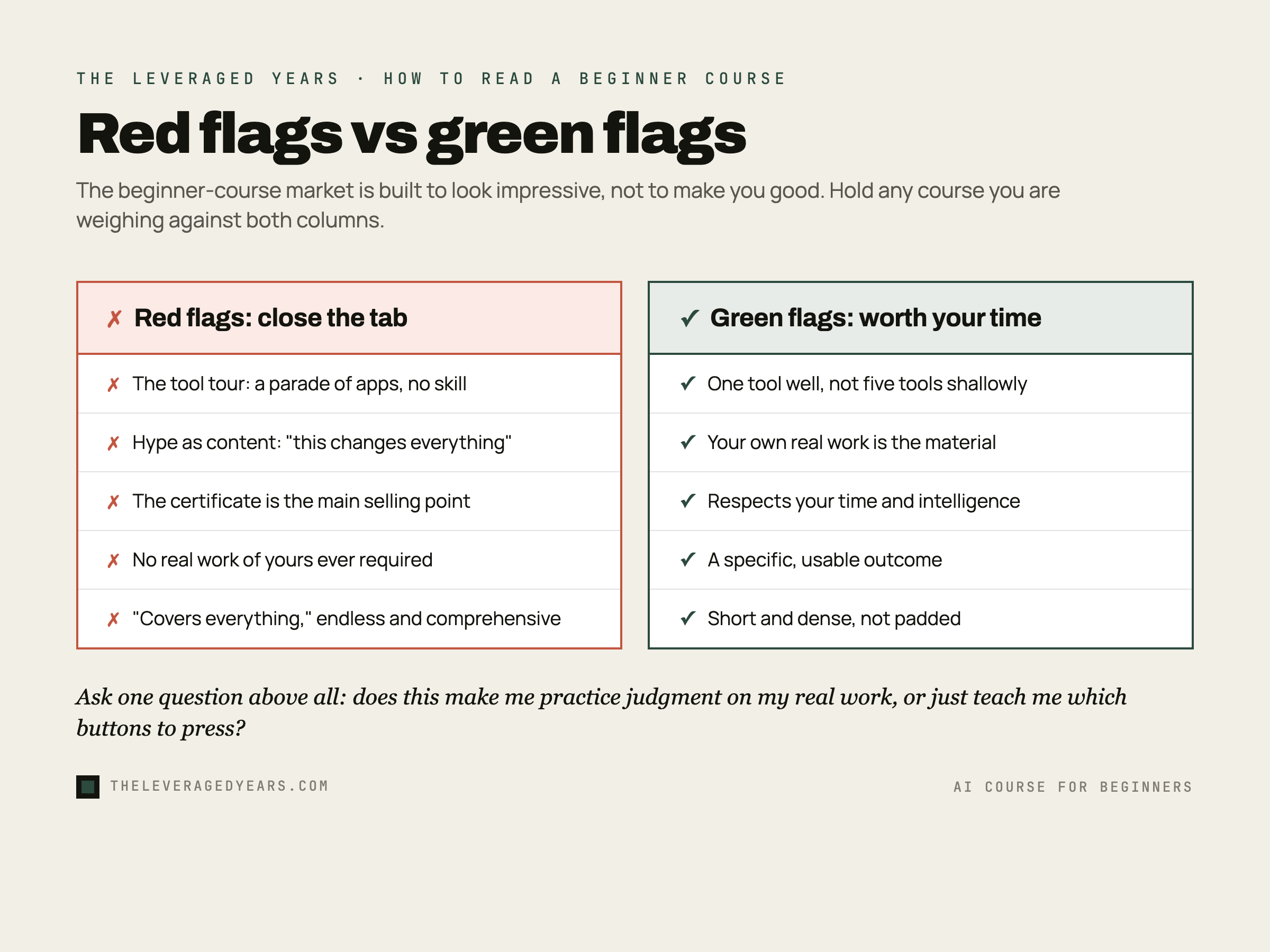
The tool tour. If the curriculum is mostly "here is ChatGPT, here is Gemini, here is Claude, here is a slide tool, here is an image tool," walk away. A list of tools is not a skill. You will finish it able to name a dozen apps and use none of them well on your actual work. Breadth is what you reach for once you are fluent, not how you become fluent.
Hype as content. If the sales page leans on "this changes everything," "the future is here," or breathless talk about how AI will replace every job, treat it as a warning. Courses that sell with hype tend to teach with hype, which means a lot of motivation and very little method. You are skeptical for good reasons. A course worth your money will respect that skepticism, not try to overwhelm it.
Certificates that mean nothing. This one deserves a hard look, because the search results are flooded with "AI course with certificate" and "free certificate" offers, and a lot of beginners chase the badge. Be honest with yourself about what that certificate is worth. For an established professional, a completion certificate from an online AI course carries very little weight. In practice, almost no senior decision-maker will change their mind about you because you finished a video series. The certificate is a participation trophy dressed up as a credential, and chasing it can quietly pull you toward courses optimized to be completed rather than courses optimized to make you good. Your resume already says you are capable. What you need is the capability, not another line item. If a course's main selling point is the certificate, that tells you where its priorities are.
No real work required. If you can complete the entire course without ever touching a real deliverable of your own, it will not change how you work. Passive courses produce passive knowledge. You will understand more and do nothing differently.
Endless and comprehensive. Counterintuitively, "covers everything" is a red flag for your situation. Comprehensive courses are built for people entering the field. For you, comprehensiveness is a tax. The more a course promises to teach you, the more of your time it will spend on things you do not need.
If you want the longer treatment of why so many established professionals stall even after finishing good material, we wrote about that separately in why free AI courses leave you stuck.
The one thing that actually matters: applied judgment
Here is the part nobody puts on a sales page, because it does not scale and it does not sound exciting. The thing that separates a professional who quietly gets enormous value from AI from one who gave up after a week is not prompt tricks. It is judgment about when to trust the output and when not to.
You already have most of that judgment. You know what a good contract clause looks like, what a credible financial assumption looks like, what a memo that will land with your board looks like. The tool does not give you that. The tool produces plausible work at speed, and plausible is dangerous precisely because it looks finished. The skill a beginner professional actually needs is the habit of pointing your existing judgment at the tool's output: catching the assumption that is wrong, the citation that does not exist, the confident paragraph that is subtly off.
This is why "applied to your real work" is not a marketing line, it is the whole mechanism. You only build that habit by running the tool on work you can actually evaluate. On a toy exercise you cannot tell good from bad, so you learn nothing about your own quality bar. On your real client memo, you can see exactly where the tool helped and exactly where it would have embarrassed you. That gap, between plausible and correct, is where your value as a professional lives, and it is the one thing a beginner course should be training. We make a fuller argument for this in our piece on judgment over prompt tricks: the scarce skill was never the prompting. It was knowing what good looks like, and you already have that.
So when you evaluate a beginner course, ask one question above all others: does this make me practice my judgment on my real work, or does it just teach me which buttons to press? The button-pressing you can pick up from a free video in twenty minutes. The judgment is the part worth paying to develop deliberately.
So where does a paid beginner course fit, honestly?
Not always. Let us be fair about it.
If you have a colleague who is genuinely good with these tools and willing to sit with your real work and tell you where it is going wrong, you may not need to pay anyone. If your firm runs internal sessions where people bring real deliverables, use them. If you are disciplined enough to set yourself a real project with a real deadline and force yourself to do it with the tool, on your own work, you can build this skill for free. We mean that. That self-directed path is the gold standard when you can pull it off, because nobody knows your work better than you do.
A paid beginner course earns its price in exactly one situation: when you cannot reliably assemble that setup yourself, which describes most working professionals most of the time. For someone with your background, what you are buying is not information and not a foundation, both of which you can largely get free. You are buying a short, structured first rep on your own real work, with enough of a defined path that you actually finish it before the week gets away from you. When a course delivers that, it pays for itself the first time you produce something genuinely good faster than you used to. When it does not, when it is just a slightly more polished version of the free videos, it is a waste, and you should walk away without guilt. We built our beginner course for exactly the professional who cannot reliably assemble that setup alone. The deeper case for paying at all, versus grinding through free material, is the free-versus-structured question we handle in the sibling guide below rather than relitigate here.
This guide answers one question. You may be asking a different one. If your question is whether to pay at all, or why you keep starting free material and never finishing it, that is the free versus structured question. If you are ready to invest and want to compare programs to find the best overall fit and return on investment, that is the general best-courses buyer's guide. This piece is for the professional asking a narrower, earlier question: as a beginner to the tools, what should my first course even look like, and what should make me walk away?
An honest case for where ours fits
With all of that on the table, here is where our beginner course sits, stated plainly so you can judge it against the same checklist we just gave you.
The Leverage Starter is built for exactly the person this guide is about: an established professional who is new to operating the tools and has no patience for padding. It is not a tool tour and it is not a theory course. It is a short, guided working session where you bring one real piece of your own work and use Claude on it, with structure, so you finish with something real instead of notes you will never reopen. It promises one tool well, your own work as the material, respect for your time, and a specific usable outcome. There is no comprehensive history module, and the point was never a certificate.
We are not going to pretend it is the only path. If you have a strong colleague or an internal program, lean on them first. But if you have watched the hype with a raised eyebrow, suspected most beginner courses were built for someone twenty years younger than you, and just want to get one real thing done with the tool before Monday, that is precisely what it is for. The whole course catalog is organized around the same principle: every program leaves you with one operating habit you can use immediately, on your own work, not a sample file. The Starter is the deliberately small first rung.
And if you are not sure you even need to pay yet, or which level fits you, take the two-minute quiz. It regularly points people back to free resources when that is the honest answer for them. We would rather you build a real skill for free than pay us to feel busy for a weekend.
The reframe worth keeping is simple. Stop measuring a beginner course by how much it covers or what badge it hands you. Measure it by one thing: what can you now reliably do on your real work that you could not do last week? By that measure, a comprehensive course with a certificate can be worth almost nothing, and a single short session spent doing one real deliverable with the tool, badly and then better, can be worth more than all of it. You are not a beginner at your work. You only need to stop being a beginner at the tool, and that takes far less than the catalogs want you to believe.