Build your first working AI system in three weeks
The Leverage Starter gives experienced professionals new to AI a structured process to deploy tools that change how you work.
You bookmarked the Harvard intro. You started the Google track. You have three YouTube playlists open in tabs you have not touched since March. None of this was a mistake. Free AI courses are genuinely good, and there have never been more of them. So why, six months and four certificates later, does your actual work look exactly the same as it did before you started?
This is the quiet frustration almost nobody names out loud. You are not lazy. You are not slow. You have consumed more high-quality material about artificial intelligence than most people will in their lifetime. And you still freeze when you open a blank chat window with a real client deliverable due Friday. The gap between what you have watched and what you can do has somehow gotten wider, not narrower.
The honest answer is uncomfortable, and we are going to say it plainly even though we sell courses for a living: the problem is almost never a shortage of free material. The problem is that watching is not the same as doing, and free courses are built almost entirely around watching. If your real question is whether to pay at all, that is the thread we pull here; if you are ready to compare programs, our best AI courses buyer's guide is the next stop.
Free courses are good. Let us be specific about what they are good at.
Before we get into where things break down, give the free stuff its due, because it earns it.
University intros from the big-name programs are excellent at one thing: giving you an honest mental model of what these systems are and are not. If you have ever wondered whether a language model "understands" you, whether it can reason, where its knowledge comes from, or why it sometimes invents things with total confidence, a solid free intro will clear that fog in a weekend. That foundation is real, and skipping it leaves you superstitious about the tool.
Vendor learning hubs (the free training portals the AI companies themselves publish) are the best place to learn current features and capabilities. They are updated constantly, they show you what the tool can actually do today rather than two years ago, and they are free for an obvious reason: the company wants you fluent enough to keep using the product. That is not a trick. It is aligned incentives, and you should use it.
YouTube is unbeatable for the narrow, specific question. How do I get the model to stop apologizing. What is the difference between two features. How do I structure a long document so the AI does not lose the thread. For a fifteen-minute fix to a thing you can already half-do, nothing beats a good walkthrough.
So to be clear: if you have done none of this, do it. Start free. Anyone who tells you that you must pay before you learn anything is selling you a story. Awareness, vocabulary, and basic capability are abundant and they cost nothing. Get them.
The trouble starts after that. And it is a different kind of trouble than most people expect.
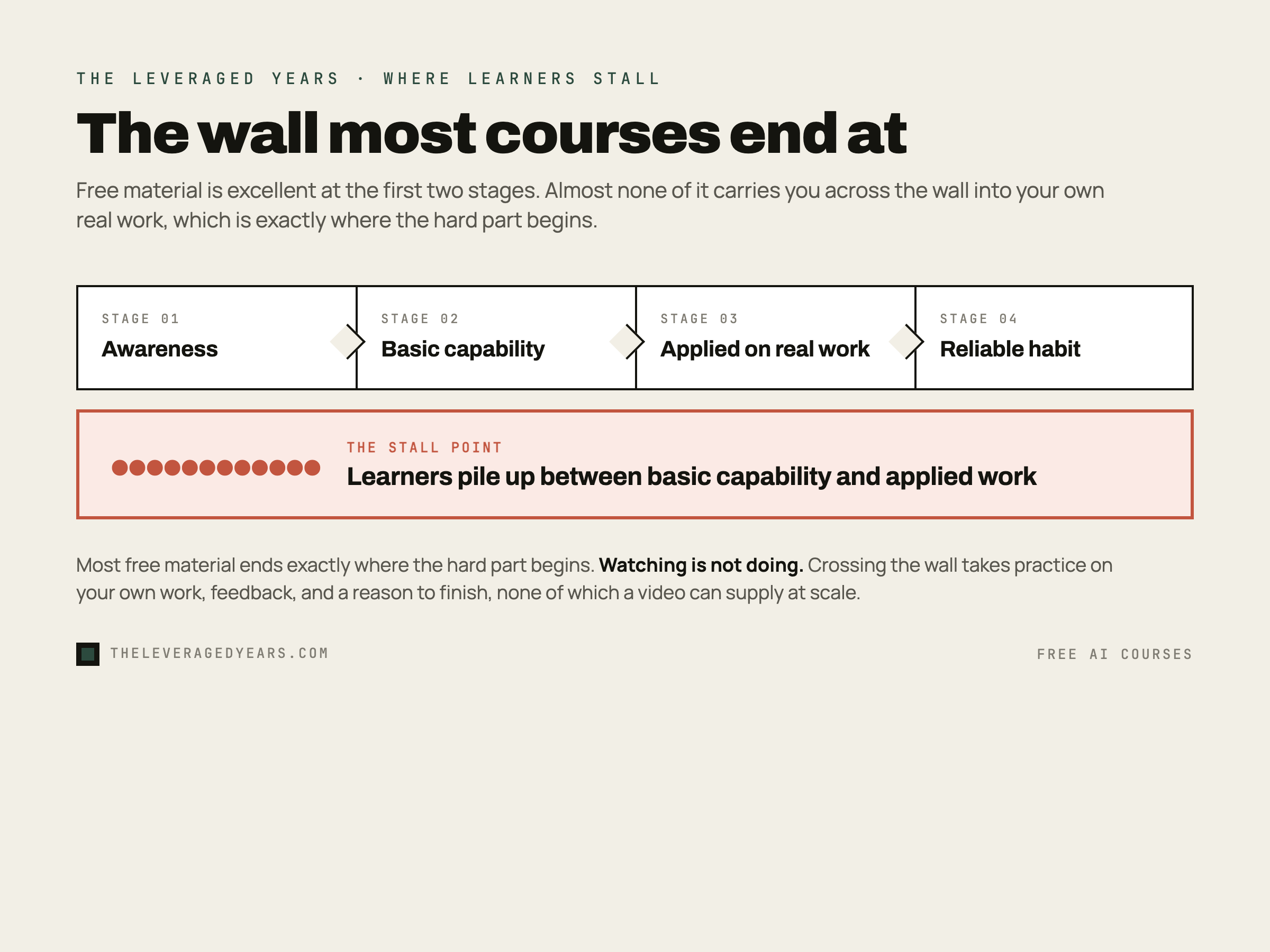
The stall is not an information problem. It is a transfer problem.
Here is the thing nobody warns you about. There is a wide canyon between understanding how something works and being able to do it under real conditions, with your own messy inputs, your own quality bar, and a deadline breathing on you. Educators call this transfer, the ability to move a skill from the clean practice environment into the chaotic real one. Transfer is where most learning quietly dies.
Think about anything you are genuinely good at. You did not get there by watching. You got there by doing the real thing, badly at first, getting feedback, and adjusting. A surgeon does not become a surgeon by finishing the anatomy lectures. A litigator is not made in the classroom. The lectures are necessary and nowhere near sufficient, and everyone in those fields knows it.
AI skill works the same way, except the culture around it pretends otherwise. The whole genre of "learn AI in a weekend" quietly implies that once you understand the concepts, the doing will take care of itself. It will not. Understanding what a good prompt looks like and writing a good prompt for your own ambiguous, high-stakes work are two completely different muscles. Most people only ever train the first one because that is the only one free courses can train at scale.
Why can't free courses train the second one? Not because they are cheap or low quality. Because the second one is expensive to teach by its nature. Applied skill requires four things that are very hard to deliver to a hundred thousand anonymous learners at once.
The four things that actually move you from stuck to fluent
When we strip away the noise, professionals who break through the stall almost always have these four ingredients. Notice that none of them is "more information."
Practice on your own real work. Not a sample dataset. Not a toy prompt about writing a poem. Your actual brief, your actual client memo, your actual financial model, with all the ambiguity and stakes intact. Concretely: instead of practicing on a tidy fictional case study, you use the actual half-formed strategy doc for your next launch, the real contract you are nervous about, the messy board memo due Thursday. The point is not a perfect output. The point is to watch how the tool handles the ambiguity of your world. The skill you need is not "use AI." It is "use AI on the specific kind of judgment-heavy thing I get paid for." A generic course cannot give you that input because it does not have your inputs. You do.
Feedback that tells you what good looks like. When you try something and it comes out mediocre, you need to know whether the problem was your prompt, your expectations, the model's limits, or the way you framed the task. Alone with a free video, you cannot tell the difference. You just feel vaguely that it is not working and you drift back to doing it the old way. Feedback collapses that confusion fast.
Accountability and a reason to finish. Free has a hidden cost: nothing happens if you stop. No one notices. The course does not care. So the moment the work gets uncomfortable (which is exactly the moment the real learning was about to start) you close the tab. This is not a character flaw. It is the predictable result of zero stakes. Ask anyone who has bookmarked a dozen online courses how many they actually finished. The gap between starting and finishing is a familiar phenomenon in every field, and AI is no exception.
Context for your actual profession. "How to use AI" is nearly useless advice. How a tax advisor uses it, how an architect uses it, how a litigator uses it, how a nonprofit director uses it, these are different skills with different failure modes and different definitions of "good enough." General courses have to stay general. Your work is specific. That gap is where most of the value lives, and it is precisely the part free material finds very hard to fill well at scale.
Look at that list again. Every single item is about doing your work, not about consuming more material. That is the whole insight. You are not stuck because you have not watched enough. You are stuck because watching was never going to get you there, and nobody told you. This is the same reason an experienced professional is better served by practical, applied training than by another round of concepts: seniors already have the judgment, they just have not yet moved it through the tool on something real.
So is the answer to pay? Not necessarily.
We want to be fair here, because it would be cheap and self-serving to conclude "and therefore buy a course." Sometimes you do not need to pay anyone.
If you have a colleague who is genuinely good with these tools and willing to look at your real work and tell you where it is going wrong, you may have everything you need for free. If your firm runs internal sessions where people bring actual deliverables and work through them together, use them, they are gold. If you are disciplined enough to set yourself a real project with a real deadline and force yourself to finish it on your own work, you can absolutely build the skill without spending a dollar. Some people do exactly this. We admire them. In fact, this self-structured path is the gold standard if you can pull it off, because nobody knows your work better than you do.
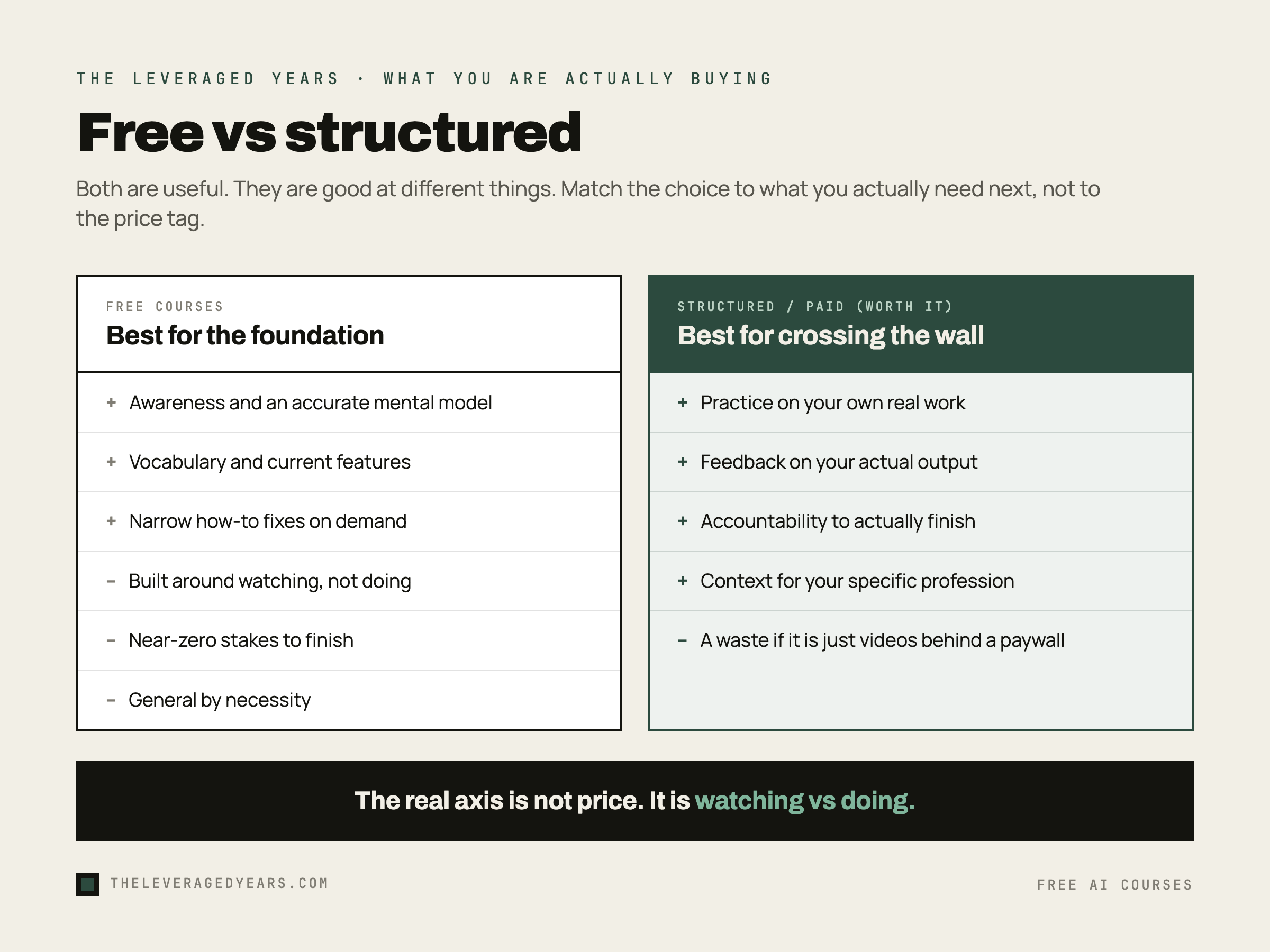
Structured or paid learning is worth it specifically when you cannot reliably assemble that gold-standard setup yourself, which describes most working professionals most of the time. You buy three things you cannot easily assemble alone: a path that uses your real work as the material, feedback on your real output, and enough structure and accountability that you actually finish. When a program delivers those, it pays for itself the first time you produce something genuinely good faster than you used to. When it does not (when it is just a slightly more polished version of the free videos behind a paywall) it is a waste, and you should walk away.
That distinction is the whole game, and it is worth being ruthless about. The question is never "free versus paid." It is "watching versus doing." A free resource that gets you doing your real work beats an expensive one that just gets you watching more. And a structured program that gets you doing your real work beats a free one that leaves you exactly where the lectures end.
How to actually use the free stuff (a sane sequence)
If you are at the start, here is the order that works, and most of it is free.
First, spend a weekend on one good university intro. Get your mental model straight. Stop when you understand what the tool is, not when you have memorized everything.
Second, go to the vendor's own free learning hub and learn the current features of whatever tool you will actually use day to day. Do not learn five tools. Learn one well. If you want a sane personal route through all of this, our roadmap on how to learn AI when you are senior and short on time lays out the order stage by stage.
Third, and this is where almost everyone fails, pick one real piece of your own work this week and do it with the tool. Not a practice exercise. The real thing. Sit with how awkward it feels. That awkwardness is the actual learning beginning, and it is the fork in the road where you have to choose: find feedback and a reason to push through, or drift back to the old way.
When that first real attempt comes out mediocre, do not read it as "AI does not work for my field." Read it as an information gap. You do not yet know whether the problem was your prompt, the model's limits, or the way you framed the task, and that ambiguity is exactly what feedback resolves. If you are on your own, try the same task three different ways and watch what changes. If you are still stuck after that, you have done something genuinely useful: you have found the precise edge of what self-teaching can solve for you.
That edge is the honest decision point. If you have a strong colleague or an internal program, lean on them hard. If you do not, that is the moment to consider structured help, because the alternative is the thing you already know happens: you drift back to the old way and the certificates gather dust. And if you are brand new to the tools and want to know what a first course should even look like, that is the narrower question we answer in the beginner's AI course guide.
If you want to skip straight to the doing, that is exactly what our entry course, the Leverage Starter, is built for. It is not more theory. It is one real working session with Claude on your own work, designed to get the tool from "I sort of understand it" to "I used it on something real before Monday." It is the deliberately small first rung, and for a lot of people it is the missing piece between everything they have watched and anything they have done. The whole course catalog is organized around that same principle: every program leaves you with one operating system you can use the next Monday, on your own work, not a sample file.
Not sure where you actually stand, or whether you even need to pay for anything yet? Take the two-minute quiz. It is designed to point you back to free resources when that is the right call for you.
The mindset shift that makes all of this click
Here is the reframe worth keeping. Stop measuring your AI progress by how much you have learned. Start measuring it by what you can now reliably do on your real work that you could not do before.
By that measure, a stack of finished free courses might be worth almost nothing, and a single afternoon spent doing one real deliverable with the tool, badly, then better, might be worth more than all of it. This is the same idea we keep coming back to in our writing on judgment over prompt tricks: the scarce thing was never the information. It was the applied judgment, and that only comes from doing your actual work.
Free courses are not the enemy. Aimless consumption is. The people who win with AI are not the ones who watched the most. They are the ones who, at some point, stopped watching and started doing their real work with the thing, and then kept going past the part where it felt uncomfortable. Free material can carry you right up to that line. Crossing it is on you, and it is worth crossing.