Build your selection system and evaluate courses for your practice
The Leveraged Attorney gives attorneys a structured process to assess AI training against the five ROI criteria and deploy what fits.
There are more "best AI courses" lists than there are good AI courses, and almost all of them are ranking by the wrong thing. They count hours of video, certificates issued, star ratings from people who finished the course but never used it on real work. None of that tells you the one thing a busy professional actually needs to know: will this change what I can do at my job, and how fast.
So this is not another ranked list of platforms. It is the buyer's guide nobody writes, because the honest version does not help anyone sell a specific product. We sell courses for a living, and we are still going to give you the criteria that apply to ours, to anybody else's, and to the free ones too. If a course cannot pass these tests, do not buy it, ours included.
The frame that matters is payback. A course is not an expense, it is an investment with a payback period, and for a working professional that period should be short. If a course cannot plausibly return its cost in saved time, better output, or one avoided mistake inside about thirty days, the price is not the problem. The design is.
First, get clear on what you are actually buying
People say "I want to learn AI" the way they say "I want to get in shape." It feels like a goal. It is not specific enough to act on, and the vagueness is exactly what lets bad courses sell to you.
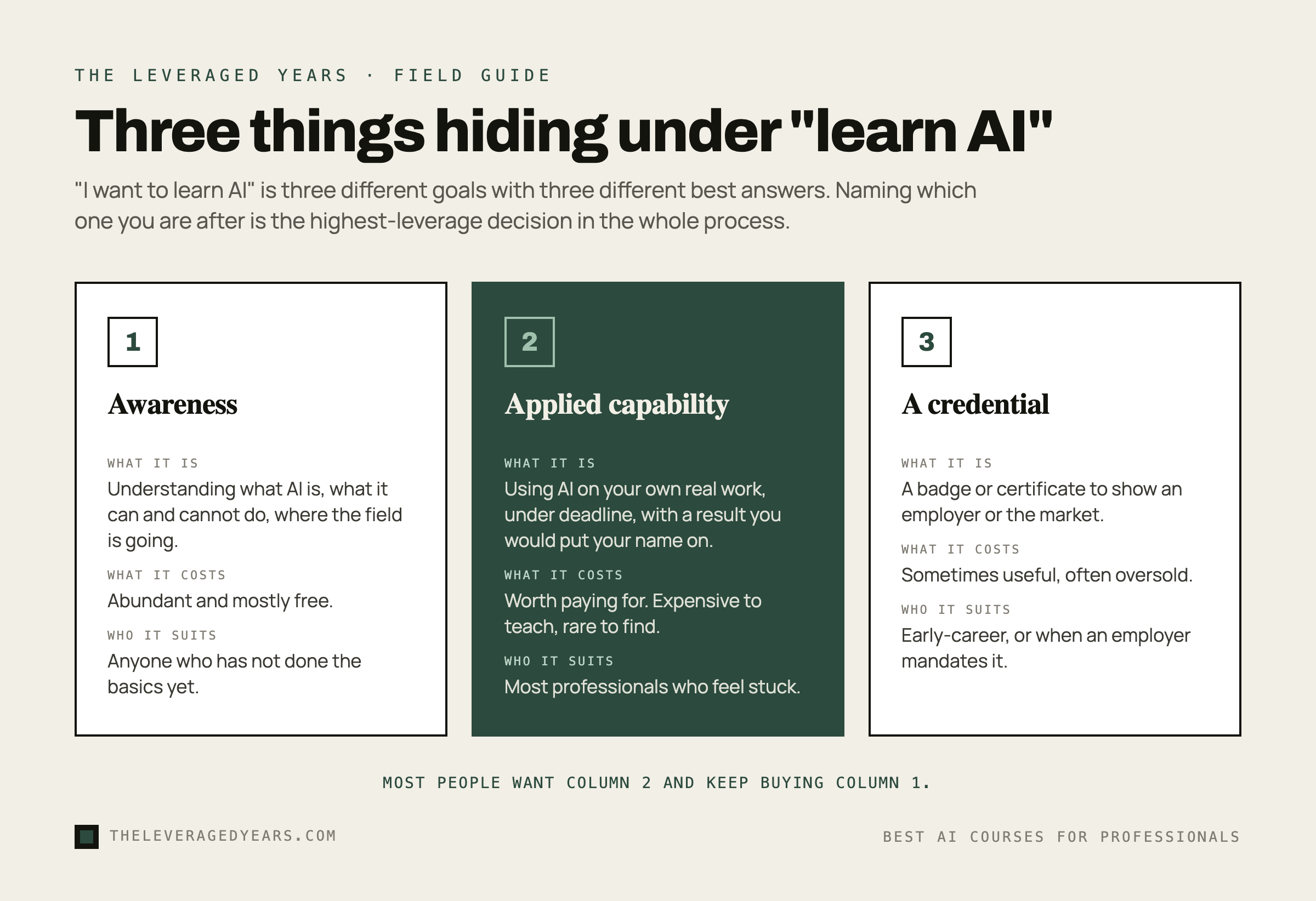
There are really three different things hiding under "learn AI," and they have completely different best answers.
The first is awareness: understanding what these systems are, what they can and cannot do, why they sometimes invent things, where the field is going. This is genuinely valuable and it is also abundant and mostly free. University intros and vendor learning hubs do this well. If awareness is what you need, do not pay much for it. Our companion piece on free AI courses covers exactly where the good free material lives and where it quietly stops being enough.
The second is applied capability: being able to use AI on your own real work, under deadline, with your own quality bar, and get a result you would actually put your name on. This is the thing most professionals actually want and almost never get from awareness material. It is also the thing worth paying for, because it is expensive to teach and rare to find.
The third is a credential: a badge or certificate to show an employer or the market. Sometimes useful, often oversold. We wrote a whole piece on when a prompt engineering certification is worth it and when it is resume-bait, so we will not repeat it here. Short version: for senior professionals the credential is usually the weakest reason to buy, and applied proof beats it every time. If you only want the prompting mechanics, compare prompt engineering courses on their own terms.
Most people who feel stuck have plenty of the first, want the second, and accidentally keep buying more of the first. Naming which one you are after is the single highest-leverage decision in this whole process. If you are new to your career, not just to AI, our guide for beginners is a better starting point.
The five criteria that actually predict ROI
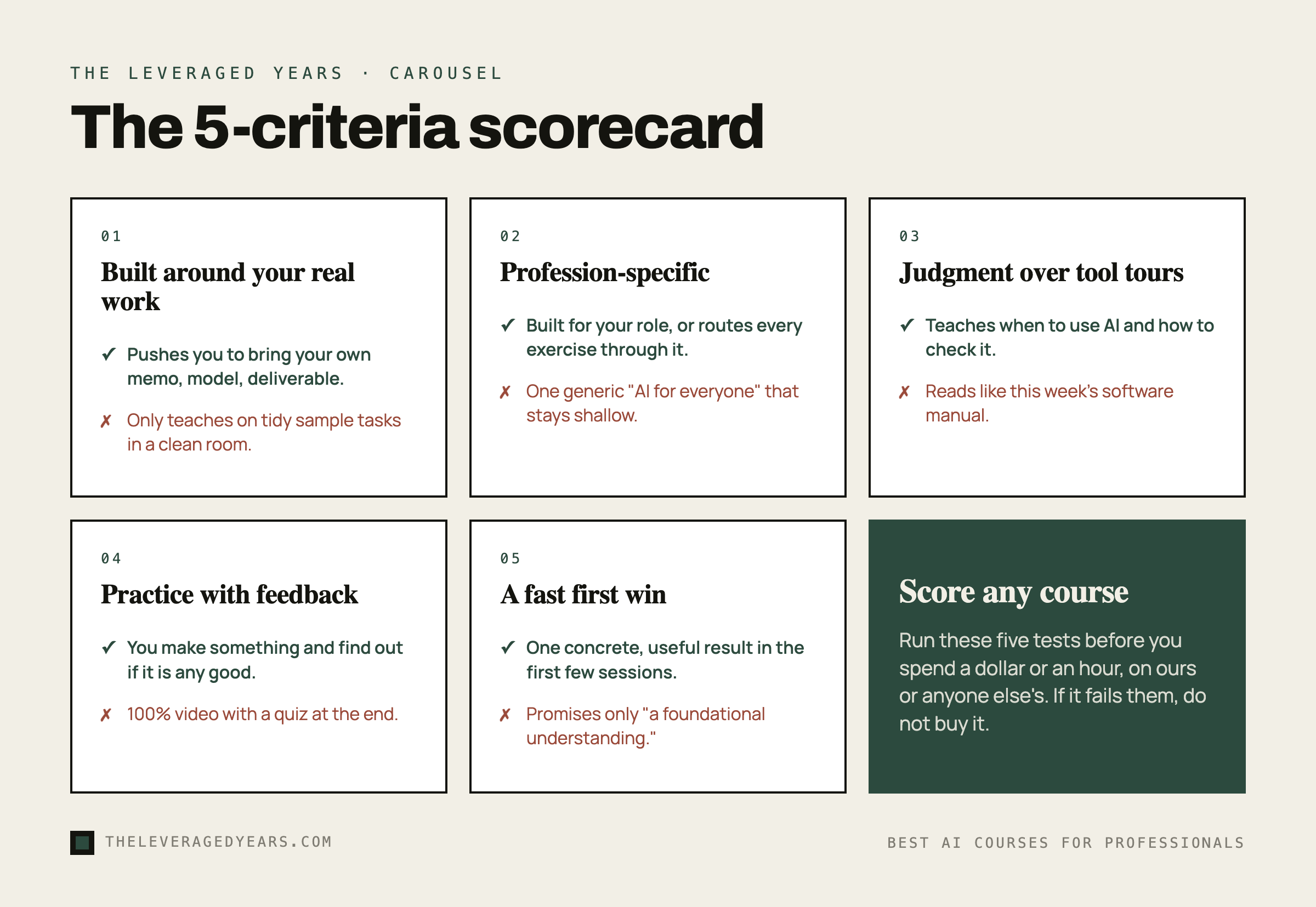
Here are the tests that separate a course that changes your work from a course that just fills your evenings. They apply to any provider. Use them as a checklist before you spend a dollar or an hour.
1. It is built around your real work, not a tidy sandbox
This is the big one, and it is where the largest share of courses fail. A course that teaches you to summarize a sample article or write a prompt about a fictional company is teaching you in a clean room. Your job does not happen in a clean room. It happens with half-formed briefs, missing context, a client who changed the spec on Friday, and a standard you cannot lower.
The skill you actually need is not "use AI." It is "use AI on the specific, judgment-heavy, ambiguous thing I get paid for." A good course knows this and pushes you to bring your own material: your real memo, your actual model, your live deliverable. If the curriculum never asks you to touch your own work, it cannot build the muscle you came for. Educators call this missing piece transfer, the ability to carry a skill from a clean example into your messy reality, and its absence is where most learning quietly dies.
2. It is profession-specific, or makes you make it specific
"AI for everyone" courses have their place at the awareness level. At the applied level, generality is a tax. An attorney, a finance lead, an HR director, and a marketer use these tools in completely different ways, with different risks, different review standards, and different definitions of a good output. A course that treats all of them the same has to stay shallow to stay general.
The best courses are either built for your profession or designed so that every exercise routes through your specific context. That is why our own catalog splits into role-based tracks rather than one giant "AI course," from the Leveraged Attorney to the Leveraged CPA and finance professional to the Leveraged HR professional. The point is not that ours is the only good one. The point is that specificity is a feature you should demand, wherever you buy.
3. It teaches judgment, not a tour of tool buttons
Tools change monthly. A course organized around "here is this week's features in this week's interface" has a shelf life of about a quarter, and you will be re-learning buttons forever. What does not go stale is judgment: knowing when to use the tool and when not to, how to spot a confident wrong answer, how to structure a problem so the model can actually help, how much to trust output before it touches a client.
When you evaluate a course, look at the table of contents. If it reads like a software manual, be wary. If it reads like "how to think about delegating this kind of work to a machine, and how to check it," that is the durable skill. Working alongside these tools well is its own discipline, which is the entire premise of our working with Claude and AI agents course, and the reason we keep models-and-tools knowledge in a separate track like practical OpenRouter rather than bolting it onto everything.
4. There is real practice with feedback, not just watching
Watching is not doing. You already know this from every skill you have ever genuinely acquired. Nobody became a litigator by finishing the lectures. The course should make you produce something, ideally repeatedly, ideally with a way to know whether it was any good. Feedback can come from a rubric, a community of peers doing the same work, an instructor, or a clear before-and-after standard you can check yourself against. What matters is that you are not the only person who ever sees your output.
A course that is one hundred percent video with a quiz at the end is an awareness product wearing an applied-course price tag. Ask, before you buy: what do I make in this course, and how do I find out if it is good.
5. It delivers a first win you can get this week
The fastest way to predict whether a course will pay off is to ask whether it can get you one concrete, useful result inside the first few sessions. Not "a foundational understanding." A result. The email triage system that saves you an hour a day. The first-draft research workflow that turns a four-hour task into forty minutes. The contract-review checklist that catches the thing you would have missed.
An early win does two things. It returns part of your investment immediately, which is the whole payback argument. And it builds the belief that keeps you going, because the real reason most courses fail their buyers is not bad content, it is that the buyer stops. A first win is the cheapest insurance against quitting.
The categories of AI courses, and who each one suits
Not every course is trying to be the same thing, and the "best" one depends entirely on which of the three goals you are chasing. Here is how the field actually breaks down, so you can match yourself to the right category instead of the loudest marketing.
Free university and vendor intros. Best for awareness. Excellent mental models, current feature knowledge, zero cost. Suits anyone who has not yet done the basics. The honest limit: they end right where applied work begins, because that part does not scale to a hundred thousand anonymous learners. Start here, do not stop here.
Broad paid platforms (the big course marketplaces). Best for a structured, low-cost tour of a topic. Suits self-directed learners who want more than YouTube and a certificate for their profile. The risk is variance: quality swings wildly by instructor, and many are awareness products at applied prices. Use the five criteria ruthlessly before buying one.
Technical and data-science specializations. Best for people who will actually build, fine-tune, or engineer with these models. Deep, rigorous, often university-backed. Suits engineers and analysts. Overkill, and frankly a poor use of time, for a professional who needs to use AI in their work rather than build it.
Role-based applied programs. Best for working professionals who want to change their actual output, not their resume. Built around your profession and your real work, with practice and feedback. Suits the busy senior who can name exactly what they get paid to do. This is the category most likely to clear the thirty-day payback bar, and it is the category we build in, so weigh that as you read. You can browse all of our courses to see the role-based structure in practice, or skip the browsing entirely and take the two-minute course finder quiz to get matched to the one that fits your work.
Certification-first programs. Best when a specific badge maps to a specific requirement, usually an employer mandate or a tool your company standardized on. Suits early-career professionals and anyone whose employer is paying. For senior independents, usually the weakest value, as our certification guide lays out.
To be straight about where we fit: our catalog sits squarely in the role-based applied category. If what you actually need is the deep technical track, the ability to build, fine-tune, or engineer with these models yourself, a rigorous university or engineering program is a better use of your money than anything we sell, and you should buy that instead.
The mistake is not picking the wrong category. The mistake is not realizing there are categories, and buying the most marketed thing in the wrong one.
AI course categories at a glance
Most buying mistakes come from not seeing the categories. Here is how the main types of AI course compare, and who each one actually suits.
| Category | Best for | Typical price | What to watch for |
|---|---|---|---|
| Broad platform courses general AI literacy | A first mental map of what AI can do | Free to $60/mo | Broad and generic. Little of it transfers to your specific role. |
| Technical, build-focused courses | People who will write code or ship models | $0 to $500 | Overkill if you only want AI on your daily work. |
| Tool-specific courses ChatGPT, Claude prompting | Getting fluent with one assistant fast | $0 to $200 | Tactics age quickly as the tools change. |
| Cohort courses and live bootcamps | Accountability and a fixed schedule | $500 to $2,000+ | Priced and paced for the group, not a senior calendar. |
| Profession-specific workflow programs the category we teach | Senior professionals who want AI on their own files | $195 to $1,495 | You have to bring your real work and adjust as you go. |
Bottom line: the best AI course is not the most marketed one. It is the one whose category matches how you actually work, at a price a single saved afternoon would cover. For most senior professionals, that means a program built around your own files, not a general survey.
The honest 30-day payback test
Before you commit, run the numbers the way you would for any investment. This is rough math, and rough is enough.
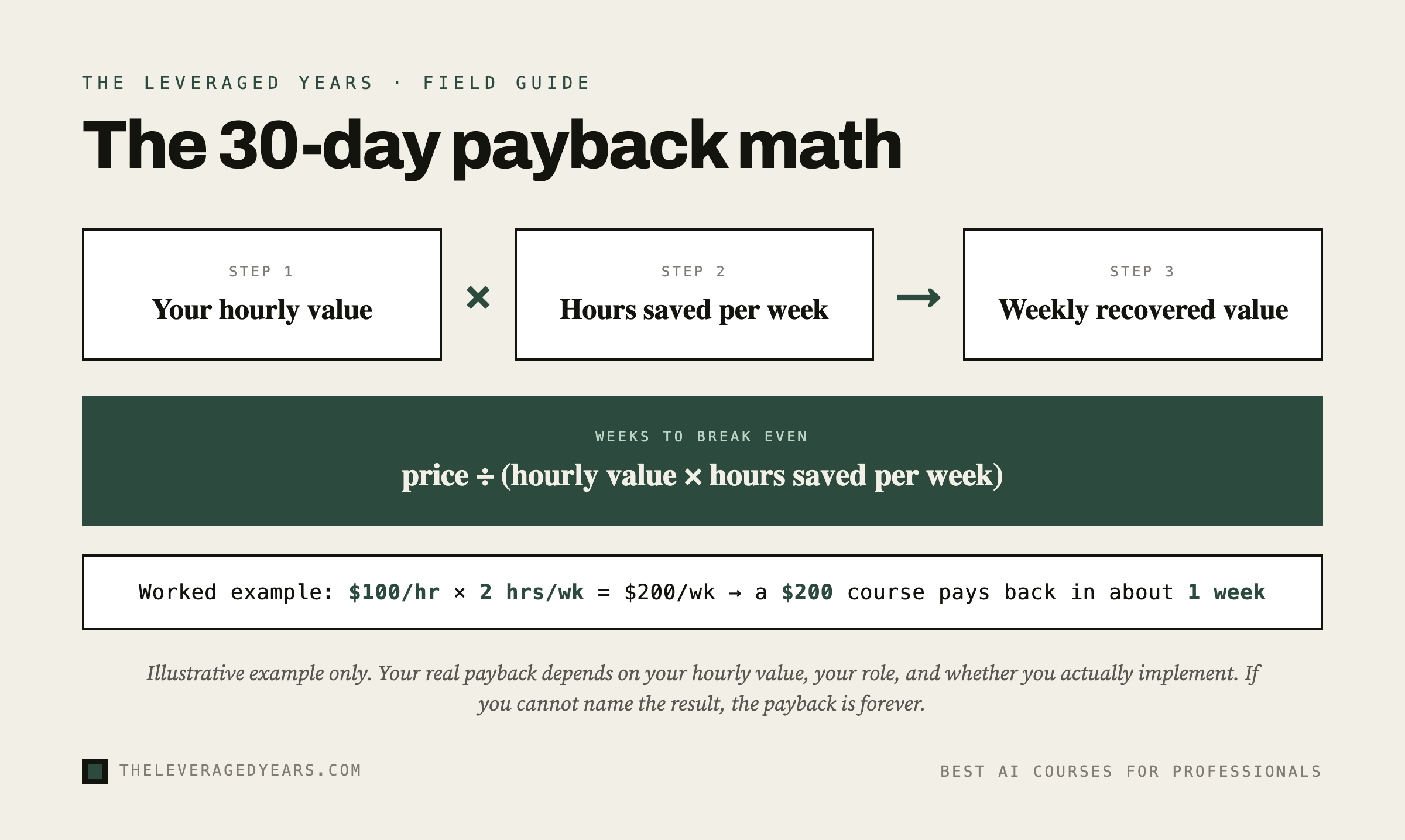
First, price your hour. Take what your time is worth, whether that is a billing rate, a salary divided by working hours, or what a comparable contractor charges. Call it your hourly value.
Second, estimate the time the course should give back. As an illustrative example, imagine an applied course that lands one solid workflow saves you a few hours a week once that workflow is in place. These are not measured results or anything we can promise you, the real number will vary a lot by role and by whether you implement, so be conservative and call it two for the sake of the math.
Third, do the division. To work a single example: if your hour is worth a hundred dollars and the course saves you two hours a week, that is two hundred dollars a week in recovered time, and a course priced in the low hundreds would clear its cost before the end of the first month. Those numbers are illustrative, not a quote on any specific course. Plug in your own. If your hour is worth more, the payback comes faster, which is precisely why senior professionals should be less price-sensitive about good applied courses, not more.
Now the catch that makes or breaks the math: the savings only exist if you actually implement. A course that you finish but never apply has a payback period of forever, regardless of price. This is why the criteria above matter so much. The "fast first win" and "your real work" tests are not nice-to-haves. They are the difference between a real payback and a sunk cost.
So the test, in one question: can I name the specific result this course will help me produce in the next thirty days, and is that result worth more than the price? If you can answer yes with a straight face, buy it. If you cannot, no price is low enough, because zero hours saved times any rate is zero.
A quick word on the things that do not predict ROI
You should also recognize the signals people over-weight, because the marketing leans on all of them.
Total hours of content is a cost, not a benefit. A forty-hour course is not better than a six-hour one, it is a bigger time bill. Star ratings mostly measure whether people enjoyed watching, not whether their work changed. A famous brand on the certificate buys you recognition, not capability, and the two are easy to confuse. And "lifetime access" is only valuable if you would ever go back, which most people do not.
None of these are disqualifying. They are just not the point. Hold them lightly and keep your attention on the five criteria and the payback question.
The bottom line: stop asking which AI course is best and start asking which one pays for itself in your work, in your profession, inside a month. Run the five criteria, do the math, and demand that any course, ours or anyone else's, earns its price in results you can name. When you are ready to apply that test to a specific track, the course finder quiz matches you to one in about two minutes, or you can read through our courses and judge each against the criteria yourself.