Turn this briefing into a structured learning system you can follow
The Leverage Starter gives experienced professionals new to AI a step-by-step process for building consistent capability without derailing your practice.
Let us name the quiet worry first, because it is stopping more careers than any skills gap. You are twenty years into a good career. You are competent, respected, paid for your judgment. And there is a low hum of anxiety that you have somehow missed the boat on AI, that the people who get it are all twenty-six and fluent in things you have never heard of, and that starting now means admitting you are behind.
You are not behind. You are reading this in the window where almost everyone is still figuring it out. The version of AI that matters for your work, using these tools to do your actual job better, has only existed in its current, broadly usable form since late 2022. Nobody has a decade of mastery with these specific tools. The people who look fluent mostly just started a few months earlier than you and kept going. That is the whole secret, and it is good news, because catching up is a matter of sequence and a few hours a week, not raw talent or a computer science degree.
This is a roadmap for an experienced professional who wants to genuinely learn AI without quitting their job to do it. Where to actually start, the order to do things in, how much time it realistically takes, how to learn by aiming it at the work already on your desk, and how to tell whether you are making progress or just busy. No coding required, and no pretending you have unlimited evenings.
A quick note on scope so you read the right thing. This piece is the personal path: your roadmap from here. If you want the underlying method, how to practice deliberately so any of this actually sticks, read our companion on the best way to learn AI. If you just want the everyday-usage primer, what to type and what to never trust it with, start with how to use AI at work. And if you are evaluating an actual course and want to know what good training should cover, that is a different question answered in what a generative AI course should teach. This one assumes you have decided to get good and want to know the route.
First, Decide What "Learn AI" Actually Means for You
The phrase "learn AI" is doing a lot of damage. It makes people picture neural networks, Python, and linear algebra, then conclude the door is closed. For the overwhelming majority of professionals, that is the wrong definition entirely.
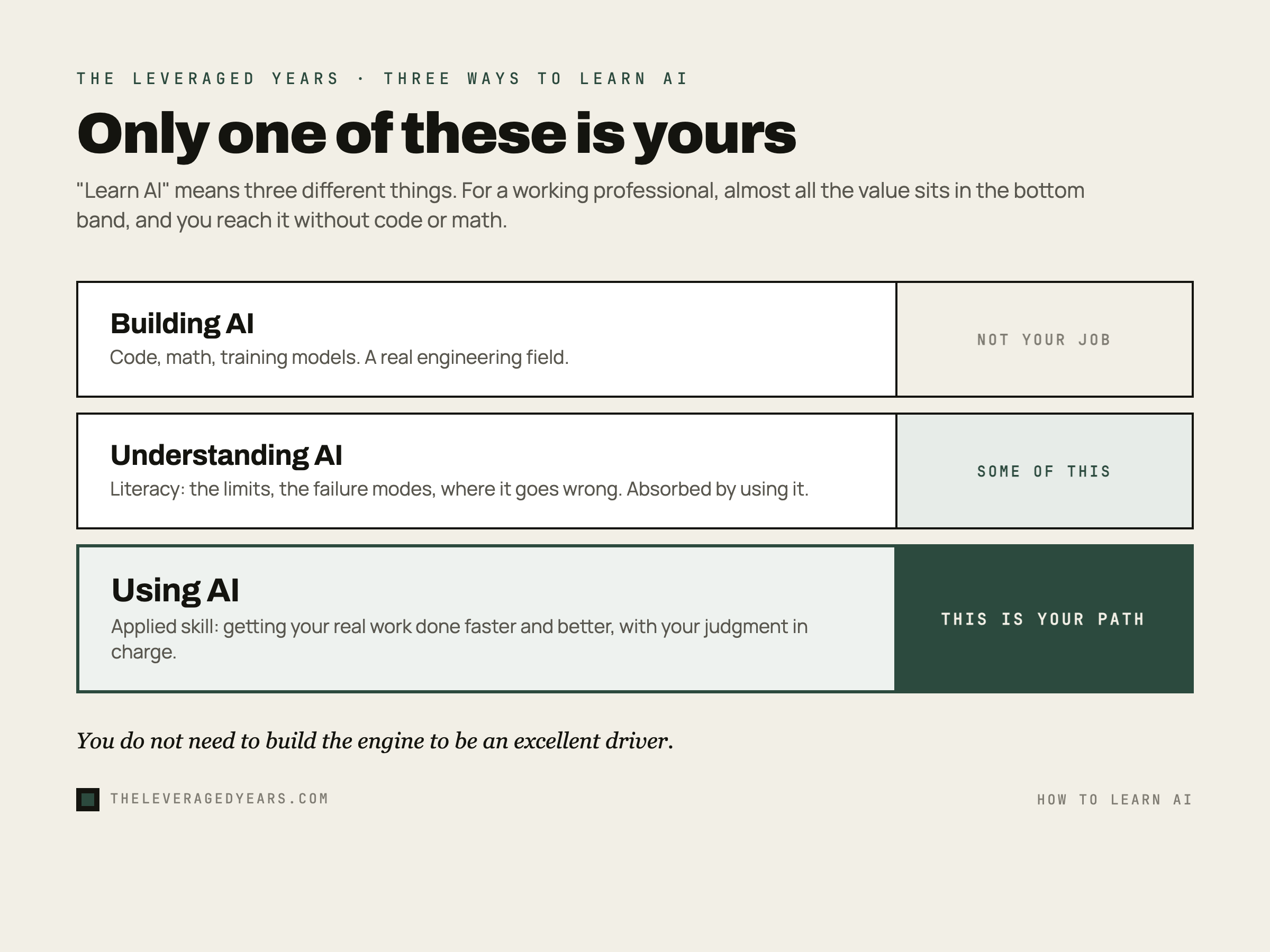
There are roughly three different things people mean by learning AI, and only one of them is yours.
Building AI is the engineering work: training models, writing code, the math. That is a real and demanding field, and unless you are changing careers into machine learning, it is not your job and never will be. You can ignore it completely. You do not need to know how an engine is machined to be an excellent driver.
Understanding AI is the literacy layer: a working sense of what these tools are, what they can and cannot do, where they fail, and why. You do need some of this, but far less than you fear, and you absorb most of it by using the tools rather than by studying them.
Using AI is applied skill: getting real work done faster and better by handing the right tasks to these tools and keeping your judgment in charge. This is the one that changes your week, your output, and your standing. This is what "learn AI" should mean for you, and the entire rest of this roadmap is about it.
So before you do anything else, drop the engineering definition. You are not learning to build the tool. You are learning to be the person who gets the most out of it. That reframe alone removes about ninety percent of the intimidation.
Where to Actually Start: One Tool, One Real Task
The most common mistake is starting with study. People bookmark a famous course, watch three hours of lectures on how transformers work, feel responsible, and change nothing about their actual day. A month later they have notes and no skill, because using AI is a doing skill, like writing or negotiation, not a knowing skill you can read your way into.
So start with doing, narrowly.
Pick one general assistant and stay there for now. A current frontier chat assistant, the kind you talk to in plain language, is the right starting point for nearly everyone, regardless of field. Pick one, any of the current frontier assistants is more than capable enough as a starting point, and resist the urge to keep switching. Familiarity with one tool beats shallow tourism across five. If you want to understand how the leading options differ before committing, our breakdown of Claude versus ChatGPT for business lays out where each fits.
Pick one real task you already do every week. Not a toy. Something on your actual plate: the status update you dread writing, the long thread you have to summarize, the first draft of a recurring report, the prep for a recurring meeting. The task should be real enough that doing it better is worth something to you today.
Do that one task with the tool, this week, for real. Give it the context a competent colleague would need, let it take a first pass, and edit the result back into your own voice and standards. The editing is not a failure of the tool. The editing is where your expertise lives, and it is exactly the part a beginner cannot do and you can. The tool might draft a status update that says "we have made significant progress this quarter." Your edit turns that into "we landed the design partner and finished the mocks, but legal review is now the long pole and will slip the launch two weeks." That edit, separating signal from noise, is your entire value, and no beginner can fake it.
That is the entire starting move. One tool, one task, real stakes. You will learn more in three actual uses than in three hours of watching someone else use it. The goal of week one is not mastery. It is to break the spell that this is for other people.
The Right Sequence: A Four-Stage Path
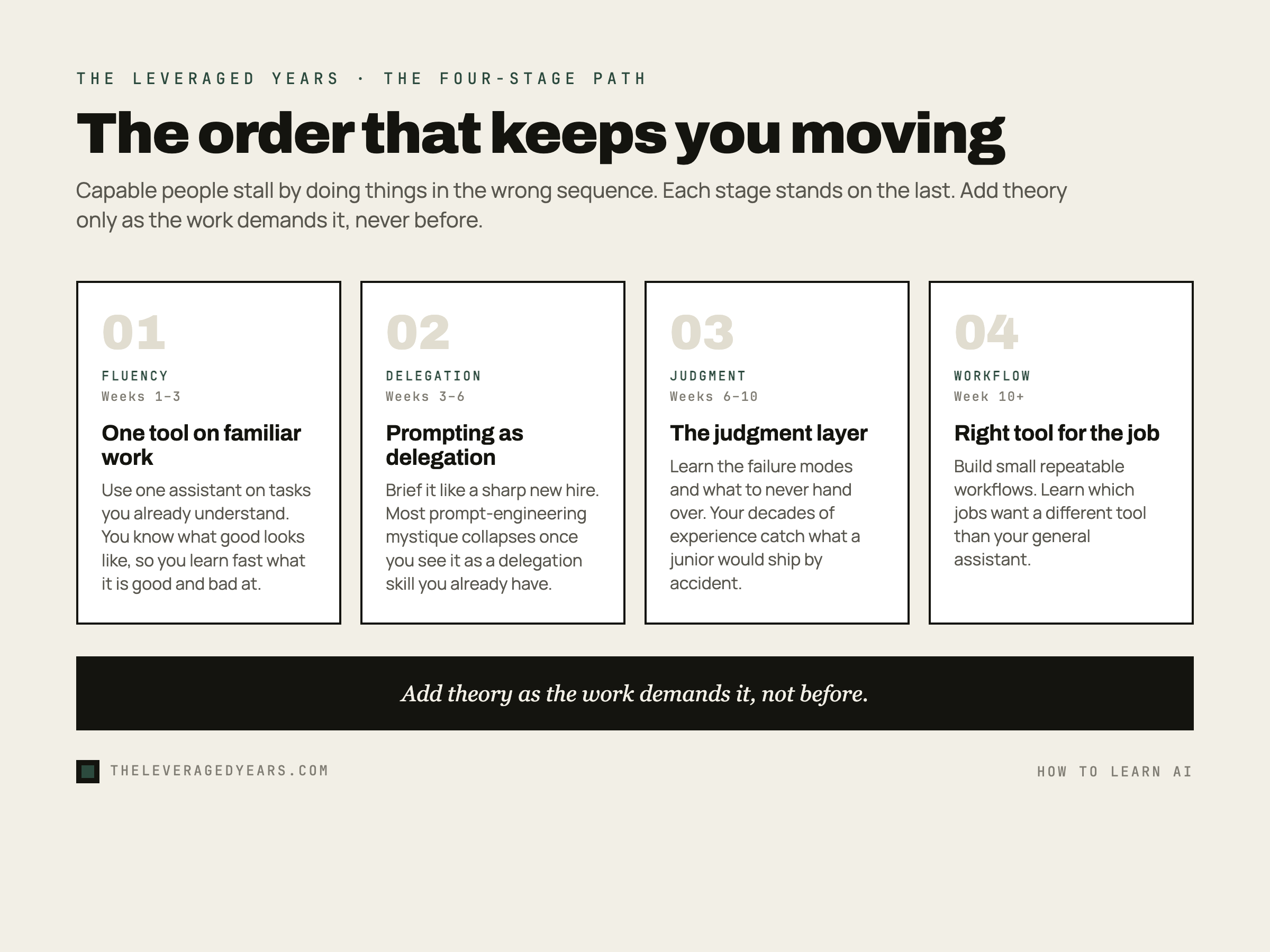
Once you have done one task, the question becomes order. Doing things in the wrong sequence is why capable people stall. Here is a path that builds in the right direction, each stage standing on the last.
Stage one: fluency with one tool on familiar work (weeks one to three)
Use your one assistant on tasks you already understand deeply. Drafting, summarizing, reformatting, turning rough notes into clean prose. Because you know what good looks like in these tasks, you can instantly judge the output, which teaches you fast what the tool is good and bad at. Do not add anything new yet. The goal is for opening the chat box to stop feeling like an event and start feeling like reaching for a calculator.
Stage two: prompting as delegation (weeks three to six)
Now get deliberate about how you ask. The good news, again: this is not a technical skill, it is a delegation skill. The core move is to brief the AI the way you would brief a sharp new hire, and most of the "prompt engineering" mystique collapses once you see it that way, because you already know how to delegate. The full case for treating this as delegation rather than syntax is in judgment over prompt engineering, and it is worth reading once your hands are warm. For the roadmap, the point is just that this is the stage where you get deliberate, not the stage where you memorize tricks.
Stage three: the judgment layer (weeks six to ten)
This is the stage that separates professionals from dabblers, and it is the stage that is actually yours to win. Here you learn the tool's failure modes and what should never be handed to it, the specifics of which we cover in the everyday usage primer, how to use AI at work. What matters for the roadmap is that your two decades of experience are not obsolete here. They are the thing that lets you catch what a junior person would ship by accident. The tool can produce a confident, well-written market forecast, and you are the one who knows it is built on pre-regulation data and silently ignores the compliance change that reshapes the whole picture. The tool produces; you decide. That division of labor is the whole game.
Stage four: workflows and the right tool for the job (week ten onward)
Only now, once the assistant is second nature and your judgment is engaged, is it worth expanding. Build repeatable little workflows for tasks you do constantly. Learn which jobs want a different tool than your general assistant. This is also the natural point to get a working understanding of the wider toolkit rather than chasing every shiny launch. For the efficient way to do that without drowning, see our piece on learning AI tools efficiently as a professional.
Notice what is not in stage one. Theory. You add understanding as you go, in the order the work demands it, which is the order it actually sticks.
The four-stage path, at a glance
You do not need to learn everything at once. Learning AI runs in four stages, each building on the last. Here is what each stage looks like and roughly how long it takes.
| Stage | What you do | What you can do after | Time to get there |
|---|---|---|---|
| Stage 1 Get oriented | Use one AI tool on one small real task, every day | Hold a useful working session without help | A few days |
| Stage 2 Build a loop | Run the same kind of task again, adjusting one thing each time | Trust the output enough to use it on live work | A week or two |
| Stage 3 Systematize | Turn your best prompts into a saved, repeatable workflow | Hand off the routine parts and keep the judgment | A few weeks |
| Stage 4 Compound | Point the same loop at a second and third task | AI on most of your recurring work, not just one task | Ongoing |
Bottom line: you do not finish learning AI. You reach the point where a new task is just another loop you already know how to run. Aim for that, not for a certificate.
A Realistic Weekly Time Budget
Here is where most plans quietly die. Someone tells a busy executive to spend an hour a day learning AI, the executive looks at their calendar, laughs, and does nothing. The hour-a-day advice is built for people with empty schedules, and you do not have one.
The honest number is smaller than you think, on one condition: the time has to be spent on real work, not separate "study." That is the trick that makes this fit a senior life. You are not adding a learning hour to your day. You are doing work you already had to do, with the tool, slightly slower at first.
A budget that actually works for a busy professional:
- Three to five hours in the first two weeks, front-loaded, to get over the initial awkwardness. This is the only part that feels like extra. After this it stops being extra.
- Then thirty to sixty minutes a week of deliberate use, meaning you consciously hand a real task to the tool and pay attention to what worked, rather than reverting to the old way under deadline pressure. The deliberate part matters more than the minutes.
- One slightly harder task a week. Pick something just past your current comfort with the tool. This is what keeps you improving instead of plateauing at "I use it for emails."
Over a quarter that lands at roughly twelve to twenty hours, most of it disguised as work you were doing anyway. That is enough to move from intimidated to genuinely capable. It is not enough to become a specialist, and you do not need to be one. The professionals pulling ahead are not the ones who studied the most. They are the ones who kept their hands on the tool, consistently, on real stakes.
The enemy is not lack of time. It is the deadline-day reversion, where you fall back to the slow familiar way because you are under pressure and the old way feels safe. Protecting that thirty to sixty minutes from your own panic is the actual discipline.
Learn by Aiming It at the Job You Already Have
The fastest learning does not come from generic exercises. It comes from pointing the tool at the specific texture of your own work, because your domain expertise is the multiplier nobody else has.
A general beginner asking an AI to "summarize this report" gets a generic summary. You, asking it to summarize the same report but flag the three assumptions a skeptical board member would attack, get something useful, because you know what a skeptical board member attacks. The tool supplies speed and tireless drafting. You supply the question worth asking. That combination is far more powerful than either half alone, and it is precisely why an experienced professional learns applied AI faster than a fresh graduate, not slower.
So make your real work the curriculum. If you live in long documents, get fluent at compression and interrogation. If you live in writing, get fluent at first drafts and rewriting in your voice. If you live in analysis, get fluent at pressure-testing your own reasoning by having the tool argue the other side. Each of these is a normal Tuesday task done with a new instrument, and each rep teaches you something a course never could, because the stakes and the standards are yours.
This is also the honest reason field-specific training tends to beat generic "intro to AI" content for people like you. The judgment that makes AI valuable is domain judgment, and it is learned in domain. That is exactly why we build practical, applied training around your own real work rather than the beginner-tutorial fare aimed at students.
If you would rather not piece this path together yourself between meetings, choosing which tasks, in which order, with honest feedback on where your judgment still needs sharpening, that is exactly the gap The Leverage Starter is built to close. It takes the same four-stage sequence you have just read, fluency, then delegation, then judgment, then workflow, and walks it with you using realistic senior-level work, so the hours you spend compound instead of scattering. If you want something tuned to your specific field, you can browse the full course catalog. And if you are not sure where you sit on the curve, the two-minute quiz will point you to a sensible starting place.
How to Tell You're Making Progress
Because there is no exam, it is easy to feel like you are flailing even while you improve, or to feel productive while learning nothing. A few honest signals tell you which is happening.
Time-to-first-draft drops. The work you used to stare at for thirty minutes before writing a word now has a usable draft in five, which you then sharpen. That gap is the most concrete measure of progress there is.
You catch more of what the tool gets wrong. Early on you either trust everything or distrust everything. Real progress looks like calibrated skepticism: you can tell which parts of an output to lean on and which to verify, quickly, without thinking hard about it. That is the judgment layer maturing.
You stop reaching for prompt tricks and start just briefing it clearly. When the back and forth feels like delegating to a colleague rather than operating a machine, you have internalized the actual skill.
You reach for it without deciding to. The real milestone is not a clever output. It is the day you hit a task and the tool is simply where your hand goes, the way you reach for a search engine without deliberating. Once it is reflex on the right tasks, you have learned AI in the only sense that matters for your work.
Your output still sounds like you. A subtle but crucial one. If your writing has started sounding generic and over-polished, you are leaning on the tool too hard and editing too little. Progress is the tool making you faster while your voice and standards stay unmistakably yours.
If you can see three of those five moving, you are on track. None of them require a certificate, and all of them show up in your actual work, which is the only place the learning was ever supposed to land.