Turn your real work into your AI learning lab
The Leverage Starter gives experienced professionals new to AI a structured process for building skill through deliberate practice on actual work.
Ask ten people the best way to learn AI and nine of them will name a thing to consume. A course. A certification track. A famous lecture series. A creator's playlist. The tenth will say "just play with it," which is closer but still not an answer. Everyone is naming the material. Almost nobody is naming the method.
Here is the uncomfortable part, and we will say it plainly even though we sell courses for a living: the material is rarely the bottleneck. You can already access more high-quality AI instruction than a person could finish in a year, much of it free. If consuming material were the answer, the problem would already be solved. It is not. Six months and a stack of certificates later, many professionals open a blank chat window facing a real deliverable and feel exactly as unsure as they did on day one.
The reason is that learning AI is not an information problem. It is a skill problem. And skills are not downloaded. They are built, the same boring way every other skill you have was built: by doing the real thing, badly at first, getting a signal about what went wrong, and adjusting. The best way to learn AI is to run that loop on purpose, on your own work, until it becomes a habit. That loop is a system. This briefing is about how to build it.
Why "watch a course and you'll know AI" quietly fails
Think about anything you are genuinely good at. You did not get there by watching. A litigator is not made only in the lecture hall. A surgeon does not become a surgeon by finishing the anatomy videos. The instruction was necessary and nowhere near sufficient, and everyone in those fields knows it. The lectures gave them a map. The skill came from the territory.
AI is no different, but the culture around it pretends otherwise. The whole "learn AI in a weekend" genre quietly implies that once you understand the concepts, the doing takes care of itself. It does not. Understanding what a good prompt looks like and writing a good prompt for your own ambiguous, high-stakes work are two completely different muscles, and a course can only train the first one at scale. The second one only gets trained by you, on your inputs, against your standards.
Educators have a name for the place this breaks: transfer. It is the ability to move a skill out of the clean practice environment and into the messy real one, with your own half-formed brief, your own quality bar, and a deadline breathing on you. For skills learned through passive consumption, transfer is where the value quietly dies. Passive course consumption is almost perfectly designed to avoid it, because the entire experience happens inside someone else's tidy examples. You finish feeling smarter and perform exactly the same, which is the most demoralizing outcome of all because it looks like effort and produces nothing.
So the failure is not laziness and not low-quality content. It is a structural mismatch. You are using a consumption tool to solve a practice problem.
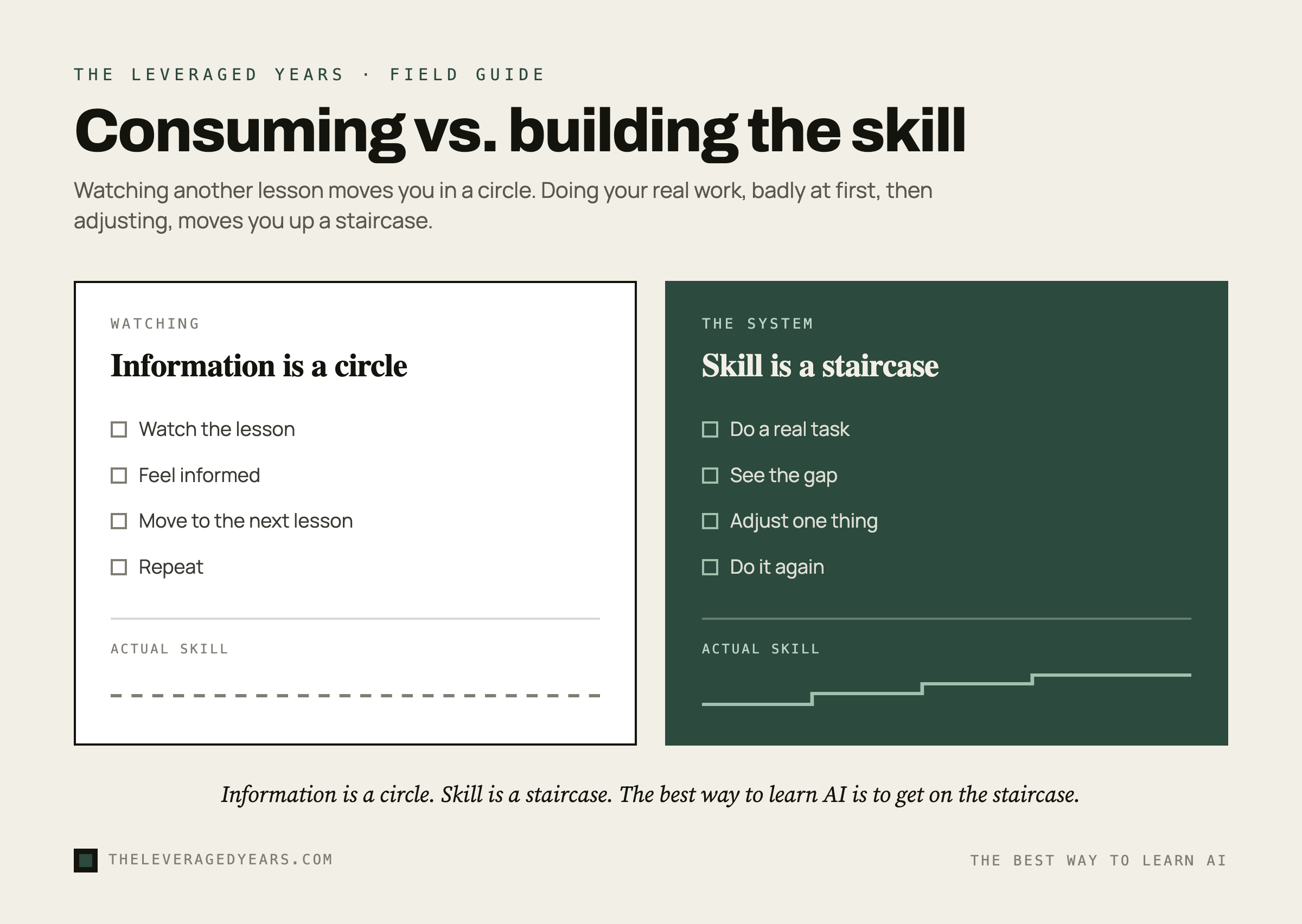
The system: four moving parts, run as a loop
When you watch professionals actually break through, not feel like they are learning but produce visibly better work faster, the same machinery is running underneath. None of the four parts is "more information." Each one is a thing you do.
1. Pick real work, not toy exercises. Do not practice on a sample dataset or a fake prompt about writing a poem. Use the actual brief, the real client memo, the messy board deck due Thursday, the contract you are quietly nervous about. The skill you are building is not "use AI." It is "use AI on the specific judgment-heavy thing I get paid to do," and that skill only develops against your real inputs, because only your inputs carry the ambiguity, the stakes, and the standards that make the task hard. Toy exercises strip all of that out, which is exactly why they feel easy and transfer nothing.
2. Run a short loop, not a long study session. The unit of learning is not an afternoon of lessons. It is one attempt: give the model a real task, look hard at what came back, and decide what to change. Then do it again. The shorter the gap between attempt and adjustment, the faster you learn, the same reason a pianist drills a four-bar phrase instead of replaying the whole sonata. Most people lose the AI skill in the lag. They do a long course, then weeks later try something real, and by then the lesson and the attempt are too far apart to connect. Close the loop. Try a real thing today, react to the result today.
3. Get a signal about what good looks like. When an output comes back mediocre, you need to know why. Was it your prompt, your expectations, the model's actual limit, or the way you framed the task? Alone with a video you cannot tell, so you conclude vaguely that "it does not really work for my kind of thing" and drift back to the old way. The signal is what collapses that confusion. Sometimes the signal is a colleague who is genuinely good with these tools looking at your real output. Sometimes it is a rubric or a known-good example you compare against. Sometimes it is just you, comparing this week's draft to last week's and naming what improved. When you are working alone, the simplest signal is a blunt two-part test: did the output cut your time roughly in half, and would you send it on with only light edits? If either answer is no, the prompt is what changes next. The source matters less than the discipline of always closing the loop with a verdict instead of a shrug.
4. Make it a standing habit, not a sprint. The professionals who pull ahead are not the ones who studied hardest for a month. They are the ones who quietly route one real task through AI every single day and pay attention to the result. Small daily reps beat a heroic burst, because the field keeps moving and a one-time course goes stale while a habit updates itself. This is the part no certificate gives you and the part that compounds.
Read those four back. Every one is about doing your work, not consuming more material. That is the entire insight. You are not stuck because you have not watched enough. You are stuck because watching was never going to get you there, and nobody framed the alternative as a system you could actually run.
If you want the concrete, week-by-week version of this, with what to do first and how to sequence it, our companion piece how to learn AI lays out the personal roadmap. Think of that one as the route and this one as the engine. This briefing explains why the loop works; that one tells you which turns to take.
How to actually start the loop this week (no coding required)
A fair question keeps surfacing in the searches around this topic: can you do this without coding, and where do you even begin? Yes, you can. For most knowledge professionals, the overwhelming value of AI today comes from working in plain language with general-purpose assistants, not from writing machine learning code. Here is the smallest version of the system that still works.
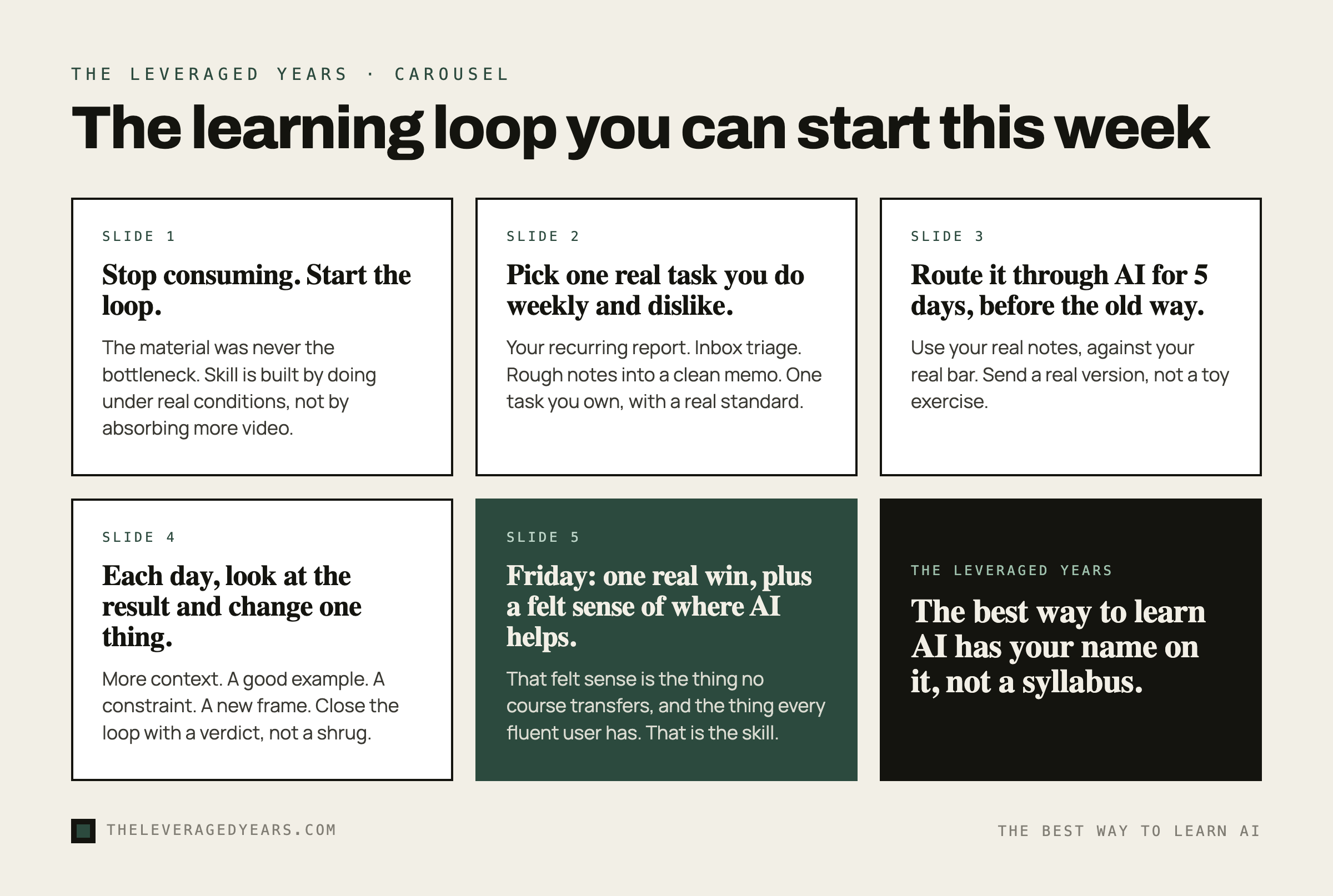
Pick one task you do every week and genuinely dislike. The first draft of a recurring report. Triaging your inbox. Turning rough notes into a clean memo. Summarizing a long document so you can decide what to do with it. One task, one you own, one with a real standard you can judge against.
For five days, route that task through an AI assistant before you do it the old way. If it is a weekly status update, your day-one prompt might be something like: "Help me draft my weekly update to my manager. Here are my rough notes: [paste]. Turn this into a concise, professional email in my voice, under 300 words, with three key wins and one or two open risks." Send a real version, with your real notes, against your real standard.
The first attempt will probably underwhelm you. Good. That is the signal. Do not stop at "this is bad." Ask three questions: is anything in it factually wrong, does the structure actually serve my point, and would I be comfortable putting my name on this as is. Then change one thing on the next attempt:
- Give more context: "Here is the brief this memo has to answer."
- Show a good example: "Match the tone of this report I wrote last quarter."
- Add a constraint: "No corporate jargon, no hedging."
- Change the frame: "Act as a skeptical editor, not a helpful assistant."
Each day, react to yesterday's result. By Friday you will not have "learned AI" in the brochure sense. You will have something better: a real, working example of the tool doing your actual job, plus a felt sense of where it helps and where it does not. That felt sense is the thing no course transfers and the thing every fluent user has.
Notice what this is not. It is not a curriculum. It is not comprehensive. It deliberately ignores ninety percent of what AI can do so you can get one real win. That is the point. One real win on your own work teaches more transfer than ten hours of polished video, because it happened in the territory instead of on the map.
A related skill quietly does most of the heavy lifting here, and it is worth naming. The hard part of this loop is rarely typing the prompt. It is judging the output: deciding whether what came back is actually good enough, knowing what to keep and what to throw away, sensing when the model is confidently wrong. We have argued elsewhere that this is the real durable skill of the AI era, more than prompt phrasing, in judgment is the skill, not prompt engineering. The loop above is, underneath, a way to train your judgment. Every time you look at an output and render a verdict, that muscle gets stronger.
Where a course actually helps
A good course is not a replacement for this system. It is a structured, accelerated way to run it. So be precise about what you are actually buying when you pay, because it is not information. Information is free and abundant. What a worthwhile program sells you is the three things the system needs and that are genuinely hard to assemble alone: real work as the material instead of toy exercises, a signal on your actual output instead of guessing in the dark, and enough structure and accountability that you finish instead of drifting off the moment it gets uncomfortable. When a course delivers those three, it pays for itself the first time you produce something genuinely good faster than you used to. When it does not, when it is just slightly more polished videos behind a paywall, it is a waste and you should walk away.
A word on price, because people get stuck here: the real axis was never free versus paid, it is watching versus doing. A free resource that gets you doing your real work beats an expensive one that just gets you watching more. We unpack that whole question, including when free is genuinely enough, in free AI courses versus structured learning. The point for this piece is simpler. If you can reliably assemble real-work practice, a feedback signal, and the discipline to finish on your own, you may not need to pay anyone, and we mean that.
Most working professionals cannot reliably assemble all three alone, not because they lack the ability but because they lack the time and the structure, and the loop quietly dies the week a real deadline hits. That is the specific gap a starter course is built to close. Ours, The Leverage Starter, is designed around this exact system rather than around dumping information on you. It puts your real work at the center: one of the first things you do is bring an actual deliverable from your job and walk out with an AI-assisted version you could realistically send. It is built to produce a usable win in your first sessions rather than in week six, and it gives you the structure and accountability that turn good intentions into a standing habit. It is the fastest honest path through the loop for someone who does not want to improvise the whole thing solo. If you are weighing several options or are not sure a beginner course is even the right fit, browse the full course catalog or take the two-minute quiz and let it point you to the path that matches your work, including when the free, self-directed route is the smarter call for you.
The takeaway underneath all of it: stop shopping for the perfect thing to consume. Build the loop. Run it on your real work. The best way to learn AI has your name on it, not a syllabus.