Build the durable skill this briefing describes
The Leverage Starter gives experienced professionals new to AI a structured process for developing prompt craft as a repeatable capability.
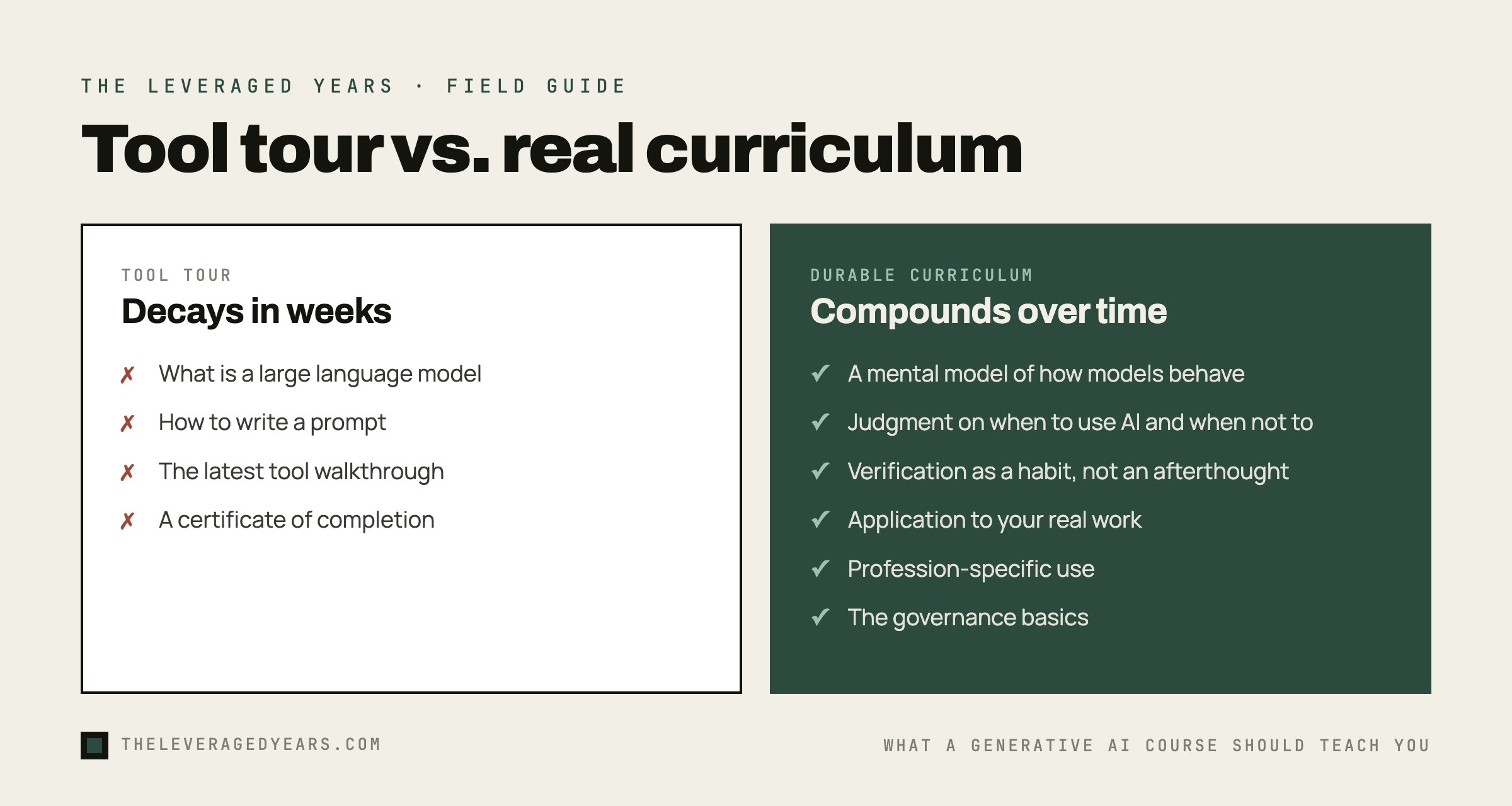
Sit through ten generative AI courses and you will notice the same thing nine times. Lesson one is what a large language model is. Lesson two is how to write a prompt. Lesson three is a tour of the latest tools, complete with screenshots that will be wrong by the time you watch them. Then a certificate of completion lands in your inbox, and nothing about how you work on Monday morning has changed.
The problem is not that these courses are lazy. Most are made carefully. The problem is that they teach the part of generative AI that is easy to teach and quick to go stale, while skipping the part that actually compounds into a professional skill. A model demo ages in weeks. Judgment about when to trust a model, how to check its work, and where it fits in your real process does not age at all.
This piece is the syllabus a generative AI course should cover if it wants to make you better at your job rather than just more familiar with a chatbot. Read it as a buyer would read a spec sheet. By the end you should be able to look at any course landing page, free or paid, and tell within a minute whether it teaches the durable skill or sells you the tool tour.
A quick note on where this fits with our other guides, because they are easy to confuse. Our buyer's guide to AI courses helps you pick a course and judge its return on investment. Our guide to learning AI maps the personal roadmap, the order you should learn things in. Our best way to learn AI lays out the method itself, the practice system that makes any of it stick. This piece is narrower than all three. It is about the curriculum, what a single course should actually contain, so you can grade the thing you are about to buy against a standard instead of a brochure.
Why the tool tour fails you
Here is the uncomfortable truth that course marketing avoids. The tools change faster than any curriculum can keep up. A course recorded around one model release is partly obsolete by the next. If the course's value lives in showing you which buttons to click in which product, that value decays on a schedule you do not control.
You can see this in how buyers now shop. People are not less interested in the skill. They are less interested in the same introductory tour they have already seen three times. The market has graduated past "what is a prompt" and the courses mostly have not.
A good course solves this by teaching things that do not expire. The mental model of how these systems behave. The judgment to know when an answer is probably right and when it is probably confident nonsense. A verification habit you apply to every output. A method for fitting the tool into a real task you already do. None of that breaks when a new model ships. If anything it gets more valuable, because you can apply it to the new model immediately while everyone who only learned the old interface starts over.
So when you evaluate a course, the first question is simple. Strip out everything that is a product demo. What is left? If the answer is "not much," you are buying a tour.
The six things a real curriculum covers
A genuinely useful generative AI course for working professionals covers six areas. Prompt-writing technique belongs inside these six, not above them. It is a tactic you use within the work, not the strategy itself. Not all of them get equal time, and the balance shifts by audience, but all six should be present in some form. If a course is missing three or four of these, it is not a course in using AI well. It is a feature walkthrough with a certificate stapled on.
1. A working mental model of how these systems behave
You do not need the math. You do need an accurate intuition for what a large language model is doing when it answers you, because that intuition is what lets you predict where it will help and where it will quietly fail.
The honest version is short. A generative model produces the most plausible-sounding continuation of your input based on patterns in its training, not a lookup against a database of verified facts. That single idea explains almost every surprising behavior you will hit. It explains why the model invents a citation that does not exist, why it agrees with you even when you are wrong, why it is brilliant at rephrasing and shaky at arithmetic, why it sounds equally confident whether it is right or making things up.
A course that gives you this model up front has armed you for everything that follows. A course that skips it leaves you to learn each failure mode the hard way, usually in front of a client or a boss. Look for it explicitly. The phrase to want is something like "here is why the model does this," not just "here is what the model does."
2. Judgment about when to use it and when not to
This is the area almost every course skips, and it is the one that separates a professional from someone who pastes a chatbot answer into an email and hopes. The skill is not prompting. The skill is judgment, which is why we treat it as the core discipline rather than a footnote.
Generative AI is excellent at some tasks, mediocre at others, and actively dangerous at a few. A useful course teaches you to sort tasks into those buckets before you start typing. Drafting, summarizing, reformatting, brainstorming, translating between styles, getting unstuck on a blank page: strong. Anything requiring a guaranteed correct fact, current data the model was not trained on, real math, or genuine accountability: handle with care or do not use at all.
The judgment also covers stakes. Using AI to draft an internal memo and using it to draft a legal filing are not the same decision, because the cost of being wrong is not the same. A good course makes you think about consequence before output. A bad course treats every task as equally safe to automate, which is how people end up in trouble.
3. Verification as a habit, not an afterthought
Because the model is a plausibility engine and not a truth engine, verification is not optional. It is the load-bearing skill. And it is almost entirely absent from the courses that sell on speed and magic, because "you still have to check everything" is a bad marketing line and an essential professional one.
A real course teaches verification as a routine you run on every output, sized to the stakes. For low-stakes work, a quick read for obvious errors. For anything that leaves your desk, a real check: confirm every named fact, every figure, every citation against a source the model did not provide. Trace claims back to something real. Treat every specific number, fact, or quotation from a model as a confident guess rather than a retrieved fact. Assume it is unverified until you prove it right, because models can and do fabricate details with complete fluency.
Here is a fast test for any course you are considering. Search the syllabus, the description, the sample lesson, for the word "verify" or "check" or "hallucination." If those concepts are missing or buried, the course is teaching you to trust output you should be auditing. Walk away.
4. Application to your actual workflow
Most courses teach generative AI in a vacuum. They show you the tool doing impressive things in a demo that has nothing to do with your job, and then leave you to figure out the translation. That translation is the hard part, and it is exactly where a good course should spend its time.
What this looks like in practice is a curriculum that takes a real task you do, a recurring report, client emails, first drafts of proposals, research summaries, meeting notes, and walks you through fitting the model into that specific process. Where it goes, what stays human, what the handoff looks like, how you check the result. You finish the lesson with one thing you can use the same day on real work, not a clever demo you will never reproduce.
A course that is serious about changing how you work will keep connecting the tool to your existing tasks, because that is where the value gets created. Our own Leverage Starter is built this way: the early lessons are organized around producing a concrete win on your own work, not a tour of features. A course that understands this keeps pointing you back at your own desk instead of at the screen.
5. Profession-specific use, not generic prompts
A marketer, an accountant, a lawyer, and an HR manager do not need the same generative AI course, even though most of them get the same one. The generic version teaches generic prompts and leaves the hard, specific judgment to you. The useful version meets you where you actually work.
This matters because the risks and the wins are different by field. The thing a lawyer most needs to learn is what not to trust the model with and how to verify what it produces, because the cost of a fabricated case citation is a sanction. The thing a marketer most needs is volume and iteration speed without losing brand voice. An accountant needs the model nowhere near a number it could get wrong and everywhere near the explanatory writing around the numbers. These are not the same syllabus.
You do not always need a course built for your exact job, but you do need one that engages with the specifics of professional work rather than hovering at the level of "here are ten prompts to try." When you look at our course catalog, you will see this is why several of the offerings are built by profession. The judgment is too field-specific to teach generically. A course that pretends one syllabus fits everyone is choosing easy production over your actual outcome.
6. The governance basics, so you do not create a mess
The last area is the one professionals skip until it bites them. Using generative AI at work comes with real questions about confidentiality, accuracy, disclosure, and ownership, and a serious course covers them as part of the skill rather than as fine print.
You do not need to become a compliance officer. You do need the basics. Do not paste confidential client data, personal information, or anything under a non-disclosure agreement into a tool without knowing where that data goes and whether it gets used for training. Understand that you are accountable for what you ship, not the model, so "the AI wrote it" is never a defense. Know your own organization's policy, because many now have one, and the gap between policy and practice is where careers get dented. Know when disclosure is expected, in academic work, in some client relationships, in regulated fields.
A course that teaches you to be fast with AI but never teaches you to be safe with it has done you a disservice. The professionals who get burned are rarely the ones who used AI. They are the ones who used it without thinking about the boundaries, and a good curriculum draws those boundaries clearly.
How to grade a course before you pay
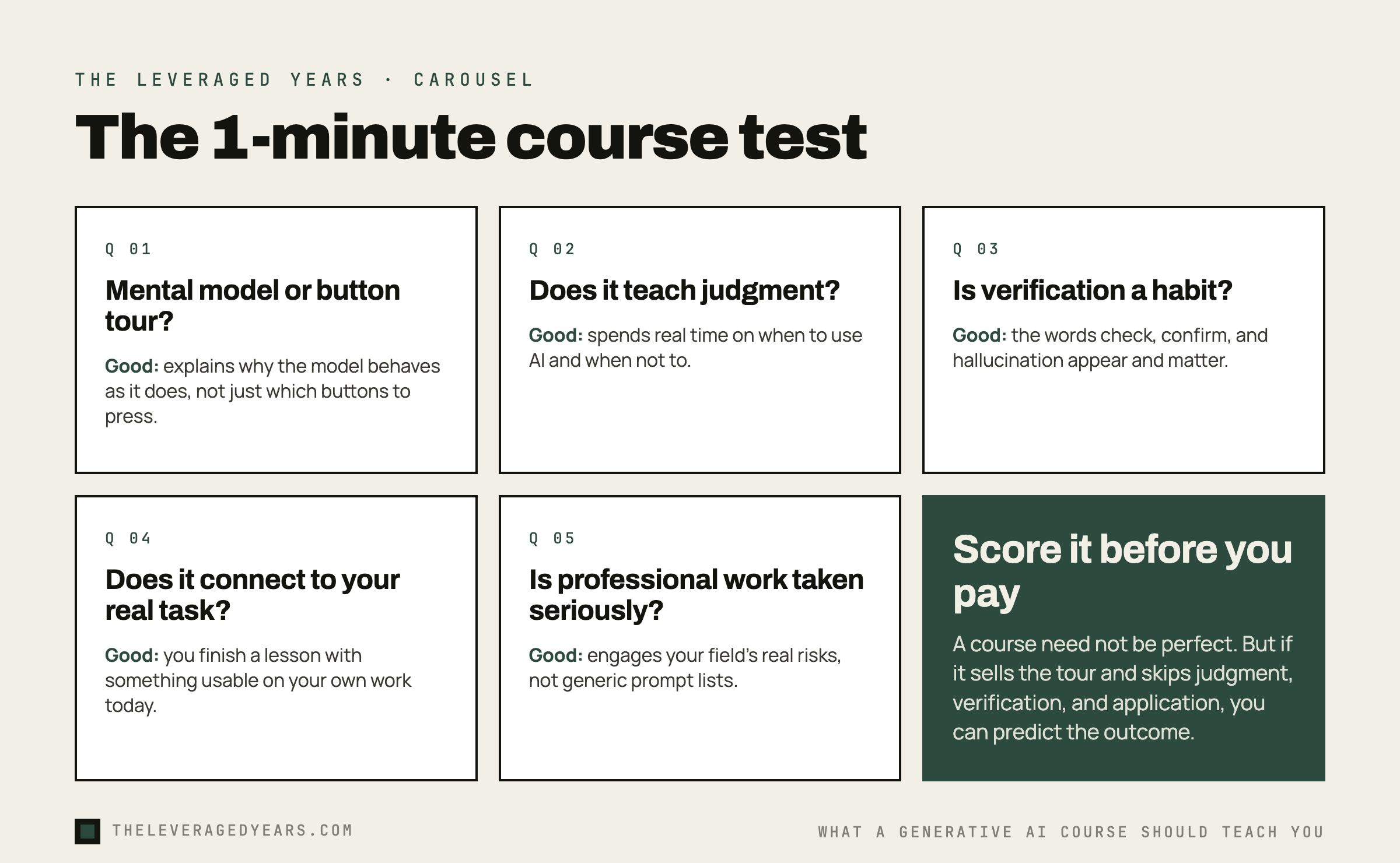
Put the six areas together and you have an evaluation lens you can apply to any course in about a minute. You are not asking "does this look impressive." You are asking "does this teach the durable skill or sell the perishable tour."
First, look for a public syllabus or curriculum breakdown at all. If a course will not show you what it teaches before you pay, that is a red flag on its own. Then run these checks on the landing page, the syllabus, and the free preview lesson if there is one. Does it teach a mental model of how the systems behave, or only what buttons to press? Does it spend real time on judgment, when to use AI and when not to? Does verification appear as a habit, with words like check and confirm and hallucination present and prominent? Does it connect to a real task you already do, or only to a demo? Does it engage with the specifics of professional work, ideally your field? Does it cover the governance basics so you do not create a confidentiality or accuracy problem?
A course does not need a perfect score. But if it teaches the tool tour and skips judgment, verification, and application, you can predict the outcome before you enroll. You will finish more familiar with a chatbot and no better at your job, holding a certificate that proves you watched the videos. Free options from large platforms are perfectly fine for the introductory tour, and you should use them for that. Just do not mistake the tour for the skill, and do not pay for a tour dressed up as something more.
If you are not sure which kind of course you need, or where you currently sit on the beginner-to-confident scale, our two-minute quiz points you to the right starting place. And if you want the longer view on choosing well across price, format, and outcome, the buyer's guide covers the decision from the other side.