Write job descriptions, screening criteria, and candidate communications that sound like you
AI for HR gives HR professionals a structured process for applying these prompt techniques across hiring, onboarding, and employee communications.
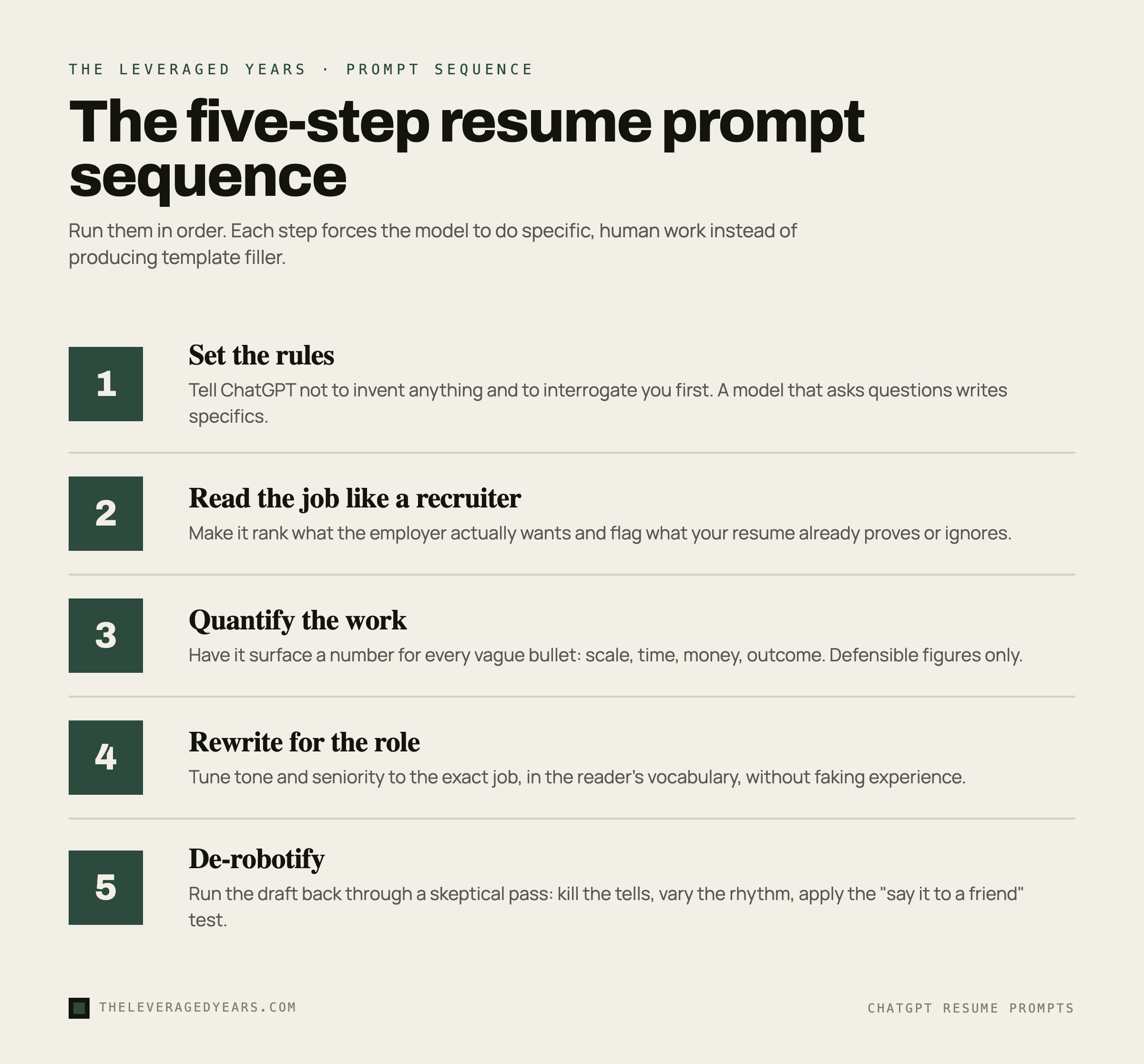
Most ChatGPT resume prompts produce a resume that any hiring manager can spot in four seconds. Same rhythm, same adjectives, the same three bullet points about being a "results-driven professional" who "spearheaded cross-functional initiatives." Recruiters have now seen hundreds of these. The prompt worked. The resume failed.
The problem is not that you used AI. In many professional roles, the people screening you now expect it. The problem is that most people take the first thing the model gives them and ship a document that reads like a template wearing a name tag. A good prompt is not a magic spell that writes the resume for you. It is an instruction set that forces the model to do the boring, specific, human work most candidates skip: match your real achievements to a real job, put numbers on them, and say them in plain language.
This is the prompt pack for that. Copy them, feed them your actual material, and then do the part nobody talks about, which is editing the output until it stops sounding like a machine. We will cover the prompts, the tells that give an AI resume away, how to kill those tells, and a short note on what is happening on the other side of the desk, because the people hiring you are changing how they read. Which model you pick matters less than how you drive it, and if you are weighing the options, here is a plain look at which model you pick for serious work.
First, set ChatGPT up so it can't write garbage
Before any specific prompt, give the model the three things it needs. Without them it invents, and invented resumes are the ones that get caught. Paste this once at the start of your session.
That last instruction matters. A model that interrogates you first writes specifics. A model you let run unsupervised writes filler.
Prompts for tailoring to a specific job
This is where most of the win is. A resume aimed at one job beats a general resume aimed at none, and ChatGPT is genuinely good at the matching once you make it work.
Read the job like a recruiter would.
Map your real experience onto their language.
Reorder for the specific reader.
The honesty clause is not a nicety. It is the difference between a resume you can defend in an interview and one that collapses the moment someone asks a follow-up question. If the AI for HR course teaches anything, it is that the follow-up question is where invented resumes die.
Prompts for quantifying what you did
The single biggest gap between a human-sounding resume and a robotic one is numbers. AI loves abstraction. Hiring managers want evidence. These prompts pull the abstraction back down to something measurable.
Turn a duty into a result.
Interrogate me for hidden metrics.
Estimate honestly when I don't have exact figures.
That last one keeps you out of trouble. A made-up "increased revenue by 47 percent" is worse than no number at all, because the interview will find the seam.
Prompts for rewriting to a specific role or seniority
A line that lands for a senior director reads wrong on an analyst's resume, and vice versa. Tell the model exactly who you are and who is reading.
Rewrite for the level you're actually at.
Translate across industries.
Write a summary that isn't a horoscope.
This is also the right tool for the adjacent documents. The same discipline that produces a clean resume line produces a clean cover note, and writing tighter with AI is a skill that pays off well past the job hunt.
The tells that scream "ChatGPT wrote this"
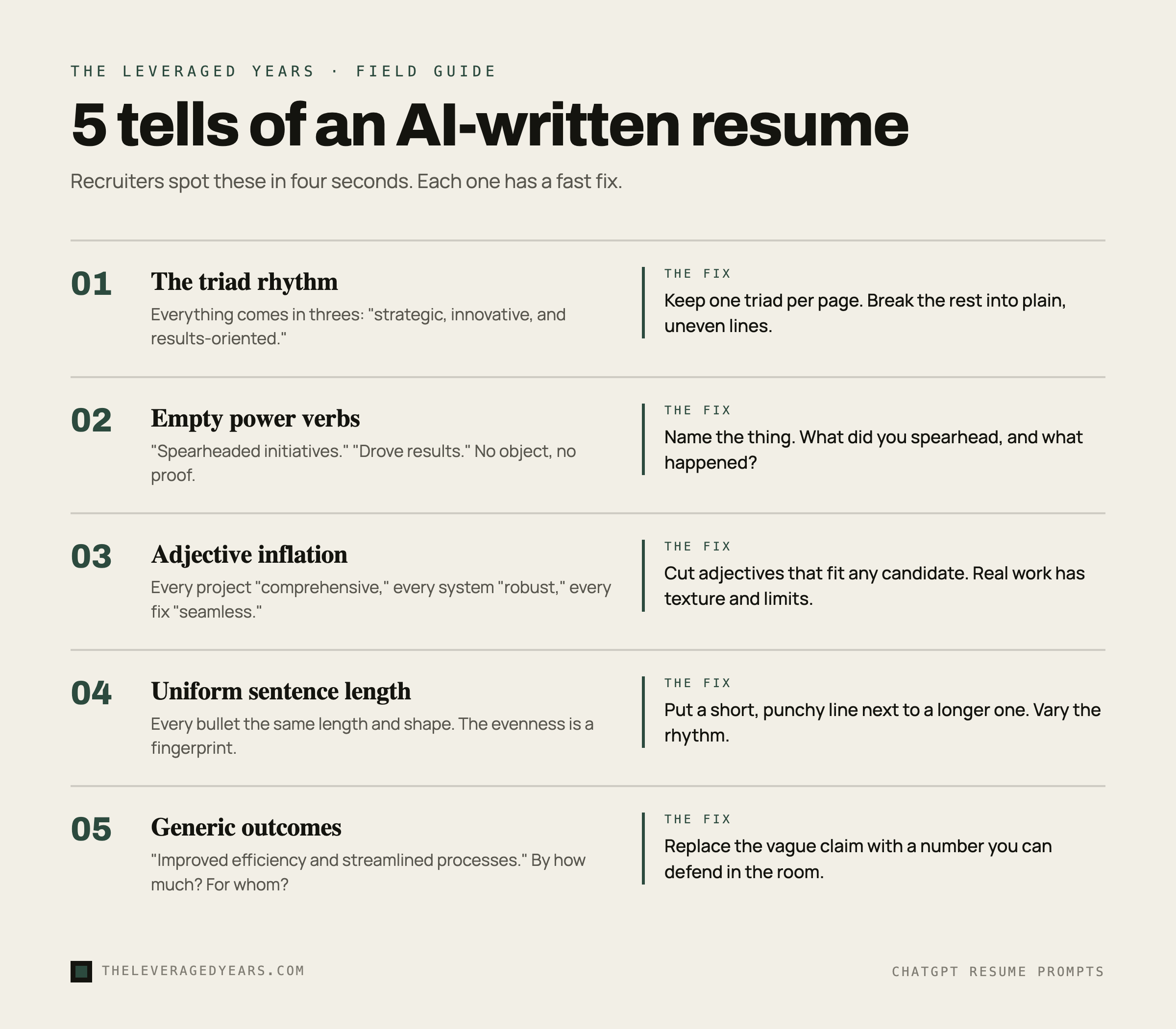
Here is what the people reading your resume have learned to spot. Memorize this list, because killing these is the entire game.
The triad rhythm. AI writes in threes. "Strategic, innovative, and results-oriented." "Planned, executed, and delivered." One or two triads is human. Five on a page is a machine.
Empty power verbs with no object. "Spearheaded initiatives." "Drove results." "Championed excellence." Spearheaded what? Drove which results? A real line names the thing.
Adjective inflation. Every project becomes "comprehensive," every system "robust," every solution "seamless." Real work has texture and limits. The inflation reads as a tell precisely because nothing in real life is that uniformly excellent.
The uniform sentence length. AI bullets often run the same length with the same shape. Human writing has short punchy lines next to longer ones. The evenness is a fingerprint.
Generic outcomes. "Improved efficiency and streamlined processes." Improved by how much? For whom? Vagueness is the cheapest thing an AI produces and the fastest thing a recruiter discounts.
Before and after
This is the gap, in one example.
Before (what the default prompt gives you): Results-driven operations professional who spearheaded comprehensive process improvements, leveraging cross-functional collaboration to drive seamless efficiency gains across the organization.
After (what a human, specific line looks like): Cut new-hire onboarding from 19 days to 6 by rebuilding the IT and payroll handoff with HR and Finance. The fix is still in place three years later.
The second one is shorter, names real teams, carries a number you can defend, and tells a small story. No recruiter reads it and thinks "AI." That is the bar.
How to de-robotify the output
You will not get the "after" version on the first try. You get it by running the draft back through a second pass. Use these.
The "say it to a friend" test is the most reliable filter there is. If you would not say it out loud, it does not belong on the page. The deeper version of this skill is judgment, not prompt mechanics: knowing what to keep and what to cut is the part the model can't do for you.
What the people hiring you already know
Here is what is actually changing. If a job seeker can mass-produce a polished, keyword-matched resume in twenty minutes, then the resume stops being a signal of effort or even of writing ability. Enough people clear that bar now that it no longer tells a hiring manager much. So the people doing the hiring are quietly moving the bar.
Screeners are leaning harder on the interview, on work samples, on specific follow-up questions designed to find out whether the numbers on the page are real. A resume that says "reduced costs 30 percent" now invites the question "walk me through exactly how," and the AI cannot answer that for you in the room. Hiring is shifting from screening the document to pressure-testing the person.
That shift cuts both ways, and for a senior professional it cuts personally, because you are usually on both sides of the desk: a candidate this year, the hiring manager next year. The recruiters and managers who learn to read past the AI gloss, and to interview for the substance underneath, will hire better than the ones still scanning for keywords. That is exactly what The Leveraged HR Professional course is built around: not banning AI from the process, but learning to interview, assess, and reference-check well in a world where every candidate has machine-polished documents. The goal is to be the person in the room who can tell the difference. Whichever side of the desk you are on today, the advantage goes to the person who understands both.